Could we colonize Callisto?
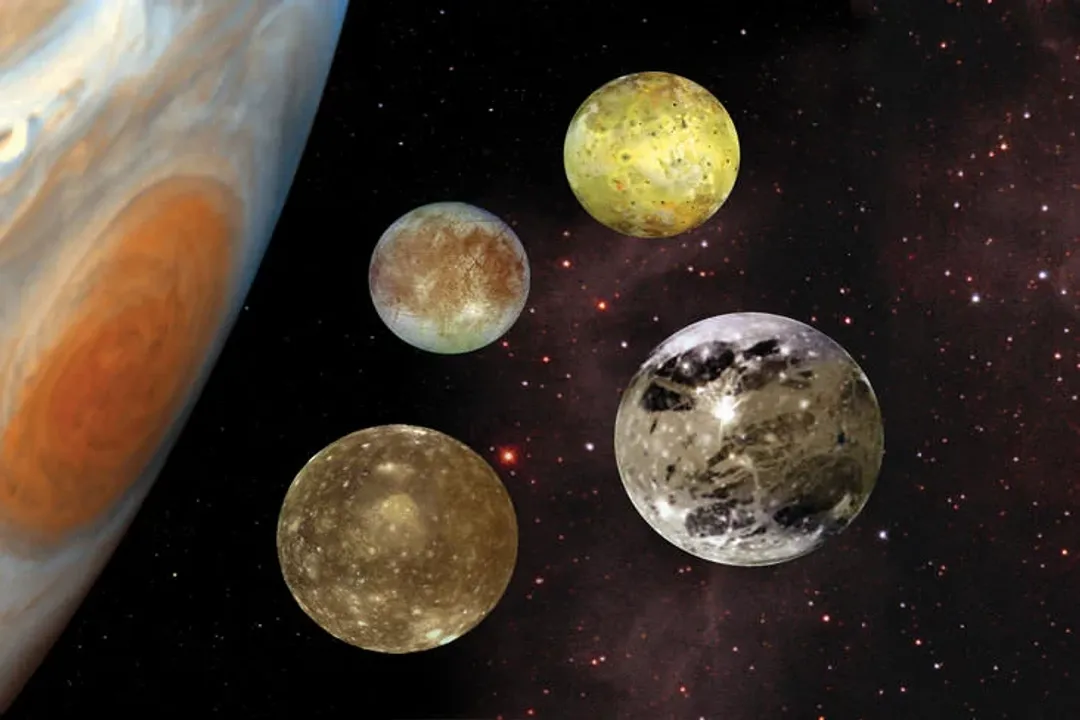
The promise of permanent human presence beyond Mars often leads the conversation toward the Red Planet, but just past the asteroid belt lies a system teeming with potential, orbiting the giant Jupiter. Among the four Galilean moons—Io, Europa, Ganymede, and Callisto—it is the outermost world, Callisto, that presents the most immediately welcoming environment for surface habitation. [1] While it lacks the subsurface ocean excitement of Europa or the massive magnetic field of Ganymede, Callisto offers a pragmatic advantage that simplifies the initial engineering hurdles of extraterrestrial settlement: relative safety from the planet’s ferocious radiation. [1]
# Radiation Advantage
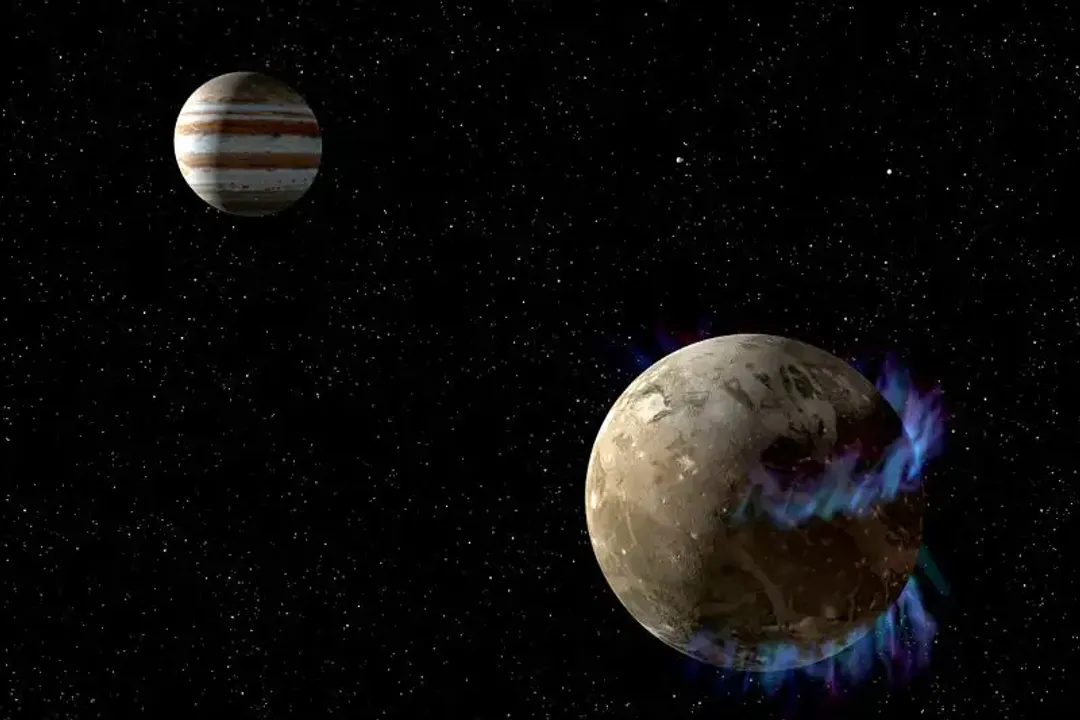
Jupiter’s immense magnetosphere traps a torrent of high-energy particles, creating belts of radiation that are lethal to unprotected human life. [1] Io, the innermost Galilean moon, suffers an exposure rate around . [3] Europa faces a harsh . [3] Even Ganymede, unique among moons for possessing its own internally generated magnetic field, is largely overwhelmed, enduring about (or ) of radiation daily, comparable to what Mars experiences annually. [3]
Callisto, orbiting at a radius of approximately $1.88$ million kilometers, sits far enough away, about $1.8$ times the distance of Ganymede, to reside outside Jupiter’s main radiation belt. [2][1] This geographical isolation drastically cuts the hazard, resulting in a surface radiation level of only about . [1] This dosage is only about twelve times the natural background radiation experienced on Earth. [1] To put this into perspective for a prospective colonist, while the inner moons necessitate extensive, massive shielding—perhaps burying habitats under layers of silicate soil—Callisto allows for a relatively transparent barrier. [1] The expectation is that a structure protected by sufficiently strong radiation-attenuating glass could permit surface living and the ability to observe the Jovian system directly. [1] This dramatic reduction in environmental shielding requirements places Callisto first on the shortlist for Jovian system bases, even ahead of more geologically interesting but dangerously irradiated siblings. [1]
# Icy Composition
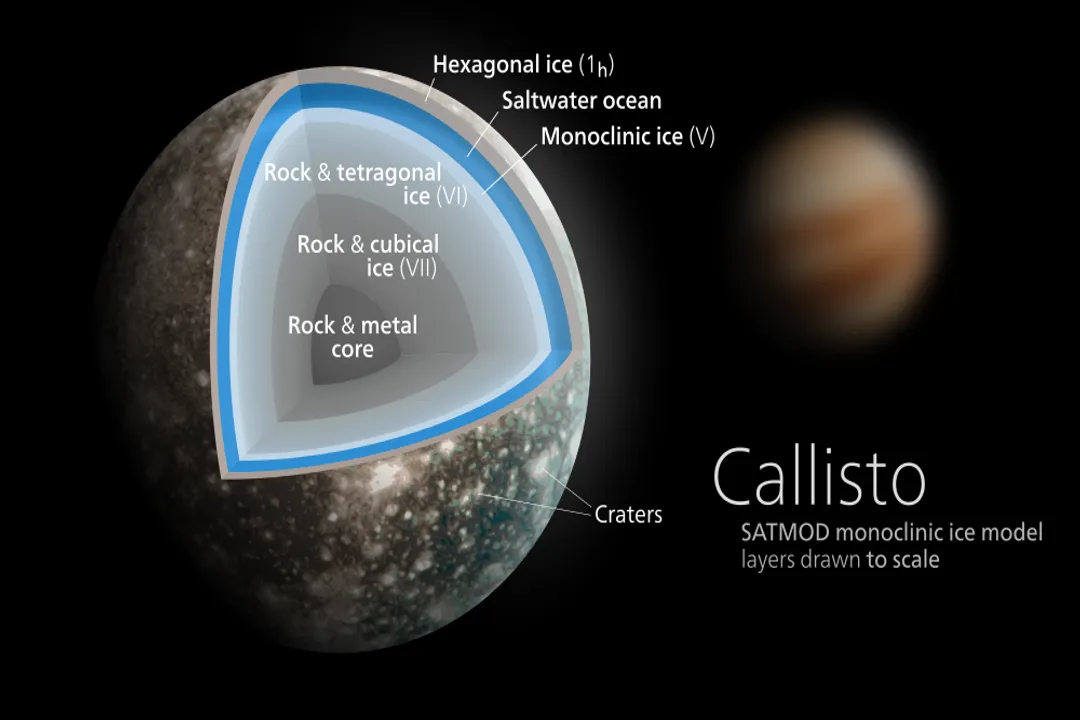
A potential colony needs resources, and Callisto appears to have the most crucial one in abundance: water. The moon’s bulk composition is estimated to be nearly half water ice by mass, with the rest being rock. [2] Spectroscopic analysis confirms water ice is ubiquitous across the surface, existing alongside carbon dioxide, silicates, and various organic compounds. [2] This $40%$ water content is a colossal reservoir, vital not just for life support but potentially as a primary propellant source for missions venturing further out into the Solar System. [1]
Callisto has a mean density of about , the lowest of Jupiter’s major moons. [2] This low density supports the model of an approximately equal mix of rock and ice, with some volatile ices like ammonia possibly included. [2] The surface itself reflects this duality; it is a heterogeneous mix of very bright patches of nearly pure water ice, often located on elevated features like crater rims, and extended dark areas composed of non-ice, rocky, or carbonaceous material. [2]
Consider the sheer mass involved in creating a radiation barrier. If a typical habitat structure requires just a few meters of regolith shielding for long-term safety on a more irradiated body, on Callisto, the requirement is significantly lower—perhaps just a meter or two of dense, water-ice mixed material. On Callisto, which is about $49%$ ice by mass, early construction efforts could conceivably melt the surrounding surface ice to form an immediate protective layer, possibly mixed with local rock dust, creating water-ice/rock composite blocks in situ. The challenge shifts from transporting tons of lead shielding from Earth to developing efficient, low-gravity, low-energy processing equipment capable of harvesting and sintering the abundant water ice into durable habitat blocks, all while dealing with surface temperatures that can peak near at the subsolar point. [2]
# Ancient Surface
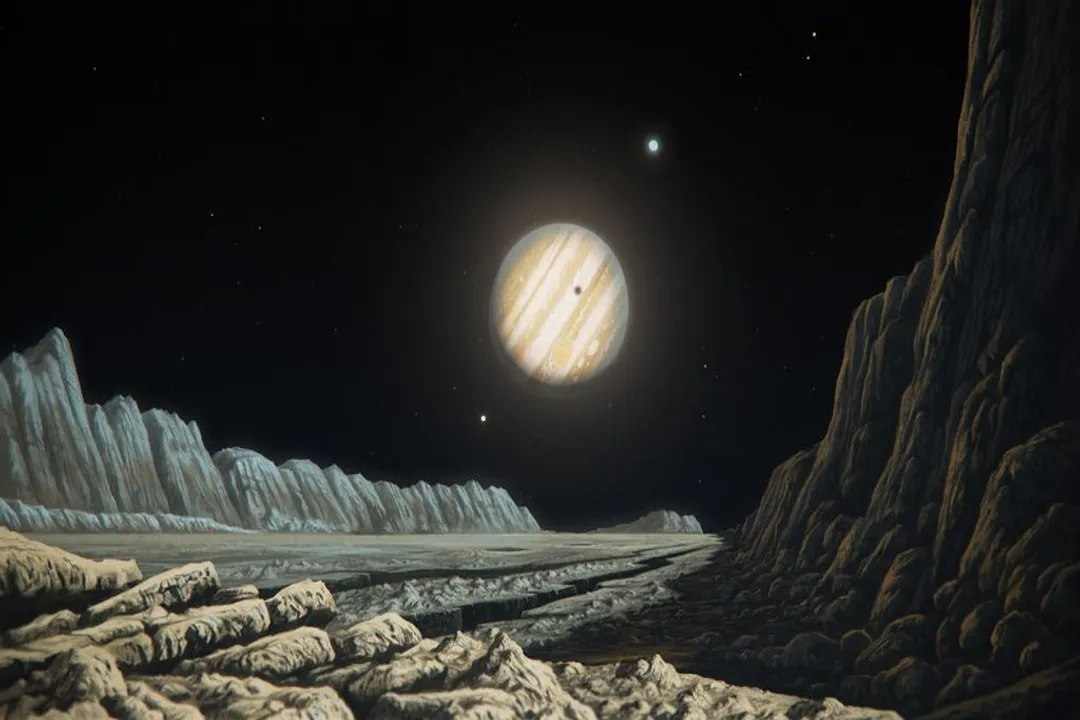
While the radiation levels are favorable for humans, the geological environment presents a picture of extreme antiquity and stagnation. Callisto's surface is arguably the oldest and most heavily cratered in the entire Solar System, possessing a density of impact craters close to saturation—meaning any new impact tends to obliterate an older one. [2] Unlike the geologically active Io, Callisto shows no evidence of endogenic processes such as plate tectonics or active volcanism, suggesting its evolution has been almost entirely dominated by impacts. [2]
The largest features are massive multi-ring impact structures, such as Valhalla, which boasts rings extending up to from its center, and Asgard. [2] On a smaller scale, the topography features impact craters, often with central domes or pits depending on size, and long chains of craters called catenae, likely formed by tidally disrupted objects impacting the moon. [2] The relative lack of geological activity is attributed to its lack of significant tidal heating from Jupiter, a consequence of its distant orbit. [2] For a colonist, this translates to unparalleled stability; no sudden surface shifts, no volcanic hazards, and a terrain that is largely static on human timescales. However, the surface does degrade slowly. Small craters are strangely absent, replaced by knobs and pits, which scientists theorize results from the slow sublimation of surface ice, leaving behind a blanket of darker, non-ice debris. [2]
# Subsurface Ocean
Despite its outward appearance of cold, inert ice, Callisto may harbor a liquid water ocean beneath its crust. [1][2] Scientific data, particularly from the Galileo spacecraft analyzing magnetic field responses, suggest the presence of a salty, highly conductive fluid layer at depths between $100$ and beneath a cold, stiff lithosphere that may be $80$ to thick. [2] The required temperature for liquid water is met in this layer, especially if trace amounts of antifreeze like ammonia are present. [2]
This potential internal ocean is intriguing for astrobiology, though it is considered less favorable for life than Europa’s ocean because it lacks contact with rocky material and is heated only by residual radioactive decay rather than strong tidal flexing. [1] For colonization, the subsurface ocean presents a major engineering decision: is it a resource to tap, or a danger to avoid? If the ocean layer is deep, the initial settlement strategy remains surface-based, capitalizing on the low radiation environment. [2] If drilling operations were ever planned to access this water, the depth presents a massive challenge, contrasting sharply with the search for shallow, accessible ice on the surface. [2] The lack of tidal heating is, paradoxically, a stabilizing factor; while it limits geothermal energy, it ensures that the interior processes are slow and predictable, minimizing disruptive events that could threaten deep subsurface infrastructure.
# HOPE Study
The vision for a Callisto base is not entirely theoretical. NASA conducted a conceptual study in 2003 called HOPE (Human Outer Planets Exploration) which specifically centered on establishing a surface base on Callisto. [2][3] The proposed operational start date was as early as 2045. [3] The primary strategic goal for this outpost was the in-situ production of rocket propellant from the moon's abundant water ice, transforming Callisto into a crucial supply depot for further solar system exploration. [1][3] Such a base would support missions heading to Europa or even out toward Saturn’s system. [3]
A key aspect of the HOPE concept involved utilizing Nuclear-Electric Propulsion (NEP) to ferry a crew to Callisto, which at the time was estimated to require a five-year transit. [3] This highlights the immense logistical gap between an initial exploratory probe and a permanent outpost. The low radiation makes Callisto an ideal waystation, a safe harbor from which to conduct riskier remote exploration of the more hazardous inner Jovian moons, such as deploying robotic submarines to investigate Europa’s ocean. [1]
# Transit Times
Getting to Callisto is the single largest non-environmental obstacle. A colony ship must traverse a distance that dwarfs anything required for Moon or Mars missions. [3] Historical uncrewed probes illustrate the baseline difficulty: Pioneer 10 took 640 days ( years) just to pass through the Jupiter system. [3] The direct Galileo mission, which entered orbit, took over six years from its launch in 1989. [3]
For a massive crewed and construction-laden vessel, these times are unacceptable. This necessity drives the requirement for advanced propulsion like NEP or Nuclear Thermal Rockets. [3] If propulsion technology remains near current capabilities, any realistic colonization scenario likely requires intermediate staging posts. It becomes logical to assume that before humanity commits significant capital to a multi-year trip to Callisto, established, self-sufficient outposts must already exist on the Moon, Mars, and quite possibly mining/refueling stations within the Asteroid Belt to break up the supply chain. [3] Establishing Callisto as a propellant hub, therefore, becomes less about setting foot on a new world and more about creating a logistical springboard for the outer Solar System that can be supplied by the inner system supply chain. [3]
# Terraforming Speculation
While the immediate goal is safe surface habitation using localized resources, the long-term dream for any colony is terraforming—remaking an alien world to resemble Earth. The sources suggest that even in fiction, the idea of introducing an atmosphere to Callisto exists. [3]
However, the reality, based on current science, suggests this is perhaps the most distant goal of all. Callisto's current atmosphere is extremely tenuous, measured at a surface pressure of only and composed mostly of carbon dioxide, with suspected molecular oxygen. [2] This thin layer is lost to space rapidly, requiring constant replenishment, possibly through the sublimation of surface ice. [2]
To create a breathable atmosphere, one would need to melt or sublime vast quantities of the surface ice to liberate and , and then somehow introduce massive amounts of nitrogen and other gases, or begin complex atmospheric processing of the available volatiles. [2] Given the moon's distance from the Sun, the required energy input to even raise the ambient temperature significantly—let alone generate the atmospheric pressure necessary for liquid water stability—would be staggering. Unless an in situ energy source vastly more powerful than solar arrays is employed, such as focusing the energy output of Jupiter itself (as seen in some science fiction narratives, though not directly sourced here), the initial colonization phase will remain focused on pressurized, shielded habitats, perhaps leveraging the natural subsurface ocean for water extraction rather than attempting a planetary-scale climate change project. [1][2] Callisto’s initial value is safety and resources, not immediate habitability; its ancient, stable crust is perfect for an engineered bubble, making the transition from a sealed habitat to a fully terraformed world a matter of multi-century engineering dedication. [2]
Related Questions
#Citations
How Do We Settle on Jupiter's Moons? - Universe Today
Callisto (moon) - Wikipedia
Viability of Inhabiting the Galilean Moons - Astrobites