Which event immediately precedes a Type II supernova?
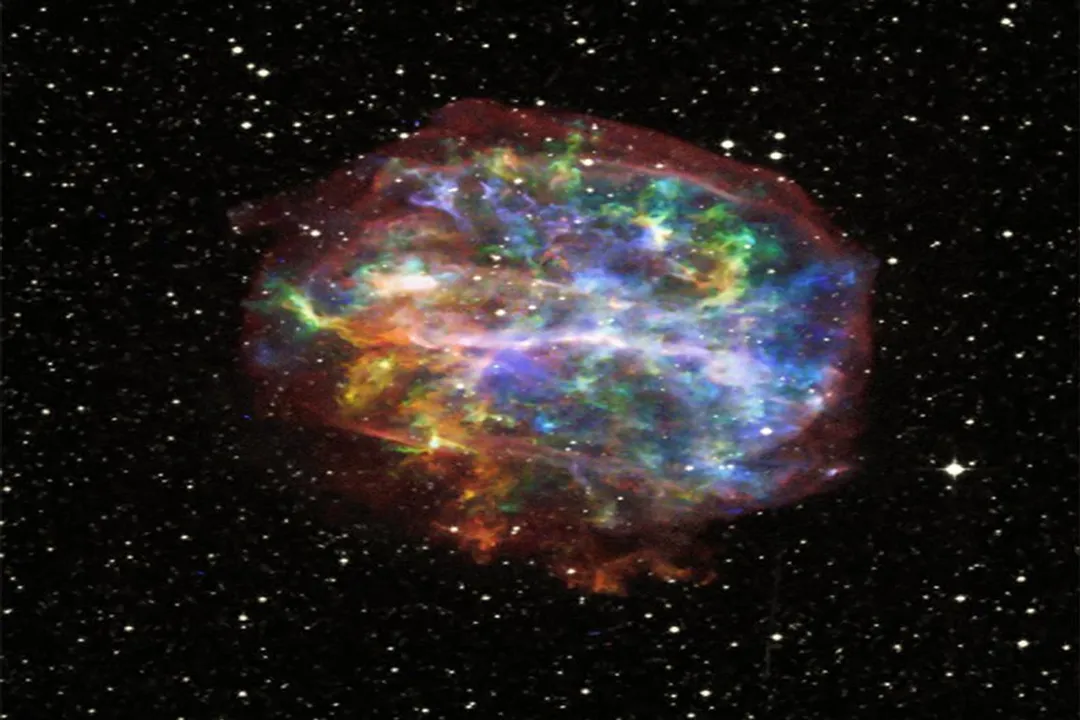
The fiery demise of a massive star, known to us as a Type II supernova, is one of the most energetic events in the universe. These spectacular explosions mark the end of the lives of stars significantly more massive than our Sun. To truly grasp the mechanics of this cosmic blast, one must look not at the blinding flash that captivates telescopes, but at the final, frantic moments occurring deep within the stellar core—the event that sets the entire chain reaction in motion.
# Stellar Fuel
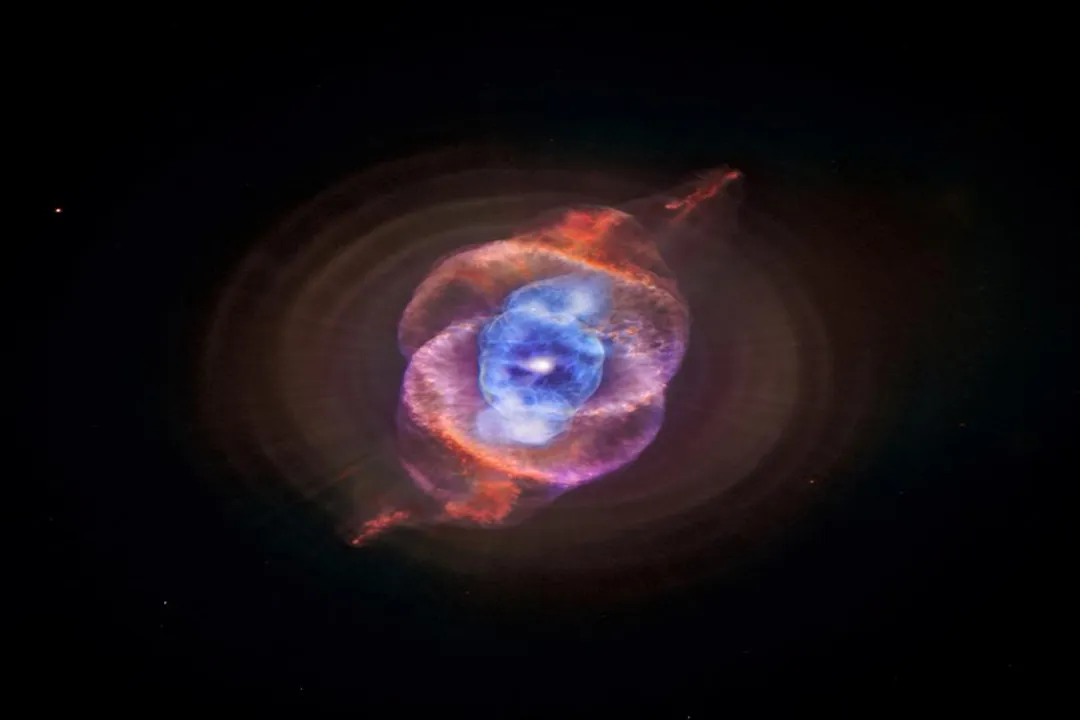
A star spends the majority of its existence in a delicate, balanced state, maintaining hydrostatic equilibrium. This balance pits the immense inward pull of gravity against the outward pressure generated by thermonuclear fusion in its core. Throughout its main sequence life, a star converts lighter elements into heavier ones, releasing energy that sustains it. For the most massive stars, this fusion process proceeds through several stages, building up an onion-like structure of shells.
Hydrogen fuses into helium, then helium into carbon, and so on, up the periodic table. This process continues efficiently until the star begins fusing silicon. Silicon fusion is the final productive stage in the life cycle of such a star. The product of silicon fusion is iron, and this is where the star’s long, steady existence comes to an abrupt halt.
# Iron Core
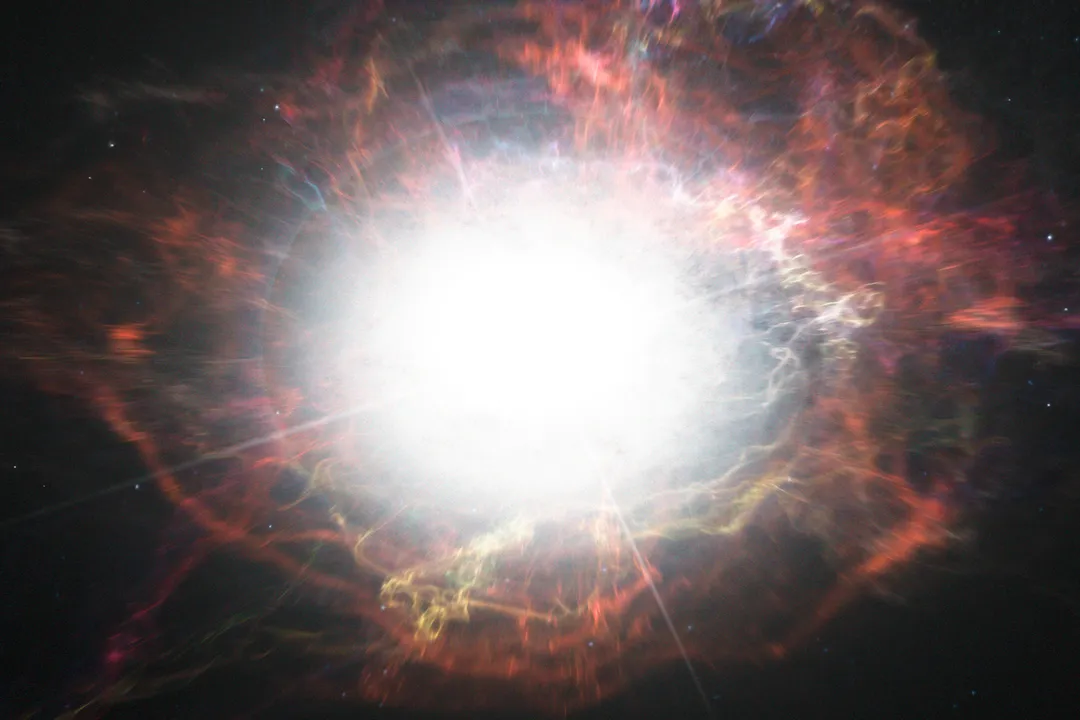
The production of iron marks a cosmic dead end for stellar energy generation. Unlike the lighter elements, fusing iron does not release energy; instead, it consumes energy from the core to proceed. Once the core is predominantly composed of iron, the star can no longer generate the thermal pressure needed to counteract gravity's relentless squeeze. The energy crisis is immediate and total, as the core can no longer sustain itself through fusion.
The mass of this inert iron core is critical to the star's fate. If the core mass exceeds approximately $1.4$ times the mass of our Sun—a value known as the Chandrasekhar limit—the degeneracy pressure of the electrons, which normally resists further compression, becomes insufficient to hold gravity at bay. For stars destined to become Type II supernovae, this threshold is invariably crossed, leading to catastrophic gravitational collapse.
It is interesting to note how razor-thin the margin of survival is for these massive stars. A star whose final inert core mass settles just under the limit might instead end its life as a white dwarf that can persist for eons. However, once the iron core exceeds that limit, the collapse is inevitable, regardless of how many solar masses the star originally possessed in its outer layers.
# Core Collapse
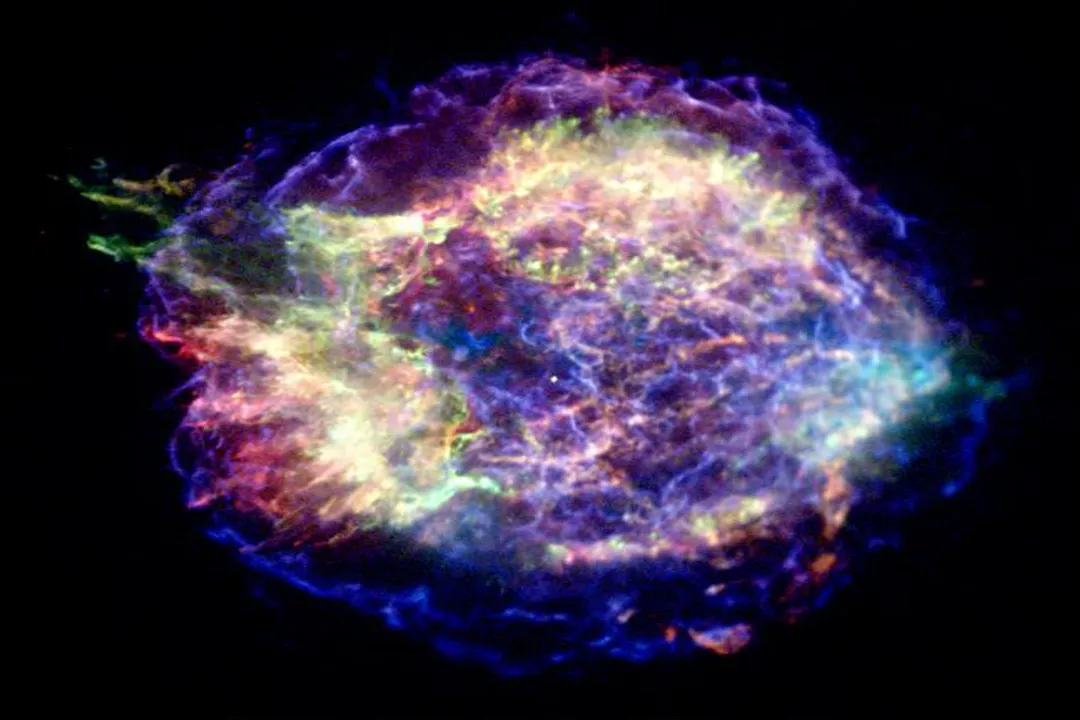
Once fusion ceases and the iron core exceeds the critical mass, the collapse is not gradual; it is frighteningly fast. Gravity overwhelms all remaining resistive forces, driving the stellar material inward at a substantial fraction of the speed of light. The core shrinks from a size comparable to Earth down to perhaps only 20 kilometers across in a matter of milliseconds. This rapid implosion compresses the material to incredible densities, far greater than that of an atomic nucleus.
When the density becomes so extreme that the atomic nuclei are essentially crushed together, the repulsive force between the neutrons—known as neutron degeneracy pressure—finally becomes strong enough to halt the inward rush. This sudden halt to the infall of material is the true precursor to the visible explosion.
# The Immediate Predecessor
The event that immediately precedes a Type II supernova is the sudden pressure spike that results from the core reaching nuclear density and rebounding. This bounce occurs because the infalling matter slams into the newly formed, incredibly rigid proto-neutron star core.
This rebound generates a powerful outward-moving shockwave. Think of it as hitting a solid brick wall at high speed; the energy of the impact must go somewhere, and in this case, it pushes outward violently. This initial shockwave is what sets the stage for the spectacular supernova that follows. While the gravitational collapse itself takes mere seconds, this pressure spike and the subsequent initial outward shock are the moments directly preceding the star’s grand finale and explosion.
It is challenging for ground-based optical telescopes to witness this specific precursor event directly because it happens deep within the star’s opaque interior. Our primary detection of this stage relies on observing the aftermath signatures, such as a massive burst of neutrinos released during the core's compression, which escape the star long before the visible light from the shockwave finally breaks through the outer layers.
# The Explosion Unfolds
The initial outward shockwave generated by the core rebound is incredibly powerful, but it often stalls as it moves through the star's outer, infalling layers. For the Type II supernova to actually occur—the bright, visible explosion—the stalled shock must be re-energized. This re-energizing process is closely tied to the enormous number of neutrinos streaming out from the newly formed neutron star. These neutrinos deposit energy into the shocked material, driving the shock outward again and creating the massive explosion we observe.
A Type II supernova is characterized by the presence of hydrogen lines in its spectrum, indicating that the star retained its outer hydrogen envelope until the moment of explosion. The shockwave, once successfully propagated, rips through the rest of the star, ejecting most of the star's mass into space at tremendous speeds, creating a brilliant flash of light visible across galaxies.
The remnants of this event are known as supernova remnants (SNRs), vast expanding clouds of gas and dust. Observatories like the Chandra X-ray Observatory study these remnants to understand the physics of the explosion and the subsequent evolution of the ejected material. For instance, studying the shockwave's propagation, as Kepler did when observing a supernova shockwave in visible light for the first time in 2008, offers direct observational proof of the mechanics involved in this colossal stellar death.
In summary, the immediate event preceding the light of a Type II supernova is the near-instantaneous halting of the iron core's collapse as it achieves nuclear density, causing a violent, density-driven rebound that initiates a shockwave through the stellar interior.
#Videos
The Evolution of Red Supergiants to Supernovae - YouTube
Related Questions
#Citations
Ch 21 Homework Flashcards - Quizlet
Solved Which event immediately precedes a type II | Chegg.com
Type II supernovae - Imagine the Universe! - NASA
Kepler Observes Supernova's Shockwave in Visible Light for First ...
Why do type-2 supernovas involve an explosion? - Reddit
Type II supernova | astronomy - Britannica
Chandra :: Educational Materials :: Investigating Supernova Remnants
The Evolution of Red Supergiants to Supernovae - YouTube