What is meteor debris?
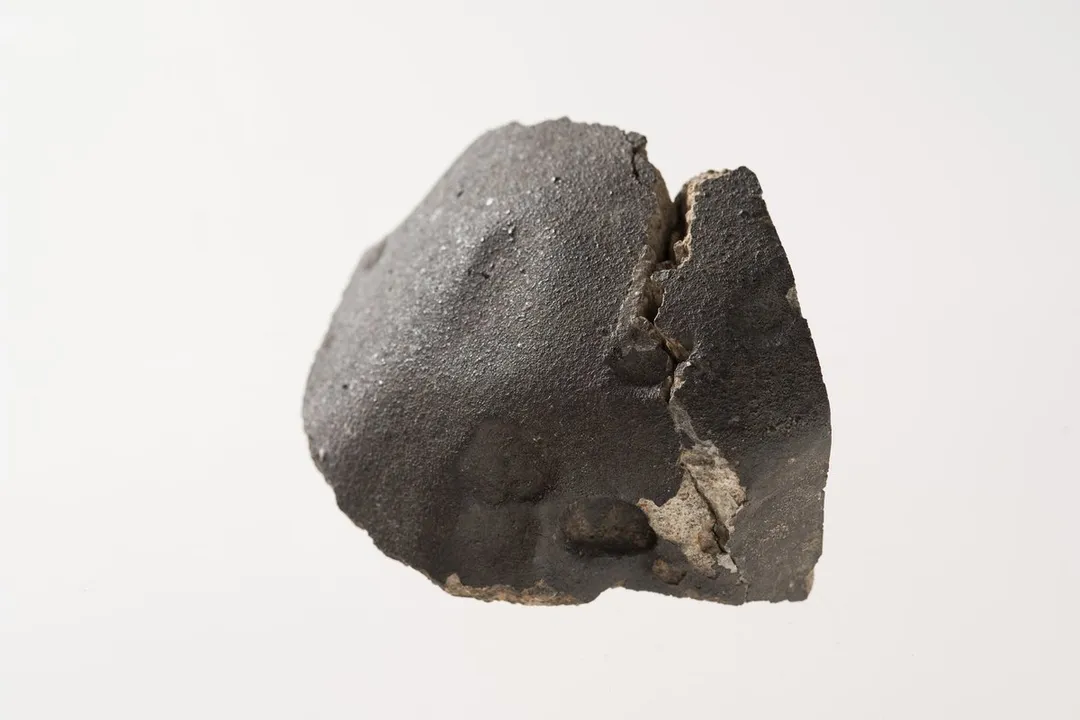
The debris that streaks across our night sky or lands upon the Earth’s surface represents remnants of the earliest days of the solar system. These pieces of cosmic material are not all the same; their designation changes depending on where they are located and what state they are in. What begins as a tiny speck of dust drifting through the vacuum of space becomes a brilliant flash in our atmosphere, and, if it survives the fiery transit, a tangible rock resting on the ground. [2][5] Understanding what constitutes this "meteor debris" requires distinguishing between three key terms: the meteoroid, the meteor, and the meteorite. [2]
# Space Objects
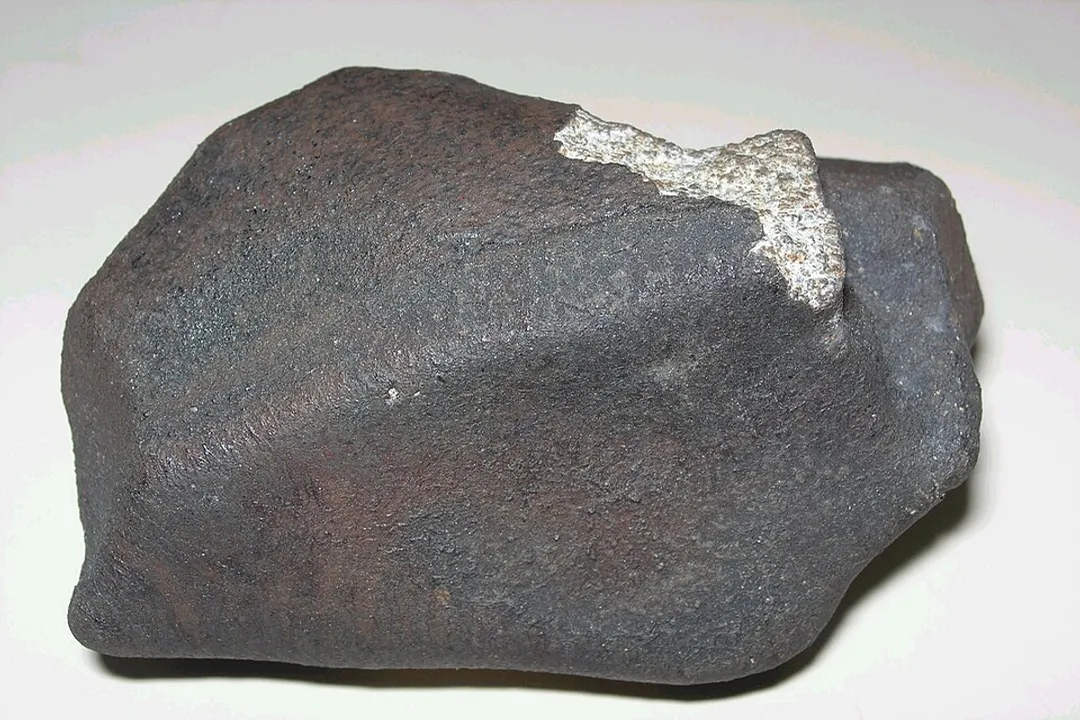
The object in space, before any interaction with our planet, is termed a meteoroid. [5] Meteoroids are essentially small fragments of rock or metal found orbiting the Sun. [3] They are typically smaller than asteroids; definitions often place the size limit for a meteoroid at about one meter in diameter. [1] Anything larger than this is usually classified as an asteroid. [1] However, the lower end of the size scale is vast, encompassing everything down to minuscule particles of dust. [3] These particles can be incredibly small, some being the size of a grain of sand. [2]
The origin of this debris is varied, though a significant portion can be traced back to the main asteroid belt located between Mars and Jupiter. [6][7] These are fragments knocked loose from larger parent bodies through collisions over billions of years. [6] Depending on their parent body—whether it was a rocky planetesimal or a metal-rich asteroid—the resulting meteoroids carry vastly different chemical signatures. [2]
It is helpful to remember the size distinction: a meteoroid is the physical object existing in space. [5] Its subsequent fate dictates its name change, much like a person changing roles depending on their environment.
# Atmospheric Fire
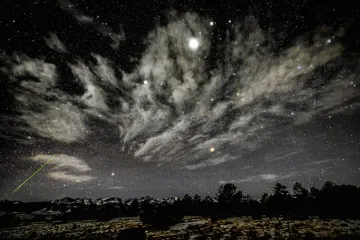
When a meteoroid encounters Earth's atmosphere, it begins its dramatic transformation into a meteor. [5] This visible phenomenon is not the rock itself burning up, but rather the effect of its extreme speed causing the air in front of it to heat up intensely due to compression. [2] As the object rams into the thicker air, ablation—the process where material is vaporized and stripped away—creates that brilliant streak of light we observe. [2] This visible streak is what most people colloquially refer to as a "shooting star". [3][5]
The intensity of the light varies based on the meteoroid’s size, velocity, and composition. [2] A particularly bright meteor is designated a bolide. [2] While most meteoroids are small enough to burn up completely high in the atmosphere, the brighter ones, like bolides, possess enough mass to survive the intense heat and friction. [2][3]
Consider the energy involved in this process. Even a particle the size of a pebble, traveling at tens of kilometers per second, releases kinetic energy comparable to a small explosion upon entry. [2] The sheer speed of entry is what generates the light, meaning that a large, slow-moving object might not produce a spectacular meteor, whereas a small, fast object will. [2]
# Ground Remains
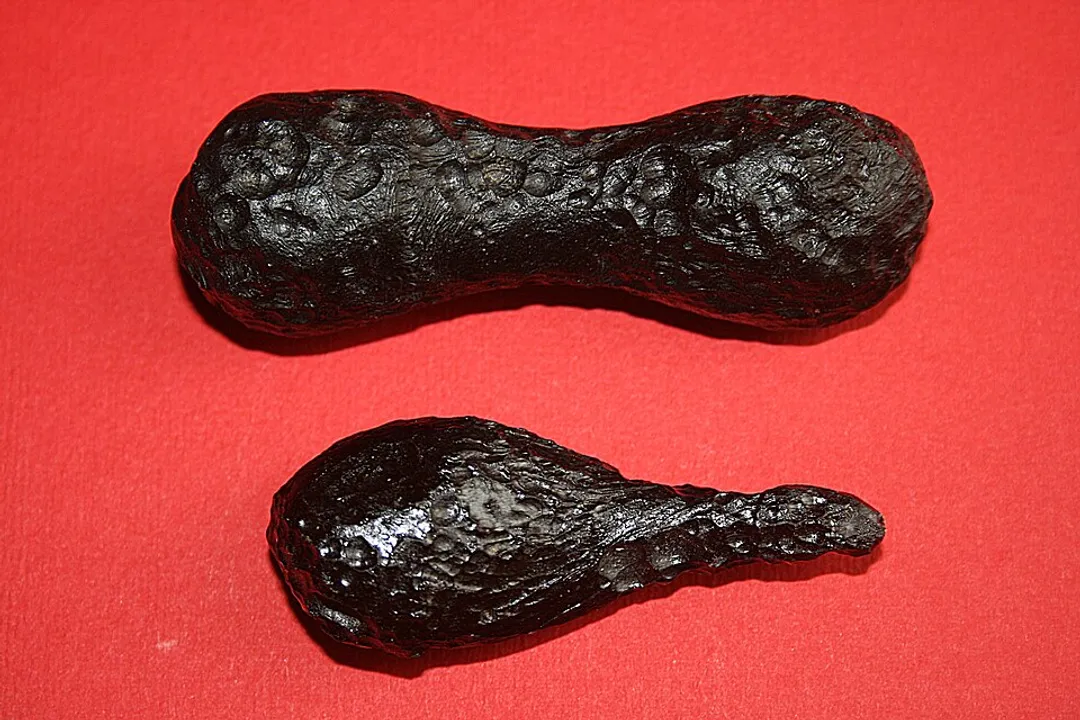
If the object manages to decelerate enough without fully vaporizing, the remaining portion that actually strikes the Earth's surface is then called a meteorite. [3][5] This surviving fragment is what scientists and collectors seek out. [4] A meteorite is, by definition, an extraterrestrial object that has been recovered on Earth. [9]
The survival rate is low, which makes every recovered meteorite scientifically valuable. [9] To reach the ground, the initial object must have been substantial enough to begin with, and its trajectory and entry angle must allow for partial survival. [2] While millions of meteoroids enter the atmosphere daily, the vast majority disintegrate high up. [2]
It is interesting to note that while rocky meteorites are more numerous in terms of incoming meteoroids, iron meteorites often have a higher rate of discovery on the ground, particularly in arid or Antarctic regions, because they are denser and stand out more visibly against the pale terrain. [6] This difference in detection bias means that the collection of meteorites we study might slightly overrepresent the iron-rich population compared to the actual influx from space. [9]
# Material Makeup
Meteorites are generally categorized into three main groups based on their primary composition: stony, iron, or stony-iron. [6]
Stony meteorites are the most common type recovered. [6] These are primarily composed of silicate minerals. [9] Within this category, two major subdivisions exist: chondrites and achondrites. [9] Chondrites are particularly important because they contain chondrules—small, millimeter-sized spheres of silicate minerals that formed when dust and rock melted and solidified early in the solar system’s history. [9] Chondrites are considered the most primitive material we can study, as they have largely avoided major melting or differentiation processes since their formation. [9] Achondrites, conversely, are stony meteorites that have undergone melting and differentiation, often resembling terrestrial volcanic rocks. [9]
Iron meteorites are mostly composed of an iron-nickel alloy. [9] These represent the core material of shattered parent bodies that differentiated before impact. [9] When cut and polished, they often reveal a crystalline crosshatch pattern known as the Widmanstätten pattern, which forms only through extremely slow cooling over millions of years deep within a parent body. [9]
Stony-iron meteorites represent a mixture of the two primary types, containing significant amounts of both silicate minerals and iron-nickel metal. [6][9] These are thought to originate from the transition zone between the core and mantle of a larger, differentiated parent body. [9]
Here is a basic comparison of the three types based on composition:
| Meteorite Type | Primary Composition | Origin (Parent Body) | Rarity (General) |
|---|---|---|---|
| Stony | Silicate minerals | Crust/Mantle | Most common recovered type [6][9] |
| Iron | Iron-Nickel alloy | Core | Less common than stony [9] |
| Stony-Iron | Silicates and Iron-Nickel | Core-Mantle Boundary | Rarest type [9] |
# Scientific Value
The study of meteor debris offers an unparalleled look into planetary formation and the early chemistry of our solar neighborhood. [9] Because they are essentially chunks of ancient rock that have been preserved in the cold, stable vacuum of space, they provide chemists and geologists with samples that have not been subjected to the constant recycling, erosion, and alteration that rocks on Earth undergo. [9] A meteorite is a pristine sample dating back perhaps 4.56 billion years, giving scientists direct access to the initial building blocks of the planets, including our own. [9]
For the general reader who might find an unusual rock, knowing the difference between an ordinary terrestrial stone and a genuine meteorite can be key. While the scientific confirmation requires laboratory analysis, an initial field check often involves looking for a fusion crust—a thin, dark rind formed on the exterior during the rapid heating of atmospheric entry. [2] Additionally, many iron-bearing meteorites will exhibit a slight magnetic attraction due to their high nickel-iron content, something that is less common in typical surface rocks. [3] If you encounter something that seems dense for its size, has sharp edges rather than smooth weathering, and perhaps sticks to a magnet, it warrants closer inspection by experts. [4] This observational expertise allows enthusiasts to contribute to the ongoing collection of material that helps map the history of the solar system's debris field. [4]
Related Questions
#Citations
Meteoroid - Wikipedia
Meteor, a space debris particle flying through the atmosphere
Meteors and Meteorites: Facts - NASA Science
Meteoritical Society
Meteoroid - National Geographic Education
Meteors and Meteorites - The Australian Museum
Overview of meteorites and their impact on the earth - Britannica
Meteorite FAQ - North Carolina Museum of Natural Sciences