What is meant by the habitable zone?
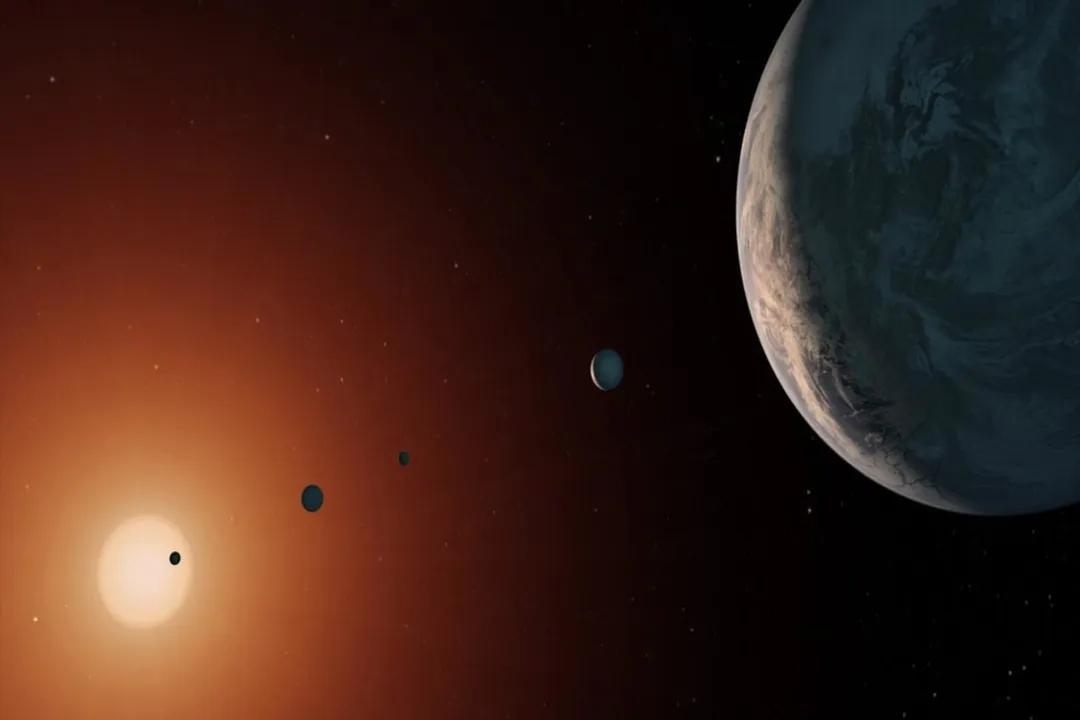
The concept of the habitable zone orbits a fundamental human question: are we alone? At its most basic level, the habitable zone, sometimes called the "Goldilocks Zone," is the region around a star where conditions are just right for liquid water to exist on the surface of an orbiting planet. [1][5] It is an area defined by temperature, specifically the range where water can be neither entirely frozen solid nor boiled away into vapor. [2][7] This zone is not a guaranteed ticket to life, but it serves as the primary initial filter for astronomers searching for potentially life-bearing worlds outside our solar system. [1][10]
# Water Essential

The focus on liquid water is not arbitrary; it stems from our understanding of life as we know it here on Earth. [2][7] Life, in its myriad terrestrial forms, depends on liquid water as a universal solvent. [1][7] This solvent is necessary for transporting nutrients into cells and carrying waste products out, driving the chemical reactions that constitute life. [10] If a planet is too close to its star, the heat will cause surface water to evaporate, stripping the planet of this essential component. [2][5] If it is too far away, any available water will freeze into ice, effectively pausing the biological processes that require mobility. [2][3]
The habitable zone, therefore, delineates the orbital distance where the energy received from the star allows surface temperatures to remain between the freezing point of water (0 degrees Celsius or 32 degrees Fahrenheit) and its boiling point (100 degrees Celsius or 212 degrees Fahrenheit) under Earth-like atmospheric pressure. [2][3] It is important to recognize that the term "habitable zone" historically refers to surface habitability based on liquid water. [7] While life could theoretically exist in subsurface oceans, such as those suspected on moons like Europa or Enceladus in our own solar system, the classical definition centers on the planet's exterior. [2]
# Stellar Distance
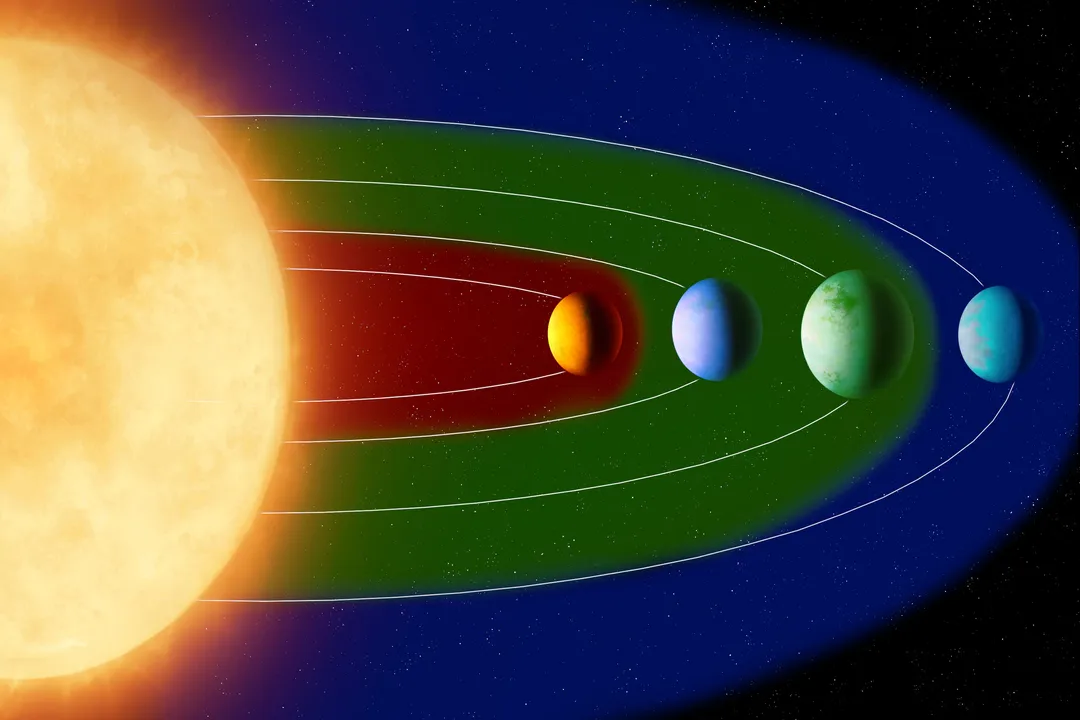
The location of this life-friendly orbital band is directly determined by the type and output of the central star. [3][6] A star's brightness, or luminosity, dictates how much energy it pours into its system. [2][9] Brighter, hotter stars—like massive blue or white stars—emit a tremendous amount of energy, pushing the habitable zone much farther out from the star than where our own Earth orbits. [3][6] Conversely, cooler, dimmer stars, such as the common M-dwarf red stars, output far less energy, meaning their habitable zones are located very close to the star, often inside the orbital path of Mercury in a system like ours. [2][9]
Consider the difference in scaling. For a star like our Sun, Earth resides squarely within the habitable zone. [1][7] If the Sun were significantly hotter, Earth would be scorched, and the habitable zone would begin further out, perhaps beyond Mars's current orbit. [3] If the Sun were dimmer, Earth would be an icy ball, and the zone would migrate inward toward Venus. [3][10] This dependency means that when astronomers search for exoplanets, they first calculate the star's energy output, establish the expected orbital radius for the HZ, and then look for planets orbiting at that calculated distance. [6]
A fascinating consequence of this stellar dependency is the phenomenon known as HZ drift. As stars age, their luminosity typically increases; our Sun, for example, is expected to become significantly brighter over the next billion years. [9] This means the habitable zone slowly migrates outward over cosmic time. [3][9] A planet that was a frozen wasteland billions of years ago might now be warming up, and one currently habitable might eventually become too hot. [3] For life to persist long-term, it needs a planet that can either migrate along with the expanding zone or possess an atmosphere capable of adjusting to the changing thermal input—a complex dynamic that the simple HZ calculation initially overlooks. [9]
# Zone Edges Defined
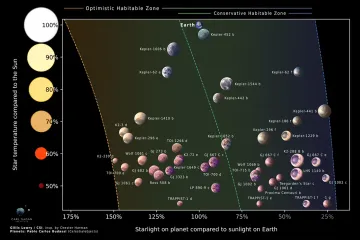
The habitable zone is typically modeled as a range with two distinct boundaries: the inner edge and the outer edge. [1][10]
The inner edge is determined by the point where a runaway greenhouse effect would occur. [2] This is the distance at which the stellar radiation is intense enough to vaporize all surface water, creating a dense, steam-filled atmosphere that traps heat, leading to ever-increasing temperatures until the water is completely lost, similar to what is believed to have happened on Venus. [1][2][10]
The outer edge is the limit where the planet receives just enough energy to prevent all surface water from freezing permanently. [2][10] Beyond this point, carbon dioxide or other greenhouse gases alone cannot generate enough warmth to keep water in a liquid state, plunging the world into a global, permanent ice age. [2][5]
Astronomers often distinguish between two definitions of this zone, which affects how many planets are deemed "potentially" habitable: [1]
- The Conservative Habitable Zone: This is the narrower, more strictly defined region where liquid water is most likely to persist based on known planetary physics and minimal atmospheric assumptions. [1][10] Planets in this zone are considered the best candidates for immediate follow-up observation.
- The Optimistic Habitable Zone: This zone extends the boundaries further out and in. [1] It accounts for the possibility of planets possessing thick, highly efficient greenhouse atmospheres—like a denser version of Earth’s atmosphere—that could keep water liquid even when the planet is receiving less stellar energy. [2][10]
To illustrate this boundary distinction, consider a hypothetical Earth-mass planet orbiting a Sun-like star. The conservative HZ might range from about $0.95$ to $1.68$ Astronomical Units (AU), whereas the optimistic zone could stretch from $0.72$ to $2.0$ AU. [1] (For context, one AU is the average distance between the Earth and the Sun). [2]
# Atmospheric Necessity
It is crucial to stress that a planet's location within the HZ only guarantees the potential for liquid water; it does not guarantee its existence or the persistence of life. [7][9] The size of the HZ calculation is often based on Earth’s atmospheric composition, but real planetary atmospheres can drastically alter the situation. [2][9]
For instance, a planet orbiting at the cool, outer edge of the HZ might be saved from eternal ice if it has a very dense atmosphere rich in greenhouse gases like carbon dioxide or methane. [2][7] This is effectively what keeps our own neighbor, Mars, from being even colder than it is, even though it orbits slightly outside the Sun's conservative HZ. [7] Conversely, a planet orbiting near the warm, inner edge might be rendered sterile even if it's within the calculated zone, if it lacks sufficient atmosphere to moderate temperature swings or, worse, has an atmosphere too thin to hold onto water vapor against stellar winds. [7]
Another major factor is planetary mass and gravity. A small world, like Mercury, cannot hold onto a substantial atmosphere over billions of years, regardless of its orbital position. [9] Life needs time for evolution to occur, meaning the planet must maintain its clement conditions for a long duration, which requires adequate mass to retain an atmosphere and internal geological activity. [7]
When thinking about the search for life, it is helpful to conceptualize the HZ not as a fixed band in space, but as a dynamic, temperature-dependent shell around a star, into which a planet must settle and stay put for eons. [2]

# Stellar Types
The diversity of stars in the galaxy profoundly influences where we should look for habitable worlds. [6][9] The vast majority of stars in the Milky Way are smaller and cooler than the Sun—M-dwarfs are the most common type. [9] Because these stars emit less radiation, their habitable zones are significantly smaller and closer in. [6]
While an M-dwarf HZ is much nearer the star, this proximity introduces different challenges for life. [9] A planet in the habitable zone of an M-dwarf orbits very closely, often completing a year in just a few Earth weeks. [2] This tight orbit makes the planet vulnerable to tidal locking, where one side constantly faces the star (scorching hot) while the other faces deep space (freezing cold). [9] For liquid water to exist widely, the atmosphere of such a planet would need to be incredibly efficient at circulating heat from the day side to the night side. [9] Furthermore, young M-dwarfs are often highly active, emitting powerful stellar flares that could strip away the atmospheres of nearby planets, complicating the simple calculation of temperature alone. [6][9]
In contrast, a massive, hot A-type star has a habitable zone located very far out, perhaps several times the Earth-Sun distance. [6] While the distance mitigates issues like tidal locking, these stars burn through their fuel much faster than G-type stars like our Sun. [3] They might only shine brightly enough to sustain a habitable zone for a few hundred million years—a geological blink of an eye—before evolving or dying, potentially not allowing enough time for complex life to develop. [3] This comparison highlights why Sun-like stars (G-type) are often seen as the "ideal" template: they are stable and long-lived, giving evolution a longer runway. [2]
# Finding Worlds In Zone
The development of advanced telescopes and detection methods has allowed scientists to pinpoint thousands of exoplanets, some of which reside in their respective habitable zones. [1][6] Telescopes like Kepler and TESS have identified numerous planets orbiting in this region around various stars. [1]
One notable example involves the TRAPPIST-1 system, which hosts several Earth-sized planets orbiting an ultra-cool red dwarf star. [6] Several of these worlds orbit within the star's HZ. [1] However, as discussed, their tight orbits mean they face significant risks related to tidal locking and stellar flare activity, demanding a deeper investigation into their atmospheric characteristics to confirm true habitability. [9]
When astronomers confirm a planet is in the HZ, the next step, often requiring next-generation instruments like the James Webb Space Telescope, is to attempt atmospheric characterization. [7] This involves analyzing the starlight that passes through or reflects off the planet's atmosphere to detect the chemical signatures of gases like water vapor, methane, or oxygen. [7] Discovering a planet in the HZ is step one; confirming it has a stable atmosphere capable of keeping that water liquid—or confirming the presence of the water itself—is step two, and arguably the more difficult challenge. [10]

# Habitability Beyond Distance
The term "habitable zone" is inherently linked to the "circumstellar habitable zone" (CHZ) for surface water, but a truly habitable world needs more than just the right orbital temperature. [2] To maintain surface liquid water over astronomical timescales, a planet needs a dynamic internal engine.
Consider Earth’s magnetic field, which is generated by the churning of its liquid iron core. [7] This dynamo creates a protective magnetosphere that deflects harmful charged particles streaming from the Sun—the solar wind. [7] Without this shield, the solar wind can slowly strip away a planet's atmosphere, regardless of how perfectly positioned it is in the HZ. A planet in the M-dwarf HZ, which is much closer to its star and thus its solar wind, would need an exceptionally strong magnetic field to survive long-term atmospheric erosion. [9]
Another key component is plate tectonics, the process by which Earth's crust constantly recycles itself. [7] This geological activity helps regulate the climate over vast timescales by cycling carbon between the atmosphere and the planet’s interior via volcanism and weathering—this is known as the carbonate-silicate cycle. [7] This internal recycling acts as a planetary thermostat, capable of buffering against slow changes in stellar output. [7] If a planet in the HZ lacks this internal heat engine, its atmosphere might freeze out over time, even if the star is perfectly stable.
For instance, a planet slightly colder than Earth but with a slightly thicker blanket of atmospheric might maintain surface water, but if it lacks tectonic activity, the might eventually be permanently locked away in surface rocks through weathering without volcanoes to replenish it, leading to an inevitable, slow descent into a deep freeze. [7] The HZ tells us where the potential for a thermostat exists, but it doesn't confirm the thermostat is actually running.
The sheer volume of data from exoplanet surveys means that the simple definition of the HZ is constantly being refined. Researchers now look not only at the classical HZ but also at the concept of the Galactic Habitable Zone, which considers the region of a galaxy safe from sterilizing events like supernovae and gamma-ray bursts—areas too close to the galactic center are often too active, while areas too far out may lack the heavy elements necessary to form rocky planets in the first place. [2] While this is on a much grander scale, it speaks to the layered nature of defining "habitability."
# Zone Refinement
The methodology used to calculate the HZ is itself an area of active refinement. Early models often relied on simplified blackbody radiation physics. [3] Modern calculations incorporate more complex atmospheric models, considering factors like cloud formation, atmospheric depth, and the albedo (reflectivity) of the planetary surface. [2][10]
For example, a planet covered entirely in bright white ice (high albedo) will reflect more stellar energy back into space than a dark ocean world (low albedo), making the ice-covered world effectively "colder" and shifting its habitable distance further inward relative to the star. [3] The standard HZ calculation generally assumes a cloud-free atmosphere for the baseline, but when assessing a specific exoplanet, these details become paramount. [10] If we model a planet with Earth's current atmosphere, the HZ boundaries are quite specific; if we swap that for a Mars-like atmosphere, those boundaries change dramatically. [2]
Ultimately, the habitable zone remains one of the most powerful and intuitive tools in astronomy for prioritizing targets in the vast search for life. [6] It shifts the focus from searching blindly across the entire cosmos to concentrating on those systems where the fundamental prerequisite—liquid water stability—is met based on the laws of physics and chemistry. [1][5] It is the first filter, defining the sweet spot where a world might transition from a sterile rock to a world teeming with possibility.
#Videos
What Is the Habitable Zone? - YouTube
Related Questions
#Citations
The Habitable Zone - NASA Science
Habitable zone - Wikipedia
Habitable Zone
habitable zone Flashcards - Quizlet
Habitable Zone - ESA/Hubble
What Is a Habitable Zone, and Why Does It Matter?
What Is the Habitable Zone? | The Planetary Society
What Is the Habitable Zone? - YouTube
Habitable Zones - Center for Astrophysics | Harvard & Smithsonian