Which material is most commonly utilized as the inert propellant in ion thrusters?
Answer
Xenon
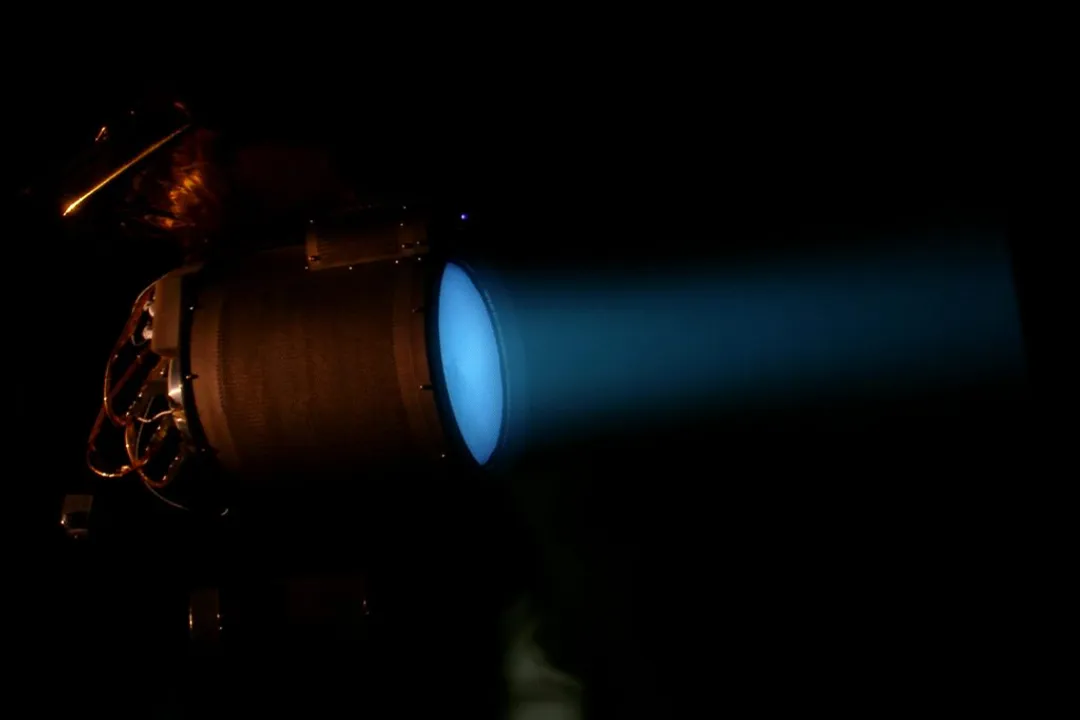
The standard propellant utilized in operational ion thrusters is Xenon. This choice is based on several factors, primarily its properties as an inert noble gas. Being chemically inert is crucial because it ensures the propellant does not react adversely with the internal engine structure or the delicate accelerator grids. While it is chemically safe, Xenon still must be stored under pressure within heavy tanks, which contributes to the overall launch mass that must be lifted from Earth, even though the required mass is substantially less than that needed by a chemical rocket to achieve the same total velocity change.
#Videos
Is Ion Propulsion Safe? - Physics Frontier - YouTube
Related Questions
What force magnitude is used to characterize the minimal thrust of an ion thruster?For missions venturing to the outer planets, what power source limits ion thruster operation?What physical process causes erosion in ion thruster electrostatic accelerator grids?How does the thrust magnitude relate mathematically to specific impulse ($I_{sp}$)?What characteristic of ion propulsion leads to rigid, non-agile mission planning?Which material is most commonly utilized as the inert propellant in ion thrusters?What drawback offsets the mass savings achieved by using highly efficient ion thruster propellant?Why are ion thrusters often designed to operate below their theoretical maximum power level?When comparing ion thrusters to Hall effect thrusters, what trade-off typically exists?What is the practical consequence of the low thrust-to-weight ratio on trajectory correction maneuvers?