What is the practical consequence of the low thrust-to-weight ratio on trajectory correction maneuvers?
A required $\Delta V$ within a short timeframe might be unattainable regardless of supplied power.
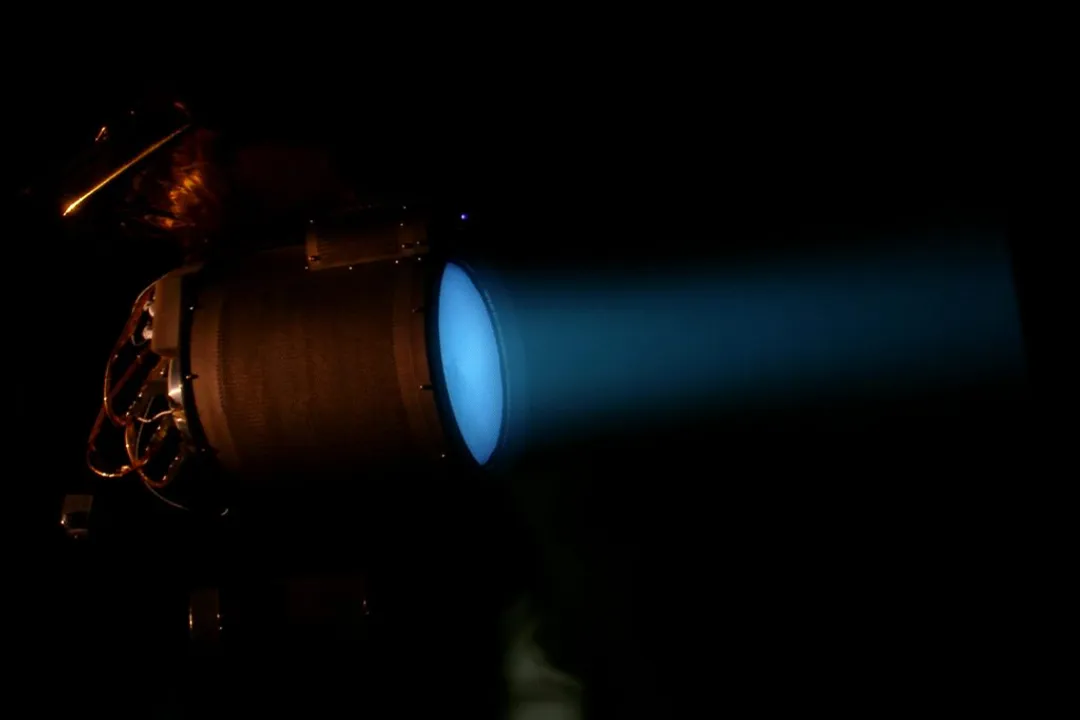
The low inherent thrust-to-weight ratio of an ion propulsion system means that it is physically incapable of generating the high force necessary to rapidly alter trajectory, even if ample electrical power is available. For instance, if a maneuver requires a $100 \text{ m/s}$ $\Delta V$ to be completed within a tight deadline, the engine's low millinewton thrust might necessitate continuous running for several days. If the time constraint is even tighter, or the required $\Delta V$ larger, the system simply cannot deliver the necessary instantaneous force output. This mechanical limitation—the inability to produce high force—is the defining constraint that confines these systems to long-duration applications rather than rapid maneuvers.
#Videos
Is Ion Propulsion Safe? - Physics Frontier - YouTube