Is ion thruster possible?
Ion propulsion isn't a science fiction concept waiting for validation; it is a proven technology that has been steering spacecraft across the solar system for decades. The core question really isn't if they are possible, but rather how possible they are for different mission profiles. What sets an ion thruster apart from the powerful chemical rockets we see launching from Earth is the methodology: instead of burning massive amounts of propellant for a huge burst of thrust, ion engines use electricity to gently accelerate a small amount of propellant to incredibly high speeds, generating a minute, yet ceaseless, push. This approach prioritizes efficiency—measured as specific impulse, or Isp—over raw power.
# Engine Mechanics
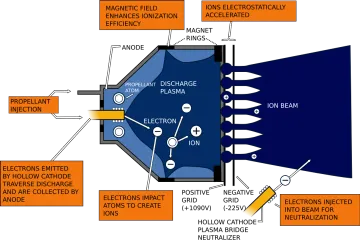
The way an ion engine generates thrust is fundamentally different from a traditional rocket, which relies on chemical reactions. In an ion thruster, a propellant, often an inert gas like Xenon, is introduced into a chamber. This gas is then turned into plasma by knocking electrons off the atoms, creating positively charged ions. These positive ions are then subjected to a powerful electric field created by grids, which pulls them out of the chamber at very high velocities, creating the required thrust. Because the exhaust velocity is so high, the engine achieves extremely high specific impulse, meaning it needs very little propellant mass to achieve a large change in velocity (delta-v) over time.
NASA’s work on the Dawn mission provides an excellent case study in this technology. The spacecraft relied entirely on solar electric propulsion, using its ion engines to cruise to both the asteroid Vesta and the dwarf planet Ceres. This ability to maintain thrust for years is what allows the small, sustained force to build up massive speed over interplanetary distances. Think of it like using a feather to gently push a bowling ball for a very long time versus using a cannon once; the feather wins over the long haul in terms of final speed, provided you have the energy source to keep pushing.
# Operating Environment
One critical aspect of ion propulsion viability is the surrounding environment. Ion thrusters operate best, and indeed, must operate, in the near-perfect vacuum of space. The mechanism relies on accelerating ions without interference, and the presence of atmospheric gases would immediately degrade performance and effectiveness. The electric fields required to accelerate the plasma would be short-circuited or overpowered by collisions with air molecules.
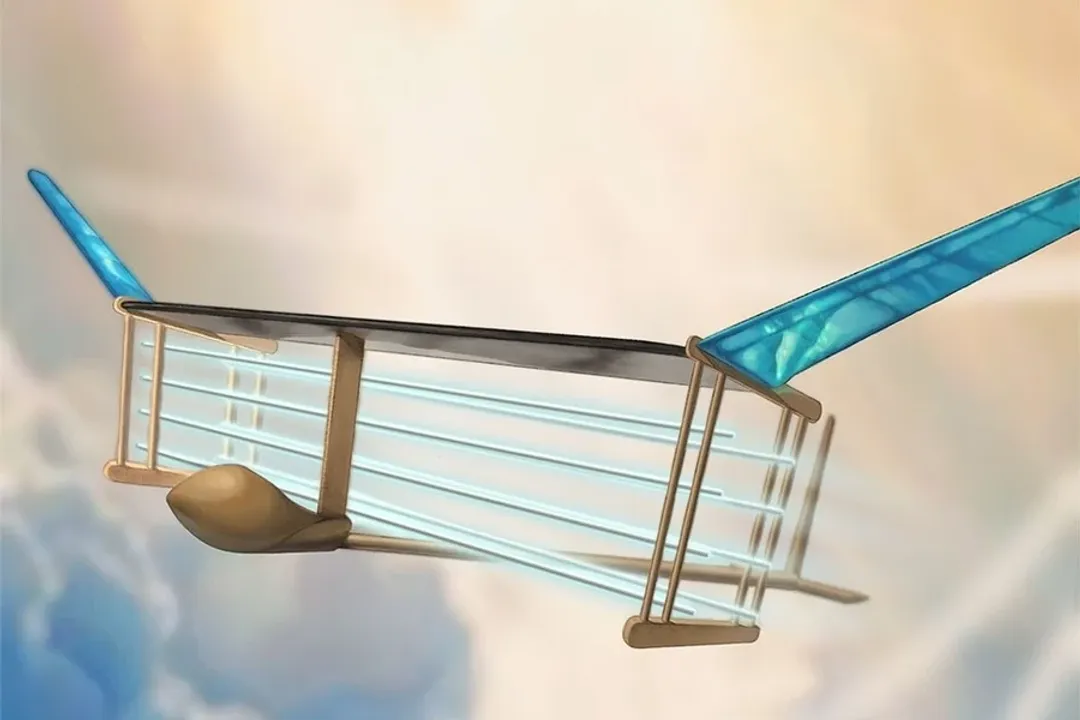
However, researchers have explored the possibility of adapting this core principle for terrestrial use. Some concepts suggest using ion drive principles to create silent propulsion systems, such as for aircraft. These concepts envision using very high voltages to generate an ionic wind—a process called electrohydrodynamics—to push against the surrounding air. While this application moves away from the vacuum-based, propellant-ejecting model of deep-space ion engines, it borrows the fundamental idea of generating thrust using electric fields rather than combustion. The efficiency challenge remains, as any terrestrial application requires overcoming the massive drag and energy requirements of moving through a dense atmosphere, unlike the near-zero resistance found in space.
# Thrust Limits Exist
While ion engines offer phenomenal efficiency, they are not limitless in their performance ceiling. Discussions around the theoretical maximum specific impulse often touch upon the practical limits of the discharge chamber design and the power available. For space missions, the major limiting factor is not the exhaust velocity itself, but rather the available power source—typically solar arrays—and the total mass of the propellant carried. Even with the incredible efficiency, the propellant, which is a consumable, will eventually run out.
A comparison between chemical rockets and electric propulsion highlights this trade-off clearly:
| Propulsion Type | Thrust Level | Specific Impulse (Isp) | Primary Mission Suitability |
|---|---|---|---|
| Chemical Rocket | Very High (Newtons/Kilonewtons) | Low (Seconds) | Launch, rapid maneuvers |
| Ion Thruster | Very Low (Millinewtons) | Very High (Thousands of Seconds) | Interplanetary cruise, station-keeping |
The Dawn mission, for instance, used only about 75 kilograms of Xenon propellant for a 11-year mission that covered over 3.1 billion miles. For comparison, a massive Saturn V rocket used about 2.8 million kilograms of propellant just to escape Earth’s gravity. This stark difference illustrates that ion propulsion makes deep-space travel practical by minimizing fuel mass, but it cannot overcome gravity wells.
Where the technology could theoretically go involves vastly increasing the power input. Modern systems on Dawn operated in the kilowatt range, but next-generation designs are targeting much higher power levels to increase thrust while maintaining high Isp. Pushing into the megawatt class, for example, would open up much faster transit times to the outer solar system, but this requires substantial advances in power generation and thermal management on the spacecraft itself. Furthermore, the maximum theoretical specific impulse might be constrained by how effectively one can extract energy from the plasma without damaging the acceleration grids over time, a major engineering hurdle.
# The Consumable Question
It is important to address the misconception that purely electric spacecraft can operate indefinitely without consumables. They cannot. While the energy source (like the sun) is effectively limitless for missions within the inner solar system, the propellant mass is finite. Xenon is the preferred working fluid due to its high mass (making ionization easier) and inert nature, but it must be physically carried onboard. Therefore, the maximum delta-v achievable by an electric spacecraft is directly governed by the Tsiolkovsky rocket equation, just like a chemical rocket, but it benefits from a vastly superior exhaust velocity term.
If we were to design a hypothetical, purely electric propulsion system for a 50-year mission to a distant star system, the propellant mass required, even at extreme efficiencies, would become the dominant factor of the spacecraft's total launch mass, potentially making the concept less feasible than chemical approaches for specific goals. A key point to consider for long-duration missions that rely on these electric systems is the need to carry enough propellant for course corrections and station-keeping over many decades, not just the initial transit. This is why current systems are optimized for incredibly long burns, maximizing every gram of Xenon.
# Advancing Efficiency
The pursuit of better ion thrusters is focused on boosting efficiency and power handling. The development of systems like NASA’s NEXT (NASA's Evolutionary Xenon Thruster) has shown continuous improvement in operational life and performance metrics over older technologies. These advanced thrusters often aim for higher power density—more thrust per unit of mass and volume—which translates directly into more capable probes.
One area of ongoing development involves alternative electrode materials or magnetic confinement techniques to reduce erosion on the acceleration grids, which is the primary cause of failure in long-duration ion drives. If engineers can create a system that suffers less wear and tear, they can run the engine harder (more power, higher thrust) for longer periods without needing to throttle back to preserve the hardware. This pushes the practical boundary of the technology closer to its theoretical maximum Isp, allowing missions that currently seem too slow or too massive to become viable. The ability to achieve efficiencies that allow Mars missions to take months instead of a year or more is heavily dependent on successfully scaling up the power input safely.
Looking at the way these concepts are progressing, it suggests that the future of propulsion isn't about one technology replacing another, but about specialization. Chemical rockets will remain necessary for overcoming planetary gravity, but the ion thruster's niche—high-efficiency, low-thrust travel across vast distances once the initial gravity well has been escaped—is solidified by its operational success and proven physics. The continued success in reducing propellant mass requirements relative to the velocity gained means that for exploration beyond the Moon, the ion engine is not just possible, it is the established workhorse, even as engineers strive for ever-higher power levels to cut down transit times across the solar system.
#Videos
The Next Generation of Ionic Plasma Thrusters (BSI MARK 2)
Related Questions
#Citations
Is there a theoretical maximum to ion engine thrust? : r/spaceflight
Ion Propulsion - NASA Science
The Next Generation of Ionic Plasma Thrusters (BSI MARK 2)
Could a ion thruster work in atmosphere with enough energy?
Is it currently or eventually possible to have purely electric spacecraft ...
A Remarkable New Thruster Could Achieve Escape Velocity—and ...
Ion drives: Science fiction or science fact? - European Space Agency
Ion Engines Could Work on Earth too, to Make Silent, Solid-State ...
The Future of Deep Space Flight Using Ion Propulsion