Why don't we use ion thrusters?
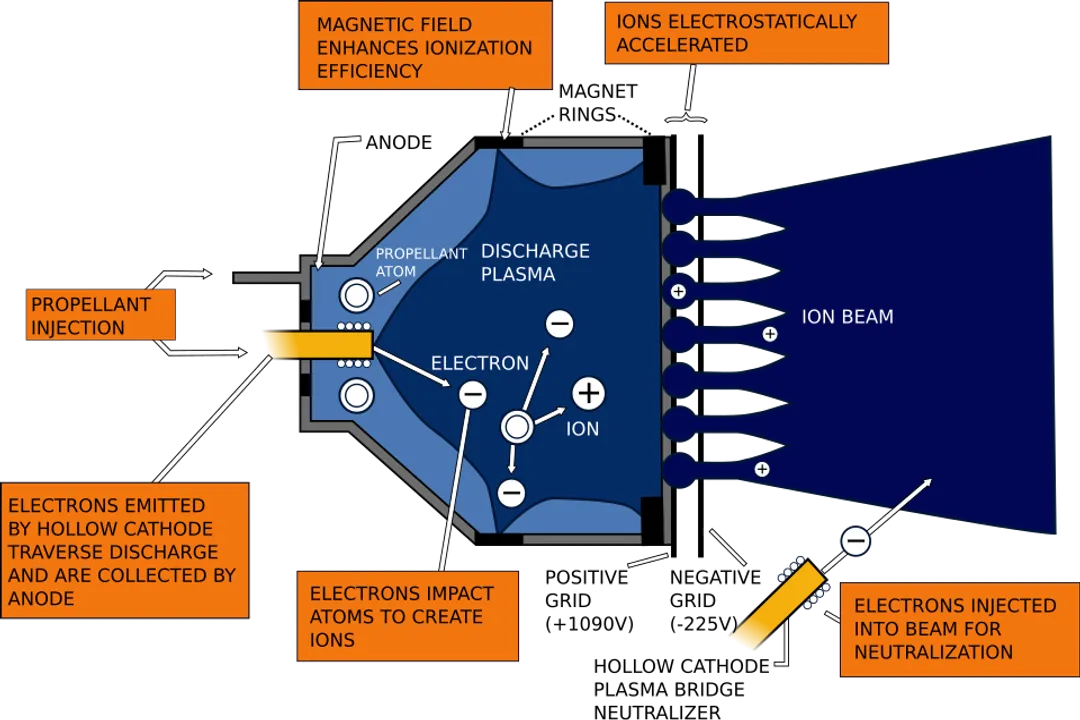
The idea of an ion thruster seems, on the surface, like a nearly perfect solution for space travel. These devices operate by ionizing a propellant, usually xenon, and then accelerating those ions out the back using electric fields, creating thrust. [5] They are famous for their incredible efficiency, often boasting a Specific Impulse () far exceeding that of traditional chemical rockets. [5] This efficiency means they use significantly less propellant mass to achieve a given velocity change (), which is a huge advantage when launching anything into space. However, despite their high , we certainly don't see them powering every satellite or replacing the massive rockets used for human exploration. The reasons boil down to a fundamental trade-off in physics: very high efficiency comes at the cost of very low force.
# Thrust Magnitude
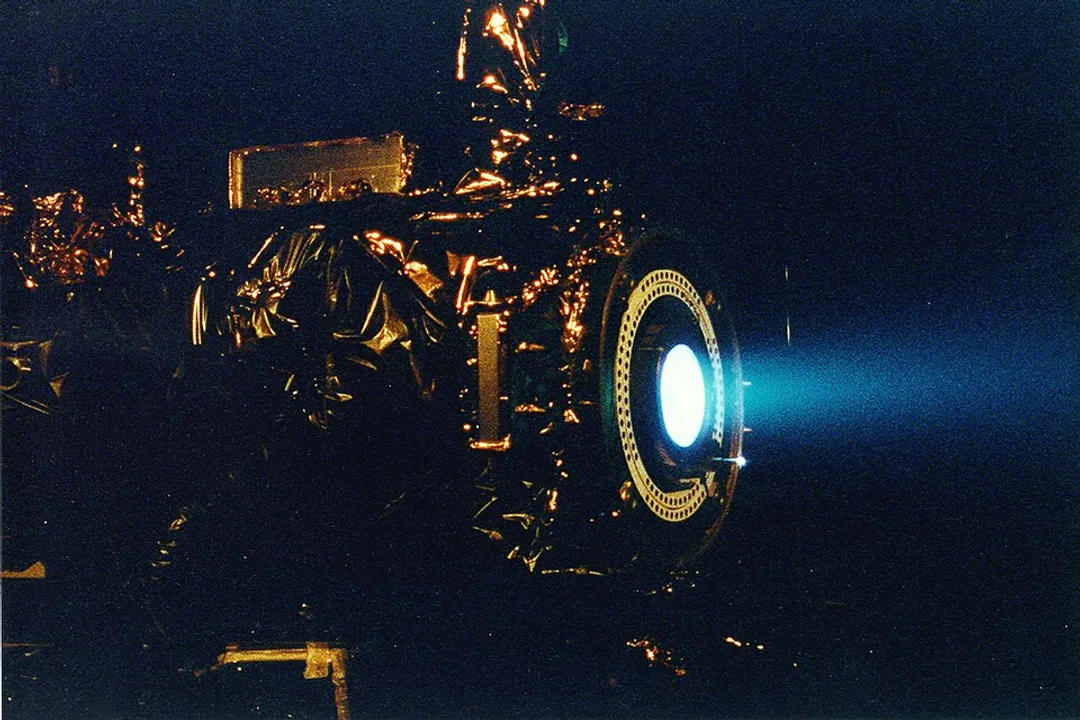
The single biggest hurdle preventing ion thrusters from being used for major tasks like launching a spacecraft from Earth or rapidly changing an orbit is their extraordinarily low thrust output. [3] While a modern chemical rocket engine can produce millions of Newtons of thrust—enough force to overcome Earth's immense gravity and lift tons of payload skyward—ion engines typically generate thrust measured in millinewtons. [3][5] To put this into perspective, a typical ion thruster might generate thrust equivalent to the weight of a single US quarter or a small piece of paper. [3]
This low thrust means the acceleration imparted to the spacecraft is incredibly slow. [3] A chemical rocket provides a massive 'kick' very quickly, pushing the spacecraft past the atmospheric drag and gravitational pull in minutes. An ion engine, operating continuously, would take weeks or months just to build up the same small velocity change. [3] Consequently, they are entirely unsuitable for escaping a planet's gravity well or performing rapid orbital maneuvers near a body with a strong gravitational field. [3] Their strength lies in long, continuous burns over vast distances where overcoming gravity is not the immediate concern. [5]
It is interesting to note the inverse relationship between the key performance metrics. Chemical rockets excel at thrust (how hard they push now) but suffer in propellant efficiency (ISP). [5] Ion thrusters are the opposite: they achieve phenomenal propellant efficiency but are severely limited in thrust. [5] An ion engine might operate for years to achieve the that a chemical engine manages in ten minutes, but it will have used a fraction of the propellant mass to do so. [3][5] This time-versus-mass calculation is crucial; near Earth, the time cost associated with ion propulsion often outweighs the propellant savings, especially when considering the operational lifetime of commercial satellites. [5]
# Atmospheric Limits
Another hard limit on the application of ion thrusters is that they fundamentally require a vacuum to operate effectively. [6] They generate thrust by ejecting a stream of charged particles (plasma) at extremely high velocities. [5] If these propellant ions were ejected into the dense atmosphere, the ambient air molecules would quickly collide with and slow down the ejected plasma, destroying the thrust mechanism and potentially causing massive damage to the delicate components of the thruster itself. [6]
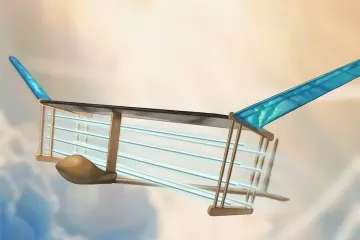
This constraint means that ion thrusters cannot be used for liftoff from Earth, nor can they be used for maneuvering within the atmosphere, such as powering an aircraft, which is why ionocrafts using ducted ionic thrusters remain primarily a niche experimental technology operating in low-pressure, high-voltage laboratory settings rather than commercial airspace. [4] The entire principle relies on unimpeded momentum transfer in a near-perfect vacuum. [6]
# Power Demands
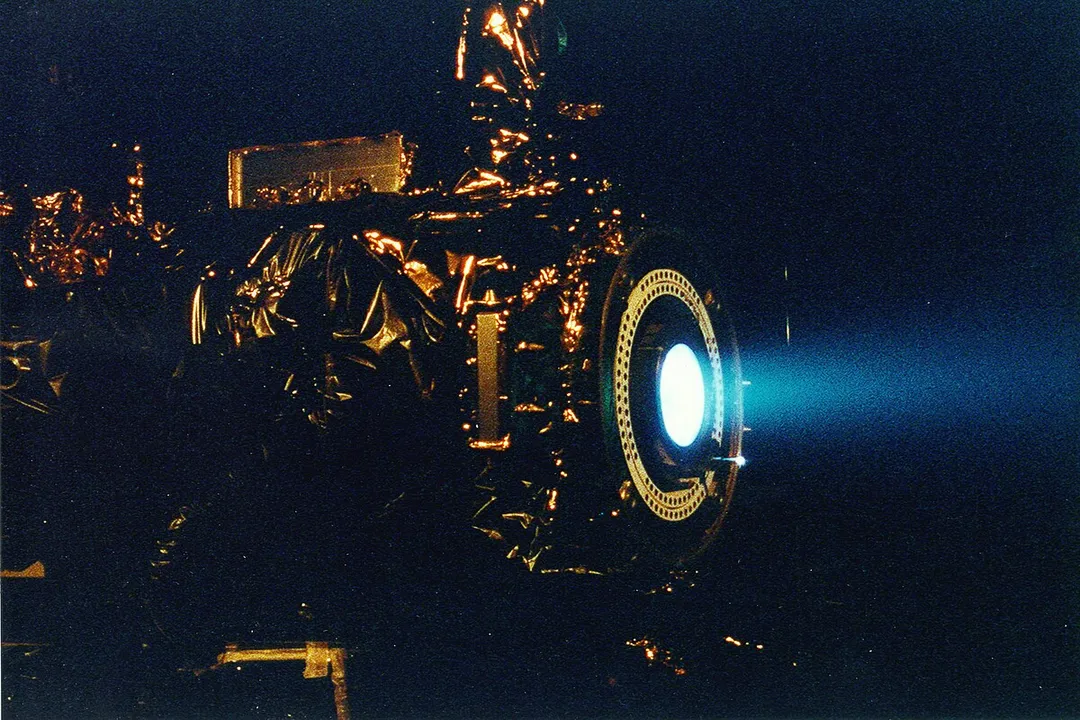
While the propellant is used sparingly, the energy required to accelerate the ions is substantial. [5] Ion thrusters operate by electrically charging and accelerating the propellant stream, which demands significant electrical power input. [5] For deep-space missions like the Dawn spacecraft or NASA’s DART mission, this power is supplied by very large, dedicated solar arrays. [5] These arrays must be massive to capture enough sunlight to run the thrusters continuously for months or years. [5]
Near Earth, this presents a different sort of bottleneck. While some satellites use solar power, the total power generation capacity of a standard communications satellite is often much lower than what a high-power deep-space ion engine would demand for rapid maneuvers. [3] Furthermore, generating that power requires the physical infrastructure—the solar panels—which adds mass and complexity, although this mass is often offset by the saved propellant mass over a very long mission profile. [3] For short-term orbital adjustments, simply carrying a tank of chemical fuel is often simpler and faster than generating the necessary megawatts of continuous electrical power for an ion equivalent. [5]
# Ideal Use Cases
Despite the limitations for Earth-bound or fast maneuvers, ion propulsion is clearly not unused; it is simply specialized for applications where the low thrust is acceptable and the high efficiency is paramount. [5] These are missions where the available time is measured in years, not hours, and where minimizing propellant mass is the primary engineering goal. [5]
# Deep Space Probes
The best-known successes involve interplanetary travel. Probes sent to the outer solar system or distant asteroids benefit immensely because the total required is very high, and the mission duration is lengthy. [5] An ion-propelled spacecraft can coast for a long time, building up speed gradually, eventually reaching velocities unattainable by carrying the necessary chemical fuel mass required for the same result. [5]
# Station Keeping
For objects already in orbit, like the James Webb Space Telescope (JWST), ion thrusters serve an important long-term role. [2] JWST uses these engines for station-keeping maneuvers to maintain its precise position at the Sun-Earth L2 Lagrange point. [2] These corrections are minor and infrequent, perfectly matching the low-thrust capabilities of the thrusters. [2]
There is even discussion about replacing the periodic reboosts required for the International Space Station (ISS) with ion engines instead of relying on visiting cargo vehicles carrying propellant. [6] This would save the mass and complexity of the reboost fuel carried by cargo ships. [6] However, this is a complex operational decision; while the high ISP is attractive for continuous low-thrust correction against atmospheric drag, the power draw, system complexity, and the need for a highly reliable, long-life system already on board the ISS present their own engineering challenges. [6] It remains an area of technical consideration rather than universal adoption. [6]
# Plasma Thruster Potential
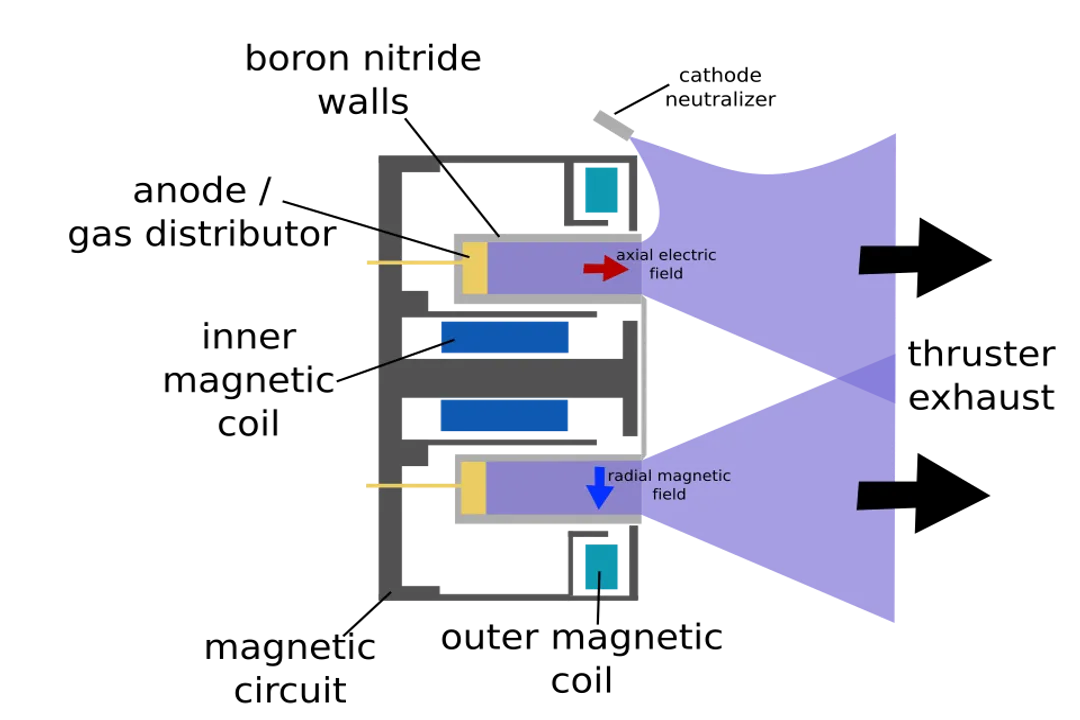
Moving forward, research continues into advanced electric propulsion systems that aim to increase the thrust level while retaining high efficiency. Concepts like plasma thrusters are being developed partly with the goal of powering crewed missions to Mars and beyond. [9] These advanced designs often look to use magnetic fields to contain and accelerate plasma rather than relying purely on electrostatic grids, potentially allowing for higher power densities and greater thrust outputs than current xenon Hall or Gridded Ion Thrusters (GITs). [9] The drive here is to find a middle ground—a system that provides enough thrust to reduce transit times for human crews significantly (perhaps cutting a multi-year trip down to months) without requiring the unreasonable mass fraction of propellant needed by chemical rockets for the same transit time. [9] While plasma thrusters are still under development, they represent the next step in pushing electric propulsion past its current low-thrust ceiling for more ambitious applications. [9]
The future of space travel will almost certainly involve a hybrid approach. Chemical rockets will remain the workhorses for escaping gravity wells and providing high-force maneuvers. [3] Meanwhile, high-efficiency ion and advanced plasma thrusters will handle the long-haul segments of interplanetary travel and the delicate station-keeping of valuable orbital assets. [2][5] The choice of propulsion is simply a matter of matching the required force and timeline to the engine's capabilities, accepting that the most efficient engine is rarely the most powerful one. [3][5]
#Videos
Could We Be on the Verge of a Major Technological Transportation ...
Related Questions
#Citations
Why not ion thrusters? : r/AskScienceDiscussion - Reddit
Why doesn't JWST use ion thrusters?
Why are ion engines not suitable for launching into orbit ... - Quora
Why don't ionocrafts (ionic propelled aircrafts) use ducted ionic ...
Ion thruster - Wikipedia
Why don't ion thrusters work within the atmosphere? - Physics Forums
Could We Be on the Verge of a Major Technological Transportation ...
Test Suggests Ion Thrusters Could Power Crewed Interplanetary ...