When comparing apparent brightness on the magnitude scale, what factor of difference does one unit represent?
Answer
A factor of about 2.5 in brightness.
The apparent magnitude scale used for measuring stellar brightness is logarithmic, not linear, which is why small numerical differences equate to large visual differences. Specifically, a difference of one full magnitude between two stars represents a factor of approximately 2.5 in brightness when measured by light intensity. This relationship is exponential; for example, a star that is two magnitudes brighter (e.g., -0.5 vs +1.5) is $2.5 imes 2.5$, or $6.25$ times brighter.
#Videos
Sirius - the brightest star - YouTube
Related Questions
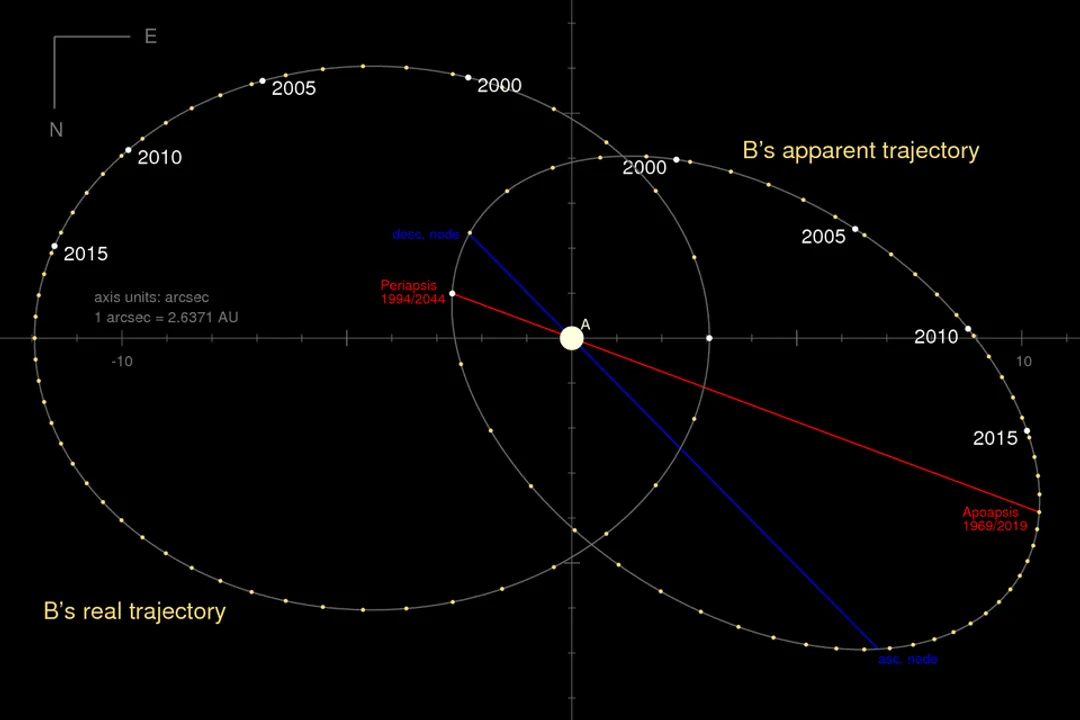
Why is Sirius frequently nicknamed the "Dog Star" and which constellation houses it?What is the approximate apparent magnitude value that signifies Sirius as the brightest visible star?What two stellar components make up the Sirius binary system orbiting a common center of mass?What spectral type and relative luminosity does Sirius A exhibit compared to the Sun?What specific stellar remnant classification is assigned to the faint companion star, Sirius B?If using Orion’s belt stars as a guide, in which direction should an observer trace a line to find Sirius?What is the measured distance, in light-years, of the Sirius system from our solar system?When comparing apparent brightness on the magnitude scale, what factor of difference does one unit represent?Compared to the Sun's apparent brightness from Earth, how much brighter does Sirius appear to a terrestrial observer?If Sirius has an apparent magnitude near -1.46, what is the approximate magnitude of the next brightest star, Canopus?What volume comparison is used to describe how compact the mass of Sirius B is?