What is the approximate degree of ionization observed in the Sun's core due to extreme pressure and heat?
Answer
Virtually 100%
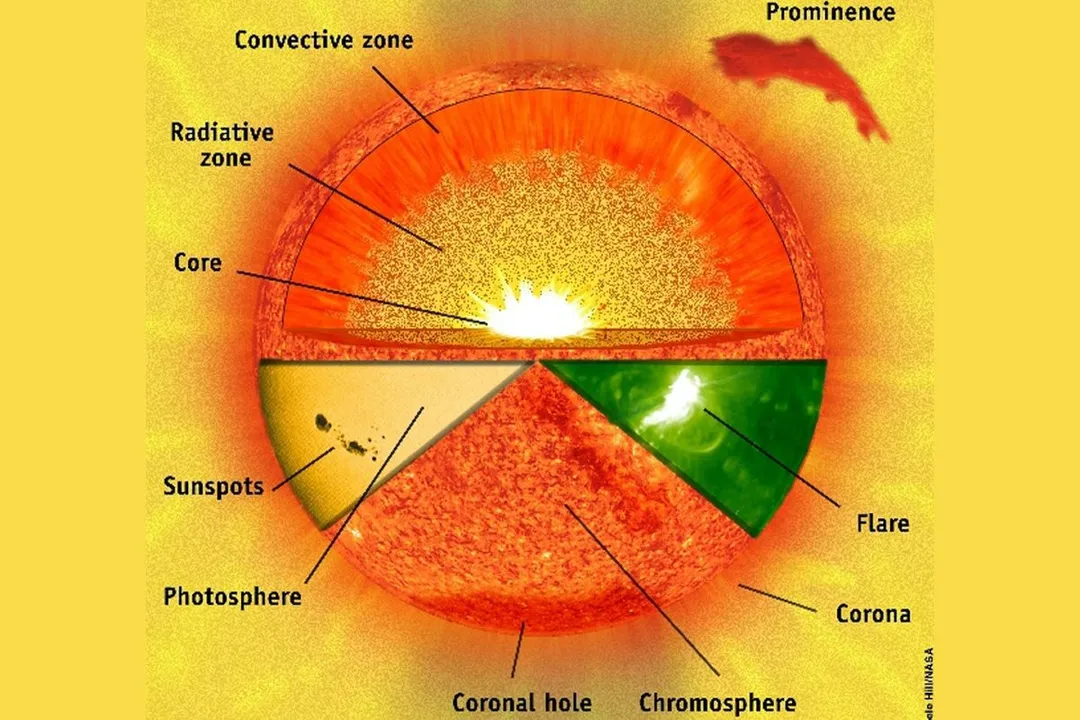
The conditions inside the Sun's core are the most extreme environments within the star, facilitating the highest degree of ionization. Given the core temperature exceeding 15 million degrees Celsius and immense internal pressure, the energy input is sufficient to strip virtually every atom bare of its electrons. The text specifies that in this central region, the ionization level is virtually 100%. As one moves outward towards layers like the chromosphere or corona, the temperature drops slightly, leading to a minor decrease in the ionization degree, but the material throughout the vast majority of the star remains firmly in the plasma regime.
Related Questions
What is the most accurate physical state classification for the Sun, beyond the simple description of a giant ball of gas?What two elements compose roughly seventy-three percent and twenty-five percent of the Sun's mass, respectively?What fundamental physical feature distinguishes plasma from a standard electrically neutral gas?What temperature, exceeding that of the photosphere, is reached in the Sun's core where nuclear fusion takes place?What physical phenomena are massive rearrangements of magnetic field lines interacting with the charged plasma, rather than atmospheric storms in neutral gas?What physics discipline is required to model the complex, long-range interactions driven by the Sun's dense sea of charged particles?If a small parcel of the Sun’s outer layer were instantly cooled to Earth-normal pressures while maintaining temperature, how would it behave relative to its current state?What specific phenomenon causes sunspots to appear darker and momentarily cooler than the surrounding solar surface?What is the approximate degree of ionization observed in the Sun's core due to extreme pressure and heat?When astronomers discuss the composition ratios of hydrogen and helium in the Sun, what state are they typically referencing before the electrons are stripped?