What catastrophic event is a leading hypothesis explaining Mercury's depleted silicate mantle?
Answer
A giant impact early in its history
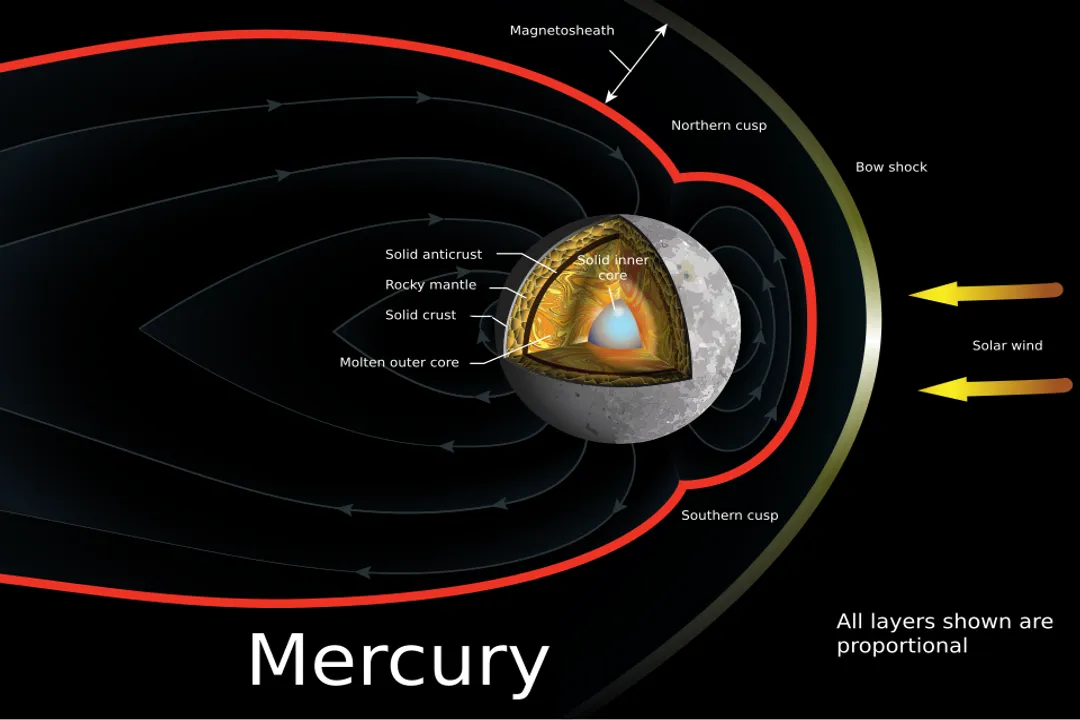
The sheer scale of iron concentration in Mercury has led scientists to propose dramatic formation scenarios. The leading hypothesis centers on a catastrophic event occurring early in Mercury’s history: a giant impact. This theoretical collision is believed to have been powerful enough to strip away a significant portion of the planet’s lighter, silicate mantle material. What remains after such an event is the dense, iron-rich remnant core that makes up the majority of the planet observed today. This scenario offers a compelling physical explanation for the planet’s unusual compositional imbalance compared to other rocky worlds.
Related Questions
What fraction of Mercury's entire mass is estimated to be its massive metallic core?How does Earth's metallic core mass percentage compare to Mercury's iron dominance?What lighter element is likely alloyed with iron in Mercury's core, helping it remain partially molten?What catastrophic event is a leading hypothesis explaining Mercury's depleted silicate mantle?What causes the reddish surface color observed on Mars, often misinterpreted regarding its deep iron content?How is the exoplanet TOI-849b, which is Neptune-sized but iron-heavy, sometimes described?Approximately how massive is the exoplanet TOI-849b compared to Earth's mass?In the cosmos, which objects are responsible for forging the element iron through stellar nucleosynthesis?What physical process in Mercury is attributed to its ability to generate a global magnetic field?What is the estimated thickness range for Mercury's immense iron heart?