How does Jupiter's mass compare to the combined mass of all other planets?
Answer
It holds more than twice the mass of every other planet combined.
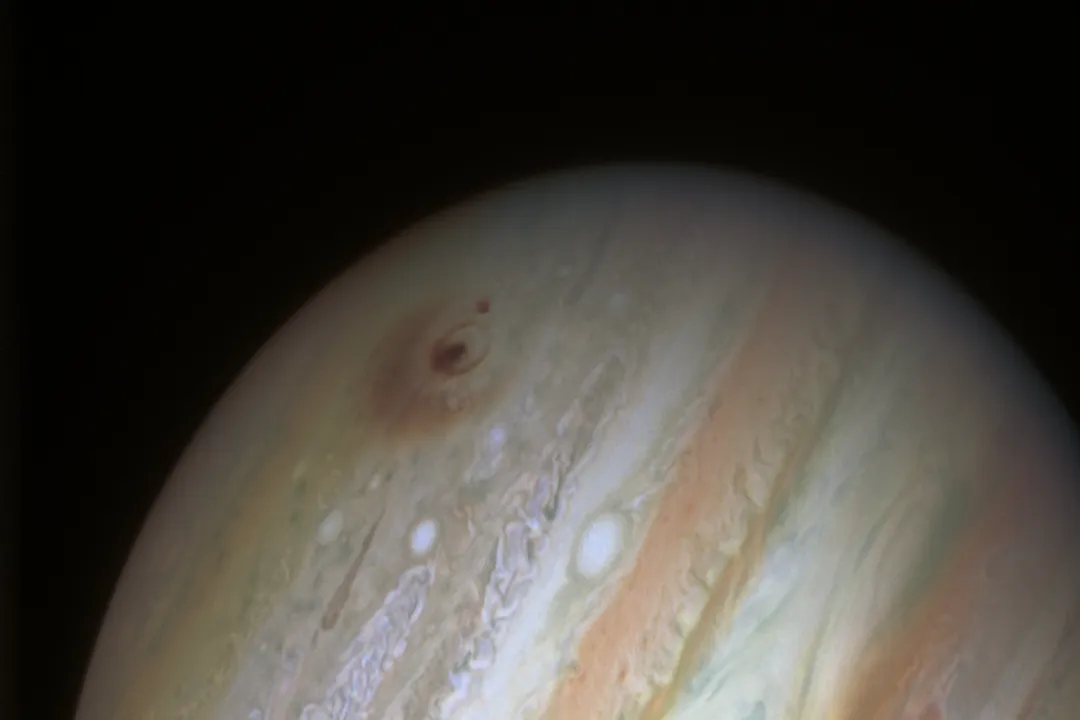
Jupiter possesses an overwhelming gravitational dominance in the solar system, evidenced by its colossal mass. The provided information specifies that this single world contains more than double the accumulated mass of all the other planets in the solar system put together. Furthermore, a specific measurement indicates that Jupiter alone accounts for over 90% of the total mass comprising all the planets. This extreme concentration of mass is the fundamental reason why Jupiter dictates the orbital mechanics and shapes the architecture of the entire system, influencing bodies from the asteroid belt to the delivery paths of distant comets.
Related Questions
How does Jupiter's mass compare to the combined mass of all other planets?What vital components might Jupiter have delivered to young Earth during formation via deflection?What protective function is attributed to Jupiter's gravitational presence concerning long-period comets?What specific bombardment rate would decrease long-term if Jupiter were hypothetically removed currently?What orbital consequence for inner planets results from the increased gravitational tug-of-war without Jupiter?What specific environmental condition for complex biology is jeopardized by extreme eccentricity in Earth's orbit?What crucial factor determines whether Jupiter's influence is deemed beneficial or detrimental across cosmic time?What specific effect regarding current impactors has research indicated about Jupiter’s present orbital configuration?What is the name of the theoretical scenario involving Jupiter forming farther out and migrating inward less aggressively?What dynamic state change in the solar system, facilitated by Jupiter, allowed Earth's biosphere to flourish beyond single-celled organisms?