For observers at a mid-northern latitude, what causes Venus to appear low in the southwestern sky after sunset during late winter and early spring?
Answer
The Sun’s path across the sky is relatively low in the southern sky during this time.
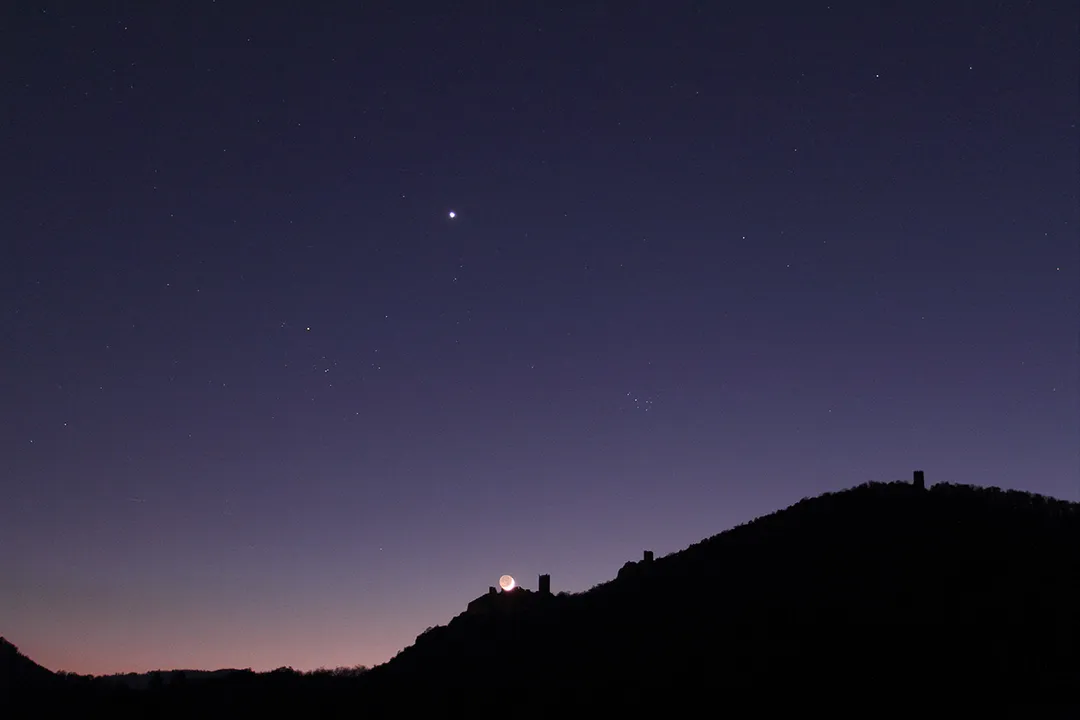
The seasonal position of the Sun dictates the geometry of the ecliptic relative to the horizon for observers at different latitudes. During late winter and early spring in the northern hemisphere, the Sun tracks a relatively low path across the southern sky. If Venus happens to be at its maximum eastern elongation during this period, its appearance in the western sky after sunset will follow this low solar track, resulting in it appearing low in the southwestern sky before setting quickly in the west.
Related Questions
What is the observed direction of the Sun from the surface of Venus due to its retrograde rotation?Why is Venus never observed high in the sky at midnight from Earth?When Venus appears as the Morning Star, what general direction must it rise in our sky?What direction does Venus generally set when visible as the Evening Star?What is the fundamental mechanism causing the Sun and Venus to appear to move from East to West across the heavens?What astronomical phenomenon dictates the constantly changing specific point on the eastern horizon where Venus appears?If an observer sees Venus blazing brilliantly an hour or two after sunset, what is this phase called and what determines its path toward setting?How long is Venus's rotation period compared to its orbital period around the Sun?What observation confirms that Venus, visible before dawn, is currently in its morning phase?For observers at a mid-northern latitude, what causes Venus to appear low in the southwestern sky after sunset during late winter and early spring?If an astronomy application shows Venus's rising azimuth as 105 degrees, what does this indicate about its morning rise point?