Do rockets always land in the ocean?
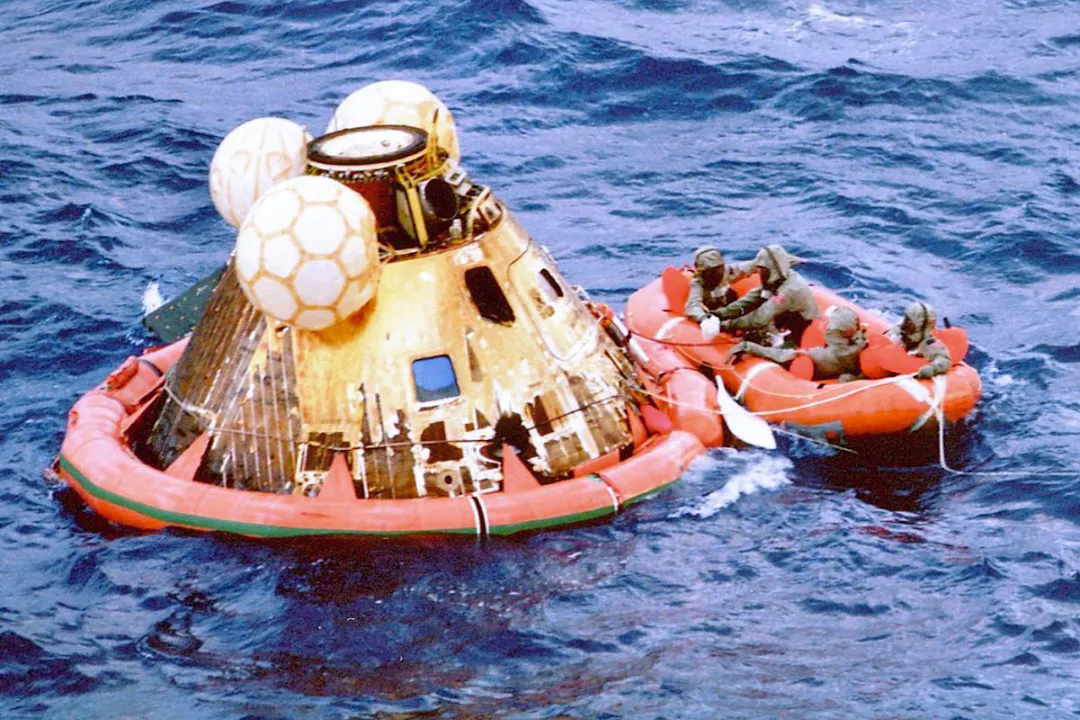
The idea that every returned space vehicle or spent rocket stage inevitably concludes its flight with a splashdown in the vast blue is a common perception, largely shaped by highly publicized footage of massive boosters returning to Earth. However, the reality of modern rocketry, particularly with companies focused on reusability, is much more nuanced. Rockets do not always land in the ocean; the destination—a concrete pad or an autonomous drone ship—is a carefully calculated outcome based on orbital mechanics, propellant reserves, and mission requirements. [2]
When assessing the fate of a returning first stage, the decision hinges on where the rocket needs to be to satisfy its primary mission objectives. For missions heading to higher energy orbits, or those launching from launch sites situated near a coastline facing the ocean (like Florida's Cape Canaveral), hitting the water is often the only feasible or safest option for recovery. [1][8]
# Landing Zones
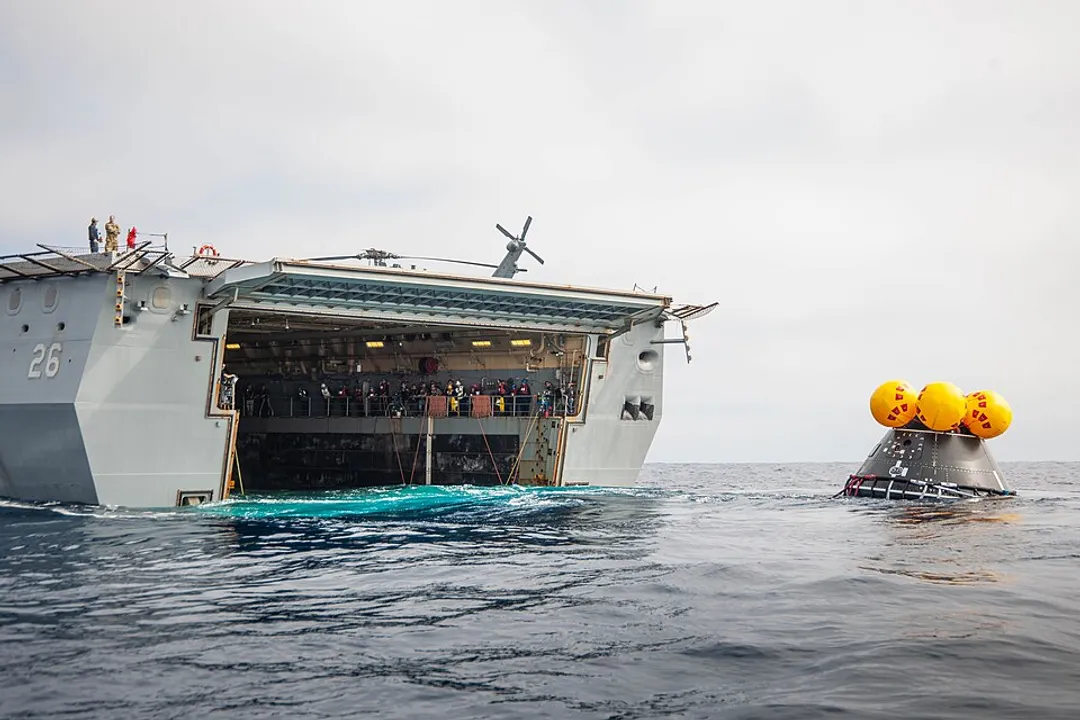
The primary driver behind recovering a booster in the Atlantic Ocean relates directly to the trajectory required for reaching orbit. Rockets launched from coastal sites, such as those on the East Coast of the United States, are typically heading eastward to gain the rotational boost provided by the Earth’s spin. [8] To return the first stage booster, which has already expended significant fuel to accelerate the rest of the vehicle, the landing spot needs to be downrange from the launch site. [1]
If a rocket is launching eastward from a location like Cape Canaveral, the trajectory means that the booster separates hundreds of miles out over the Atlantic Ocean. [2] Attempting to perform a powered landing back at the launch site, or even an inland site, would demand carrying significantly more fuel. This extra fuel translates directly into a reduced payload capacity for the primary mission. [2] Therefore, for missions aiming for high orbital velocities, the trade-off is accepting an ocean landing to maximize the mass delivered to space. [1][2]
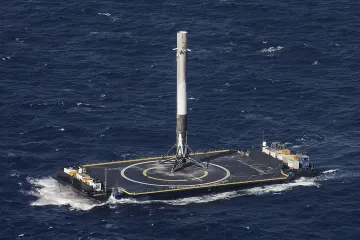
SpaceX employs highly specialized, unmanned marine platforms, often referred to as drone ships, to serve as floating landing targets in the ocean. [1][2] These ships are positioned hundreds of miles offshore, allowing the booster to use the minimal amount of fuel required for a successful landing burn after stage separation. [2] Landing on one of these barges is an intentional, highly controlled maneuver designed to bring the hardware back in the most fuel-efficient manner possible for that specific launch profile. [1]
# Water Impact
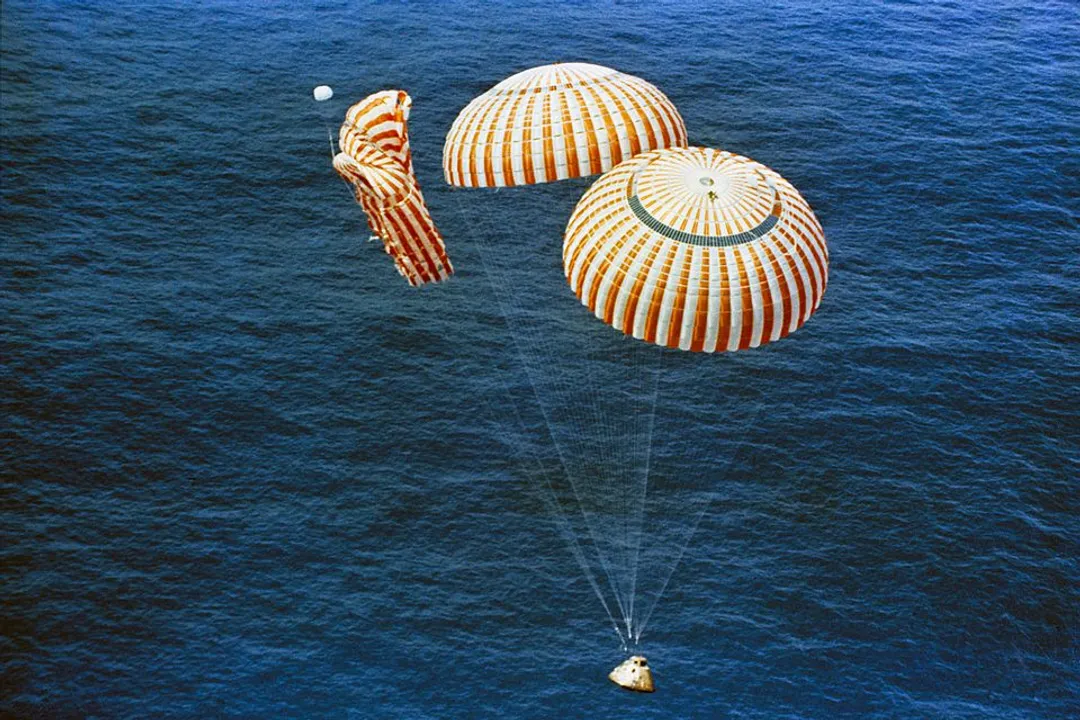
When a stage is not targeted for a soft landing, either because it missed its landing zone or because the mission parameters specifically dictated that no recovery attempt would be made, the stage performs what is known as a splashdown. [6] A splashdown is the controlled or uncontrolled descent into the ocean. [7]
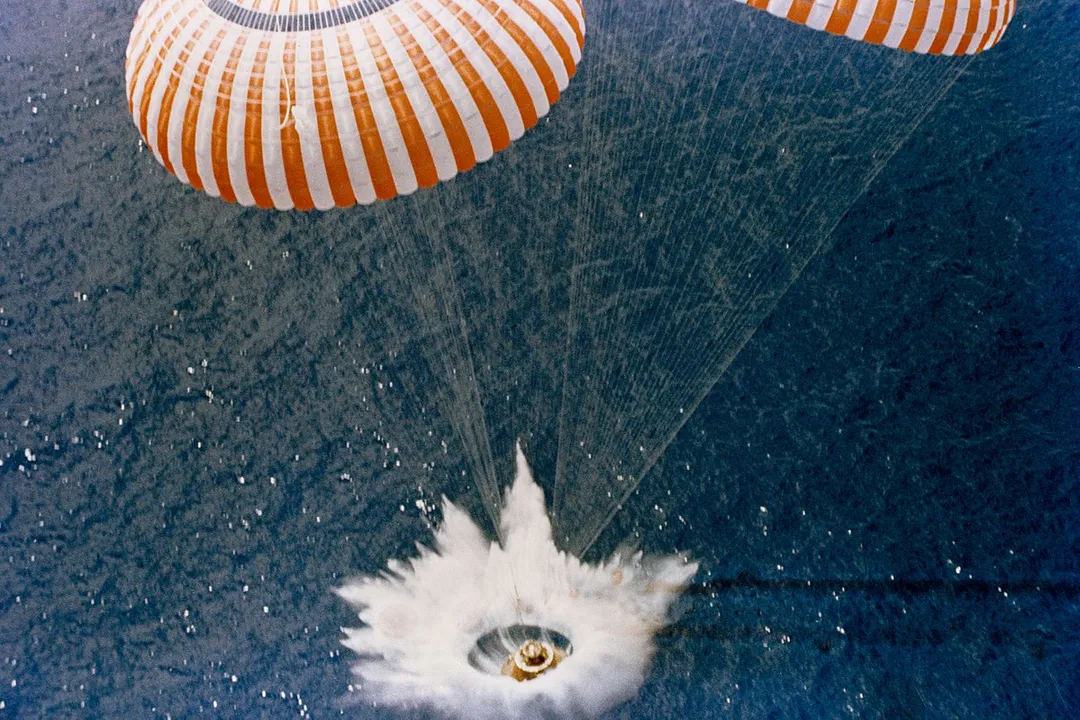
Historically, many space programs, including those using expendable rockets, accepted the loss of the first stage into the sea as standard procedure. Even recoverable capsules or vehicles that are not intended for a land landing often execute a water landing, which is referred to as a splashdown. [7] For many crewed capsules, like those historically used by NASA, splashdown was the designated return method, requiring specialized recovery crews to retrieve the capsule from the ocean surface. [7]
For an uncontrolled descent or a failed recovery attempt of a reusable booster, the result is typically a hard impact with the water surface. While the ocean seems like an infinite cushion, the closing speed of a massive, descending rocket stage is enormous, and the impact is far from gentle. [6] These impacts can scatter debris across a wide area of the ocean. [6] If a booster is intended for an ocean landing on a drone ship, the controlled descent ensures the vehicle lands upright on the deck, not into the water beside it. [1] However, even successful drone ship landings are not universally possible; some early attempts or specific trajectories might still result in an intentional or accidental water landing depending on the mission’s propellant budget. [2][6]
# Recovery Sites
The existence of land-based recovery sites fundamentally changes the calculus regarding ocean landings. The presence of a land pad, such as Landing Zone 1 (LZ-1) at Cape Canaveral, provides an alternative to the drone ship for missions that do not require the absolute maximum payload capacity. [1]
When a mission can afford the necessary fuel margin—meaning it is targeting a lower orbit or flying a less ambitious trajectory—the booster can be directed back toward land. [2] Landing on a fixed concrete pad like LZ-1 offers distinct logistical advantages over retrieving a booster from a moving ship at sea. [1] Land recovery avoids the inherent risks associated with sea recovery, such as strong waves or high winds potentially damaging the vehicle or jeopardizing the landing sequence on a pitching deck. [2]
Consider the trade-off: a mission destined for a very high orbit might only have enough fuel to slow down enough for a drone ship landing, meaning the booster must land in the ocean to be recovered at all for reuse. [2] Conversely, a mission to the International Space Station might have enough margin to aim for LZ-1, even if it means sacrificing a few hundred kilograms of payload mass compared to an ocean-optimized flight path. [1] The choice is therefore a direct function of economic necessity versus performance requirements. If the target orbit is achievable by landing back at the launch site, land recovery is generally preferred for logistical simplicity.
# Coastal Launch
The geography of the launch range significantly dictates where a booster lands downrange. Launch sites situated near the ocean allow rockets to shed stages over water, which is inherently safer than flying over populated land areas during the initial, most turbulent phase of flight. [8]
Rockets launching from sea level, such as those at Cape Canaveral, benefit from the added boost provided by Earth’s rotation, which is maximized at the equator and decreases closer to the poles. [8] However, launching from sea level means the subsequent trajectory sends the first stage out over the ocean. [8] If a facility were situated on a high plateau or deep inland, the downrange target for the first stage would likely be land, necessitating a different set of recovery procedures or an intentional jettison over an unpopulated area. [8] The proximity to the sea allows for safe over-water separation and opens up the possibility of using the drone ships stationed hundreds of miles offshore. [1][2]
A fascinating engineering consideration arises when looking at the fuel requirements for these recovery attempts. For a first stage to return, it must perform a series of complex burns: the boost-back burn to reverse direction, the re-entry burn to manage atmospheric friction, and the final landing burn. [2] Every second the engine fires burns propellant that cannot be used for payload delivery. The engineers calculate the precise "propellant budget" such that the required delta-v for the mission is met while leaving just enough reserve fuel for the boost-back and landing burns necessary for either the drone ship or land pad recovery. [1] If a mission requires a landing far downrange over the water, the required fuel expenditure for the boost-back burn might push the vehicle past its propellant limit, making a land landing impossible, even if the vehicle could fly that far, simply because the delta-v required to slow down for the water landing trajectory is less efficient than a higher-energy trajectory that only lands on the ship or requires dropping into the water. [2]
# Stage Fate
When a rocket stage is intentionally expended, or when a landing attempt fails, the hardware ends up in the ocean, leading to questions about its ultimate fate. The hardware that successfully lands on a drone ship is generally inspected, refurbished, and flown again, which is the entire economic justification for the effort. [1]
However, stages that splash down—whether intentionally or not—face a different end. A stage that lands in the ocean, unlike one landing on land, cannot typically be recovered for immediate refurbishment, nor is it designed to survive a high-velocity impact with water. [6] The salt water and corrosive environment pose severe challenges to the sensitive engine components, avionics, and structural integrity required for another flight. [3] While a stage designed for a soft splashdown (like some older crew capsules) is built with buoyancy and recovery in mind, an expended booster is not. [7] The hardware that settles on the seabed after a failed landing attempt effectively becomes space debris resting on the ocean floor, often far from the intended landing zone due to the horizontal velocity at impact. [3][6] The distinction between a controlled, upright landing on a barge and an uncontrolled splashdown into the surrounding water is critical to whether the hardware returns to service or rests on the ocean floor. [1][3]
The current operational landscape shows a clear trend toward maximizing land landings when the mission profile allows, primarily because it simplifies the logistics of recovery and refurbishment. Yet, the ocean remains an essential component of the launch architecture, serving as the default, fuel-efficient recovery zone for the most ambitious missions heading eastward, ensuring that the search for orbital performance takes precedence over the convenience of a terrestrial landing pad. [2]
#Videos
Why SpaceX Really Lands In The Ocean (Physics) - YouTube
Related Questions
#Citations
ELI5: Why does SpaceX land their rocket on a barge on the ocean?
What is the point of landing SpaceX's rocket on a barge in the ocean?
What happens to rocket stages that land in the oceans, and how ...
Why SpaceX Really Lands In The Ocean (Physics) - YouTube
How does SpaceX legally dump boosters in the ocean? - Facebook
Why Returning Spacecraft Land in the Ocean — Sometimes
Splashdown - Wikipedia