Why did SpaceX booster land in the ocean?

The decision to bring a massive Falcon 9 first stage booster down for a controlled landing in the Atlantic or Pacific Ocean, often on a specialized floating platform, is not made for show. While the visual spectacle of a propulsive landing is certainly dramatic, the why is rooted deeply in the cold, hard physics of orbital mechanics and the relentless pursuit of reusability. [1][3] When a rocket launches, it must achieve a specific velocity and altitude—its energy—to reach its intended orbit, whether that's Low Earth Orbit (LEO), Geostationary Transfer Orbit (GTO), or an interplanetary trajectory.
# Energy Limits

Every bit of fuel burned by the first stage during its ascent contributes to putting payload into space. However, if the first stage needs to save enough propellant to execute the complex maneuvers required to return to Earth—throttling up engines, flipping around, and landing—that saved fuel cannot be used to push the second stage and its payload to the target destination. [5] This trade-off between the return energy and the payload energy is the fundamental constraint SpaceX faces with every launch. [1]
For missions targeting lower-energy orbits, like a simple LEO mission from Cape Canaveral, the first stage often has enough residual velocity and fuel margins to make it back to land, specifically Landing Zone 1 (LZ-1) near the launch site, or to an onshore landing zone. [5] This return-to-launch-site (RTLS) trajectory is generally preferred because it is simpler: the landing pad is stationary, recovery is quicker, and the risk profile is arguably lower since the recovery crew is not operating miles offshore. [5]
However, when the target orbit is very high-energy—meaning the payload needs significant velocity imparted to it—the first stage has to burn its engines for longer and harder during the initial ascent. By the time stage separation occurs, the booster has less spare fuel available for the complex landing burns. In these high-energy scenarios, the booster simply does not have enough delta-v (change in velocity capability) left over to slow down enough to land back at the launch site or even a nearby land-based location. [1][5]
For missions requiring the highest performance, attempting a land landing would necessitate shrinking the payload size significantly, sometimes to an unacceptable degree. The engineering decision becomes: trade payload mass for a land landing, or trade a more distant, ocean landing for maximum payload delivery. SpaceX consistently chooses the latter for performance-critical missions. [5]
# Drone Ship Necessity

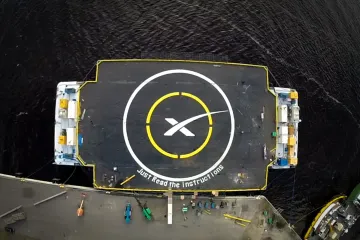
When the required energy dictates that the first stage must travel far downrange and land hundreds of miles offshore, an Autonomous Spaceport Drone Ship (ASD) becomes essential. [8] These vessels, such as Just Read the Instructions or Of Course I Still Love You, are essentially floating landing pads that act as replacement ground landing sites positioned strategically in the ocean. [8]
The drone ship's position is determined by the specific mission's trajectory. For a launch heading east over the Atlantic, the ship might be positioned hundreds of miles downrange to intercept the booster at the point where it has the right velocity vector for an ocean landing burn. [1] This is not simply a matter of letting the rocket crash into the water; it requires the booster to perform the boost-back burn, the re-entry burn, and the final landing burn, all while navigating toward a moving target hundreds of miles away. [7]
The ASD is classified as an unmanned marine vessel, allowing it to operate autonomously, though crews are present during recovery operations. [8] It is crucial to understand that the drone ship is not a passive target. To successfully catch the booster, the ASD must be able to position itself precisely beneath the descending rocket. This requires sophisticated navigation systems to maintain its position relative to the Earth's surface while correcting for ocean swells and wind. [8]
# Performance Trade-Offs
The concept of maximizing payload delivery by accepting an offshore landing is a key element of SpaceX's business model. Landing on the drone ship imposes a slightly higher performance penalty than RTLS because the boost-back and re-entry burns needed to reach the distant drone ship consume more fuel than the burns needed to return to the launch site. [5] However, this penalty is significantly less severe than the penalty incurred by simply dropping the first stage after burnout (an expendable mission). [1]
Consider a hypothetical mission to Geostationary Transfer Orbit (GTO) from Florida. An expendable first stage might deliver a certain maximum mass, . If the company attempted an RTLS landing, the booster must execute a significant deceleration and flip maneuver earlier, perhaps reducing the deliverable mass to , where . By extending the flight path to the offshore drone ship, the booster uses its remaining propulsive capability more efficiently to achieve a return that still allows for a high , where is only slightly less than , but much greater than . [1]
This means that for a customer paying to put a satellite into a high-demand orbit, choosing the drone ship landing option over an expendable mission allows them to send a heavier, more valuable satellite, thus justifying the complexity of the offshore recovery operation.
If we were to look at the mass savings over time, the value proposition becomes clear. A single Falcon 9 first stage costs millions of dollars. If a company launches 10 times a year with stages that would otherwise be destroyed, the cumulative savings quickly dwarf the operational costs associated with maintaining the drone fleet. [3] Landing in the ocean is simply the geographically necessary solution for achieving orbital requirements while preserving the vehicle for reuse on those high-energy paths. [5]
# Recovery Milestones
The achievement of landing on these ships represents a significant engineering milestone. Early attempts often resulted in booster destruction or splashing down next to the ship due to minor errors in trajectory, wind correction, or fuel margins. [9] The first successful landing on a drone ship, Of Course I Still Love You, marked a critical step toward routine reusability, proving that the complex guidance, navigation, and control systems could successfully guide the returning stage to a precise, moving point over water. [7]
The complexity of operating on the water is non-trivial. The ASD is required to hold its position even in rough seas. Furthermore, the landing process itself is incredibly fast and violent. The final seconds involve rapidly decelerating from hundreds of miles per hour to zero vertical velocity, all controlled by three engines firing in a precisely choreographed sequence. [4] Successfully completing this sequence on a stable platform hundreds of miles from shore validated the entire recovery concept required for missions heading further out into the solar system, where land return is physically impossible. [3]
# Operational Refinements
Over time, SpaceX refined the process, evolving from landing attempts that often resulted in hardware loss or near-misses to routine successes. The initial focus was simply proving it could be done—making it land anywhere offshore. [3] Once that was proven, the focus shifted to making the recovery quicker and less stressful on the hardware, moving toward more frequent reflight intervals. The proximity of the landing zone to the required orbit directly influences the turnaround time for the booster, which is a major economic factor in reusability. [3]
For example, a booster that lands close to shore (even on the drone ship) needs less time to be transported back to the processing facility than one that lands far out in the Pacific. The longer the required burn to reach the drone ship, the more wear and tear on the engines and structure, potentially increasing refurbishment time. Therefore, SpaceX often selects the closest possible drone ship location that still meets the payload requirements for that specific mission inclination and destination orbit. [1] This optimization ensures the recovery effort is targeted and cost-effective, balancing the immediate need for performance against the long-term need for rapid turnaround.
The ability to successfully recover from an ocean landing means that SpaceX is not constrained by geography for their highest-value missions. This flexibility allows them to launch payloads into various orbital inclinations, something that is often limited when restricted to fixed land-landing sites near the equator. [8] The ocean landing capability effectively expands the useful range of the Falcon 9 architecture to near its theoretical maximum performance for any given trajectory.
#Videos
Why SpaceX Chose To Land Off Coast of the Bahamas - YouTube
Why SpaceX Really Lands In The Ocean (Physics) - YouTube
Related Questions
#Citations
What is the point of landing SpaceX's rocket on a barge in the ocean?
Why SpaceX Chose To Land Off Coast of the Bahamas - YouTube
Why the SpaceX Rocket Ocean Landing is a Big Deal | Space
Why did SpaceX attempt to land the booster on a barge instead of ...
How does SpaceX legally dump boosters in the ocean? - Facebook
SpaceX pulls off first successful mid-ocean rocket landing - PBS
Autonomous spaceport drone ship - Wikipedia
Musk's Starship rocket makes breakthrough ocean landing - BBC