Why do all stars contain hydrogen?
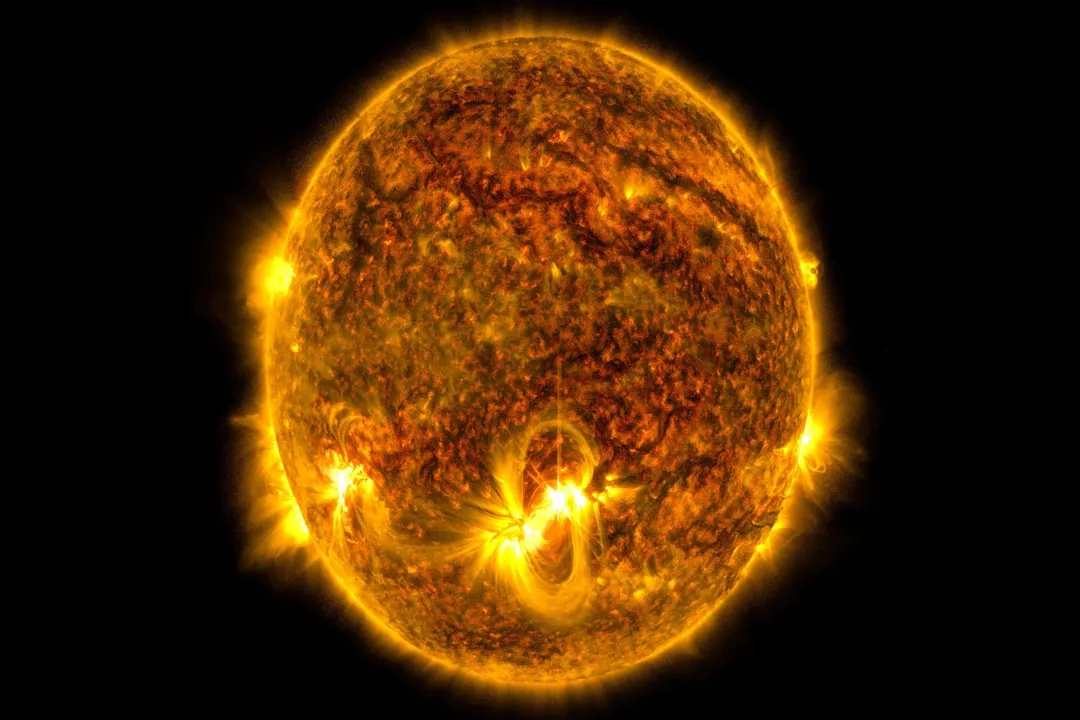
The vast majority of the material making up every star in existence is, simply put, the leftover building blocks from the beginning of the cosmos. Stars are fundamentally reservoirs of primordial matter, and because the universe itself began overwhelmingly composed of the simplest element, hydrogen, stars inherit this composition as their starting point. [1][4] This initial state is not a coincidence but a direct consequence of the Big Bang, which primarily synthesized hydrogen and helium, with only trace amounts of other elements present. [4] Stars are, therefore, born from clouds of gas and dust—nebulae—that represent this ancient cosmic mixture. [2]
# Cosmic Abundance
When we examine the elemental makeup of stars, the dominance of hydrogen is striking. On average, stars are constructed of roughly 75 percent hydrogen by mass, with helium accounting for nearly all the remainder, usually around 24 percent. [2][4][7] This leaves a mere 1 or 2 percent for everything else—the heavier elements like oxygen, carbon, iron, and so on, which astronomers often collectively label as "metals". [5]
This universal distribution is critical to understanding stellar mechanics. Because hydrogen is the lightest and most abundant element created in the earliest moments of the universe, it forms the bulk of the raw material available for gravity to pull together into star-forming clouds. [1] If the universe had started with a much higher percentage of, say, neon, then every star we observe would be fundamentally different in its life cycle, energy output, and observational properties. [4] The fact that nearly every star, from the smallest red dwarfs to the most massive blue giants, begins its life with this H/He ratio underscores a universal initial condition that dictates stellar structure. [7]
# Birth Materials
A star's life begins when a sufficiently massive region within a giant molecular cloud begins to collapse under its own gravity. [2] These nebulae are essentially cosmic nurseries, remnants of previous stellar generations mixed with the original hydrogen and helium from the Big Bang. [2] The collapse process compresses the gas, causing the temperature and pressure in the center to rise dramatically. [2]
The initial chemical composition dictates the entire evolutionary path. Since the interstellar medium from which our Sun and other stars formed was already enriched with a small percentage of heavier elements from prior stellar explosions, these "metals" are present when the star ignites. [5] However, their presence is passive in the core during the star's long, stable youth. The sheer volume of hydrogen available at the start ensures that this element will remain the primary component for the longest period of the star's existence. [2]
Consider the initial density required. For a cloud fragment to become a true star—an object capable of sustained nuclear fusion—it must reach a core temperature of about 10 million Kelvin. [9] The vast reservoir of hydrogen surrounding the forming core provides the necessary mass to generate this immense gravitational pressure, overcoming the internal pressure until this threshold is met. [2] A body that fails to achieve this temperature, like a brown dwarf, remains "star-like" in appearance but is defined by its inability to sustain hydrogen fusion, meaning it is essentially a failed star whose composition remains largely primordial. [9]

# Fusion Engine
The reason hydrogen is so central to a star is that it is its primary fuel. A star shines because it is an ongoing, controlled thermonuclear reaction. [6] This reaction is the fusion of hydrogen nuclei (protons) into heavier nuclei, primarily helium. [3] This process, known as stellar nucleosynthesis, releases enormous amounts of energy according to Einstein's famous equation, . [3][6]
The main sequence phase, which is the longest and most stable period of a star's life—lasting about 10 billion years for a Sun-like star—is entirely fueled by this hydrogen burning. [3] The energy released creates an outward pressure that perfectly balances the inward crush of gravity, leading to hydrostatic equilibrium. [2] Without the abundant hydrogen fuel in its core, the star could not maintain this balance and would rapidly collapse or evolve into a different state. [9]
The mechanism varies slightly depending on the star's mass. Our Sun and lower-mass stars primarily use the proton-proton chain, a multi-step process that slowly combines four hydrogen nuclei into one helium nucleus. [3] More massive stars, which have hotter cores, rely more heavily on the Carbon-Nitrogen-Oxygen (CNO) cycle, where carbon, nitrogen, and oxygen act as catalysts to speed up the conversion of hydrogen to helium. [3] While the catalysts differ, the input fuel remains hydrogen. [3]
In observing the life cycle, it becomes clear that the hydrogen reservoir dictates the lifespan. A massive star burns through its hydrogen supply at a furious pace, perhaps in just a few million years, because the higher core temperatures drive fusion much faster. [3] A smaller star, like a red dwarf, burns its fuel so slowly that its main sequence life can extend for trillions of years. [3] This comparison reveals that the primary role of hydrogen isn't just to power the star, but to power it for a specific duration dictated by the star's initial mass and resulting core conditions. [2]
# Cosmic Evolution
What happens once the central hydrogen supply is exhausted? The star begins to change dramatically, initiating the subsequent stages of its life cycle. [3] In a star like the Sun, the core contracts, heats up, and eventually becomes hot enough to begin fusing the newly created helium into carbon and oxygen. [3][6] This transition marks the end of the hydrogen-fueled main sequence phase.
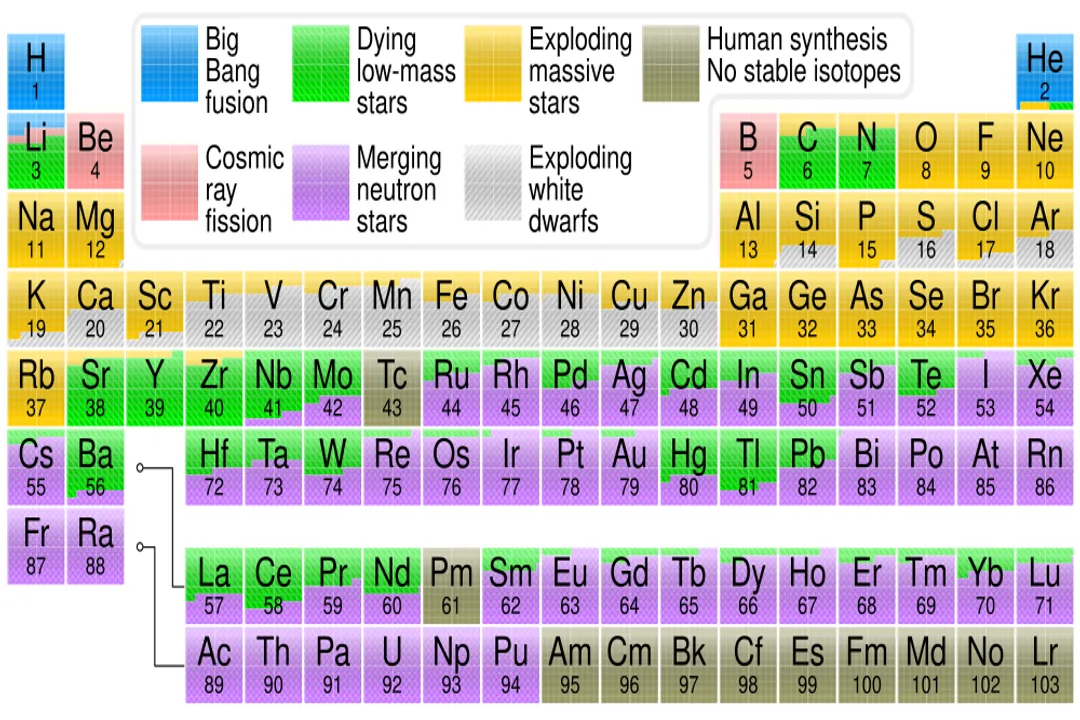
It is important to realize that the synthesis of elements heavier than helium—the creation of everything else we see on Earth, from the iron in our blood to the silicon in rocks—occurs after the star has burned through its initial hydrogen stock. [3][5] These heavier elements are forged in later, hotter stages of stellar evolution or are ejected into space when the star dies, perhaps as a supernova. [3][5]
This means that the very first stars in the universe, known as Population III stars, would have been composed almost exclusively of hydrogen and helium, as there were no prior generations to create heavier elements. [4] Every subsequent generation of stars inherits a slightly higher percentage of these "metals" from the interstellar medium enriched by those earlier deaths. When we look at stars in our current epoch, they contain trace metals because they formed from gas clouds that had already been processed by previous star lives. [5] However, the overwhelming initial component, the foundation upon which all this element creation rests, remains the hydrogen inherited from the Big Bang. [1]

# Composition Limits
While the rule is that all true stars contain hydrogen, the definition of containing it versus fusing it provides a subtle boundary. As mentioned, if an object falls short of the mass needed for sustained hydrogen fusion—roughly 0.08 solar masses—it becomes a brown dwarf, defined precisely by its failure to ignite that primary fuel source. [9] Thus, even brown dwarfs contain hydrogen, but they never achieve the core conditions necessary to consume it in a self-sustaining manner, distinguishing them from true main-sequence stars. [9]
An interesting aspect to consider when observing stars across the galaxy relates to where and when they formed. Stars born in the galactic halo, which are incredibly old, exhibit very low metallicity, meaning their composition is closer to the original primordial mix of pure hydrogen and helium. [5] Conversely, stars forming today in the spiral arms of the Milky Way have significantly higher trace element abundances. [5] This difference isn't because they started with less hydrogen—they all started with nearly the same vast reservoir—but because the percentage of the non-hydrogen portion has increased over cosmic time due to successive cycles of element creation and dispersal. [5] The hydrogen content, however, remains the fixed, dominant constant that defines the stellar object itself. [4]
Related Questions
#Citations
Why is the majority of the universe still hydrogen? Why hasn't it all ...
Star Basics - NASA Science
Stellar nucleosynthesis - Wikipedia
Why are all stars in our universe mostly made up of hydrogen and ...
Elemental Abundances | Center for Astrophysics | Harvard ...
The Elements: Forged in Stars | PBS LearningMedia
What are stars made of? - Cool Cosmos - Caltech
Are stars really made of hydrogen? - Facebook
Is it possible for stars to not begin fusing hydrogen at all?