What protoplanet crashed into Earth?
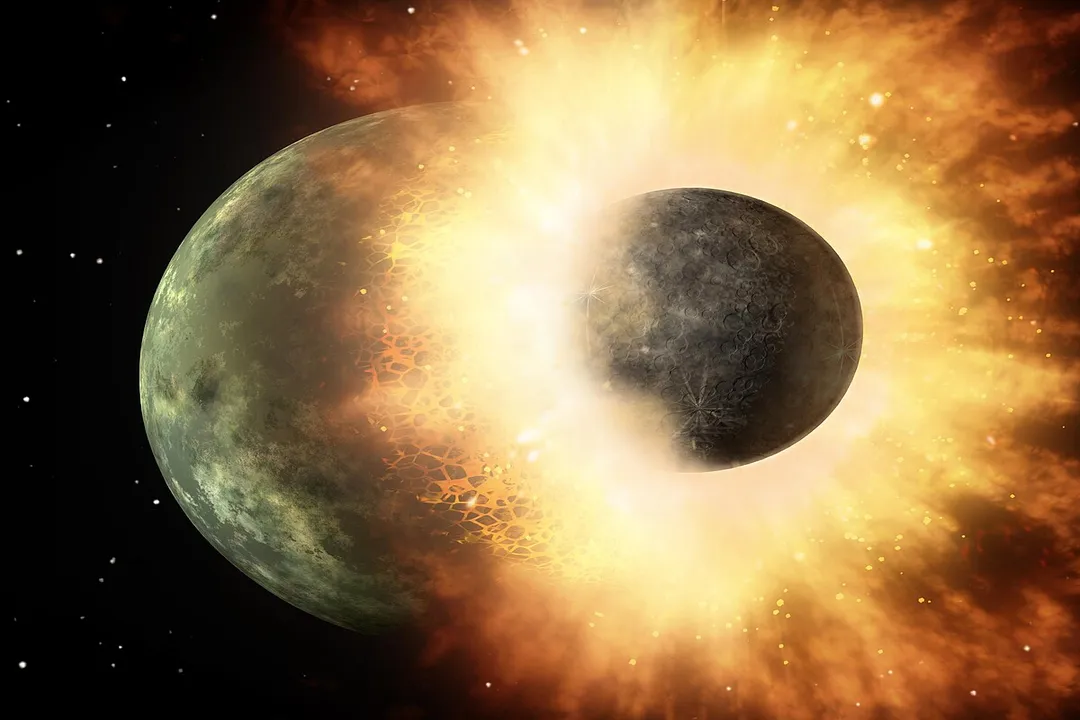
The formation of our Moon remains one of the most compelling and dramatic events in the history of the solar system, hinging on a colossal, ancient impact. This event involved a collision between the proto-Earth and another sizable celestial body, a smash-up that fundamentally shaped the planet we inhabit today. [4][8] The object responsible for this cataclysm is not a known planet but a hypothetical world hypothesized to explain the Moon's existence and composition. [1][8]
The leading scientific explanation for the Moon’s origin is known as the Giant Impact Hypothesis, which posits that a large, rocky protoplanet slammed into the early Earth. [4][8] This impact was violent enough to eject a vast cloud of vaporized rock and debris into orbit around the Earth, which subsequently cooled and accreted to form our lone natural satellite. [4][8] The identity of this impactor has been debated for decades, but naming conventions borrowed from mythology have settled on a single candidate.
# The Impactor Named
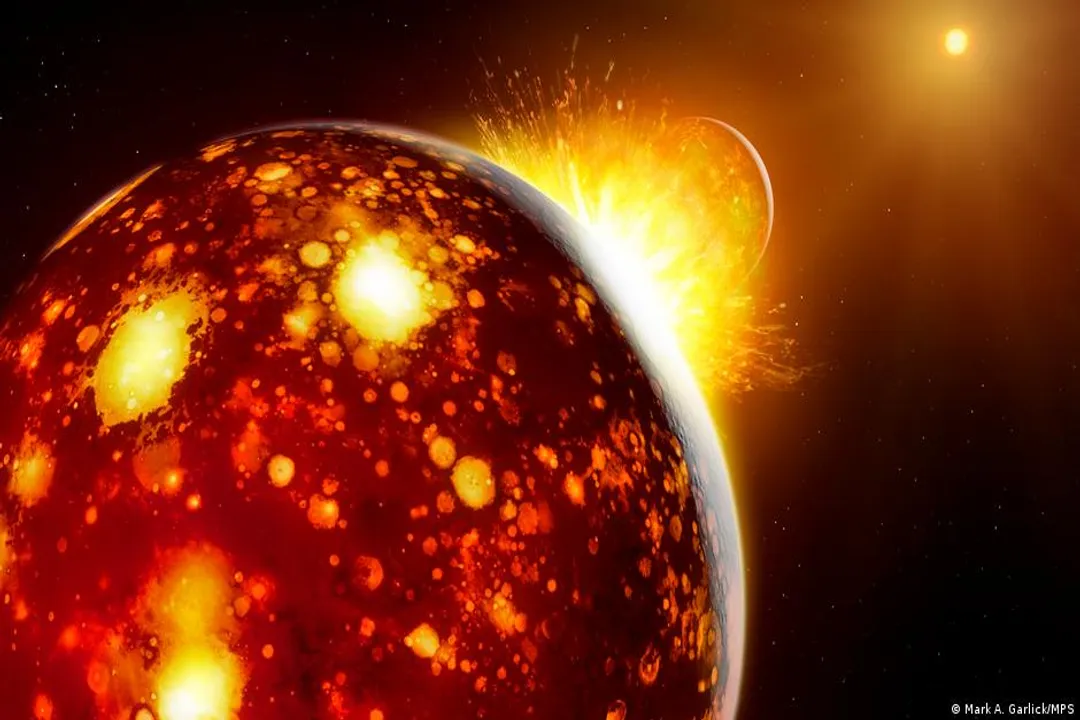
The hypothetical body that struck Earth has been given the name Theia. [1][5][8] This name is derived from Greek mythology, referencing the Titaness who was the mother of Selene, the goddess of the Moon. [1] While the theory relies on the existence of this body, Theia itself was never observed; it exists only in scientific models designed to recreate the aftermath of that critical collision. [8] The consensus surrounding Theia is strong because this scenario best explains the physical characteristics of the Moon, particularly its depleted iron core relative to Earth, and the nearly identical isotopic signatures shared between lunar and terrestrial rocks. [1][6]
# Mars Sized
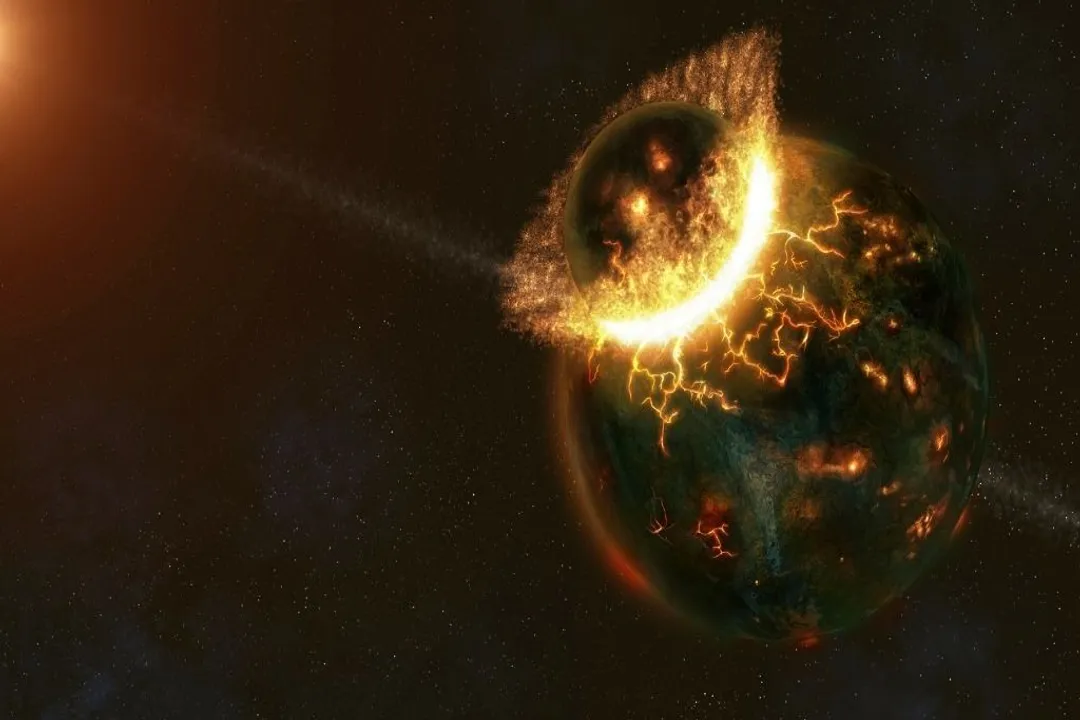
Scientists have estimated the size of Theia based on the amount of material needed to form the Moon and the necessary energy to cause such a large-scale mixing event. [4] Current models suggest Theia was comparable in size to Mars. [1][5] It was a substantial, fully formed protoplanet, not just a wandering asteroid. [8] Being roughly the size of Mars—a world significantly smaller than Earth—was necessary to account for the Moon's mass, which is approximately 1.2% of Earth's current mass. [4]
A Mars-sized impactor represents an almost unimaginable amount of kinetic energy delivered to the young Earth. To put this scale into perspective, if the Moon’s mass is about 1.2% of Earth’s, the physical transfer of mass and energy required to launch that much material into orbit means that a significant fraction of the Earth's own volume must have been vaporized and ejected during the process. The resulting planet, Earth after Theia, was a molten sphere completely unlike the world that existed before the collision. [9]
# Inner Solar System
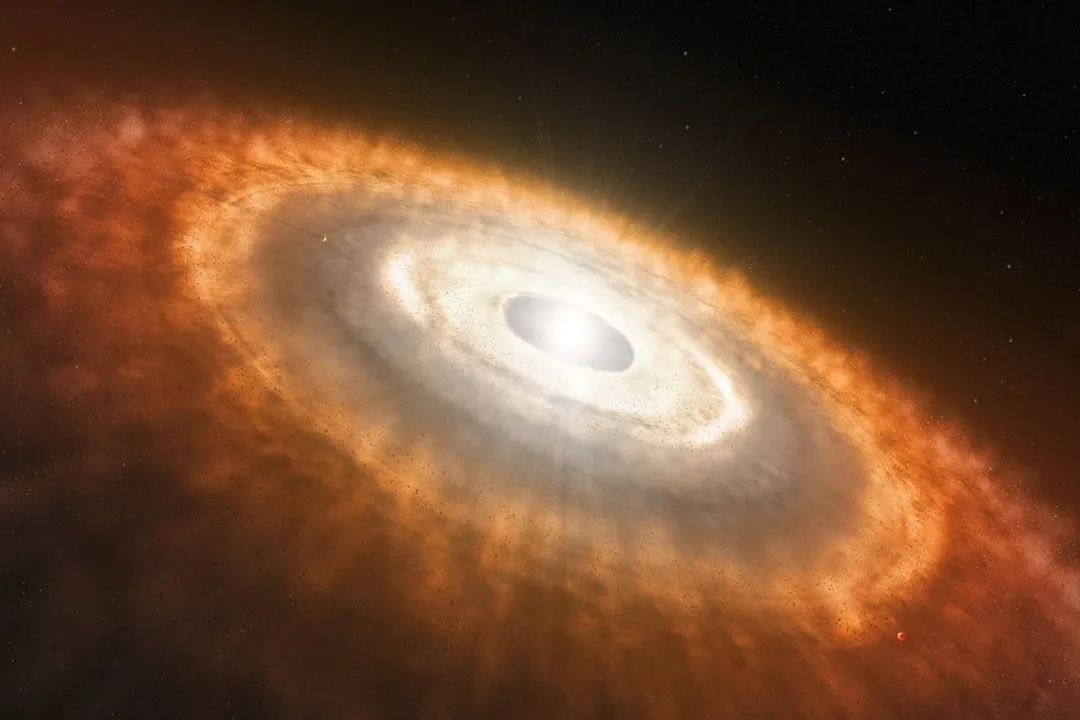
While the general parameters—a rocky body the size of Mars—have remained consistent in the theory, the specific trajectory and birthplace of Theia have seen refinement based on modern geochemical analysis. [5] Early theories were flexible regarding Theia’s origin, suggesting it could have formed in the outer solar system before being kicked inward, or perhaps formed in the same region as Earth. [5] However, newer research involving the isotopic composition of Earth’s mantle has placed tighter constraints on where Theia must have originated. [7]
Recent studies point toward Theia originating from the inner solar system. [5][7] This conclusion is largely based on the chemical fingerprints, specifically the isotopic ratios, found in Earth’s mantle rocks today. [7] If Theia had formed much farther out, its chemical signature would likely differ more significantly from Earth’s, especially concerning volatile elements. The relative similarity suggests Theia formed in a similar material environment to Earth, likely near the Sun’s current orbital path, making its collision with the proto-Earth a much more direct, internal solar system affair than previously supposed. [5]
# Moon Creation
The process of the Moon’s creation was swift following the initial impact. [4] The collision was not a direct head-on strike but rather a glancing blow. [4] This angle was important; a direct hit might have completely merged the two bodies without successfully ejecting enough material to form a satellite. [4]
The sheer force of the impact would have vaporized large portions of both the impacting body and Earth’s outer layers, sending a massive plume of molten and gaseous rock into orbit. [4][8] Over a relatively short period—perhaps only decades or centuries—this orbiting debris cooled, condensed, and gravitationally pulled itself together, forming the Moon. [4] The impact fundamentally altered Earth’s rotation rate and axial tilt, creating the dynamic environment that set the stage for later geological and, eventually, biological evolution. [9]
# Earth's Mantle
If a planet the size of Mars struck Earth, one might expect the resulting Earth-Theia hybrid to show clear chemical divisions between the original Earth material and the impactor’s remnants. [6] However, the isotopic chemistry of Earth’s rocks suggests an extremely thorough mixing occurred. This uniformity has posed a challenge to the Giant Impact Hypothesis because it implies that almost all of Theia's material was incorporated into the Earth, rather than just forming the Moon. [6]
One intriguing explanation for this deep mixing points to anomalies deep within the Earth's lower mantle. [6] Geologists have identified massive, irregularly shaped regions known as Large Low-Shear-Velocity Provinces (LLSVPs), situated beneath Africa and the Pacific Ocean. [6] These LLSVPs are chemically distinct from the surrounding mantle material. [6] An analysis suggests these strange formations might not just be unusual mantle plumes but could actually be the preserved, undigested remnants of Theia’s own core and lower mantle material, submerged deep inside Earth following the impact. [6] The existence of these two distinct blobs of material, one under Africa and one under the Pacific, actually provides a physical record of the merger, suggesting the mixing was not entirely homogeneous across the entire globe. [6] The fact that these massive structures remain distinct thousands of kilometers down is a testament to the sheer scale and violence of the collision, which was energetic enough to alter the planet but somehow left certain chunks of the intruder largely intact within the deep interior. [6]
# Life's Origin
The event that created the Moon was certainly cataclysmic, marking the end of the early solar system’s chaotic bombardment phase for our world. [9] While the destruction must have been near total for surface life as we know it, the subsequent conditions proved beneficial. [9] Some scientists suggest that this collision, which may have also provided Earth with much of its volatile elements or drastically changed its rotational dynamics, is directly linked to why life eventually managed to take hold and thrive here. [9] Without the immense kinetic energy transfer from Theia, Earth’s orbital mechanics, its axis tilt that creates seasons, and perhaps even the presence of water in stable forms, would all be vastly different, potentially precluding the rise of complex biology. [9] The impact was less an ending and more a necessary, violent genesis for the environment that allowed for our existence. [9]
#Videos
What was Theia like? - YouTube
Related Questions
#Citations
Theia (hypothetical planet) - Wikipedia
I was just reading up on the ancient Theia planet that supposedly ...
What was Theia like? - YouTube
Did you know? The leading theory for how #Earth got its moon is ...
The Lost Planet That Created the Moon Came from the Inner Solar ...
Hints of an Ancient Protoplanet Inside of Earth | American Scientist
An ancient planet smashed into Earth. We now know its origin - DW
Theia (planet) | Research Starters - EBSCO
Cataclysmic crash with neighboring planet may be the reason ...