What is the stellar evolution?
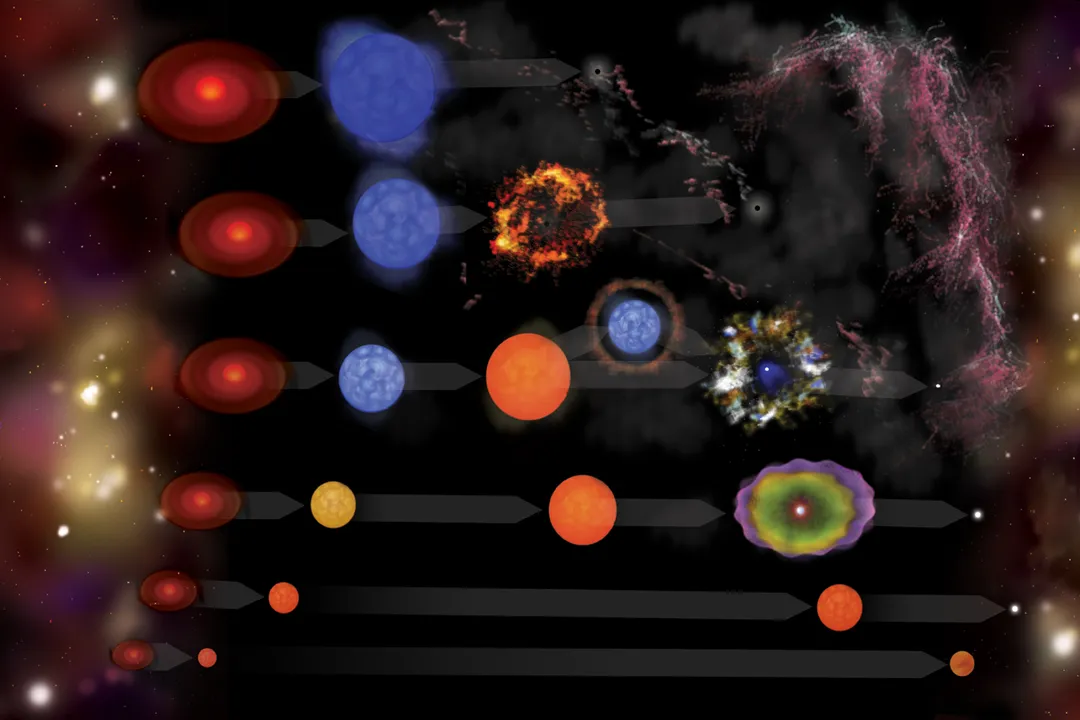
Stars appear unchanging to the naked eye, offering a reliable backdrop for navigation and mythology. However, this stability is an illusion born of the immense timescales involved. Beneath the surface, every star is engaged in a continuous, violent struggle between the inward pull of gravity and the outward pressure generated by nuclear fusion. [1][3] Stellar evolution is the term astronomers use to describe the life cycle of a star, from its humble beginnings in cold clouds of gas to its eventual death and transformation into something entirely different. [2][4]
# Cloud Collapse
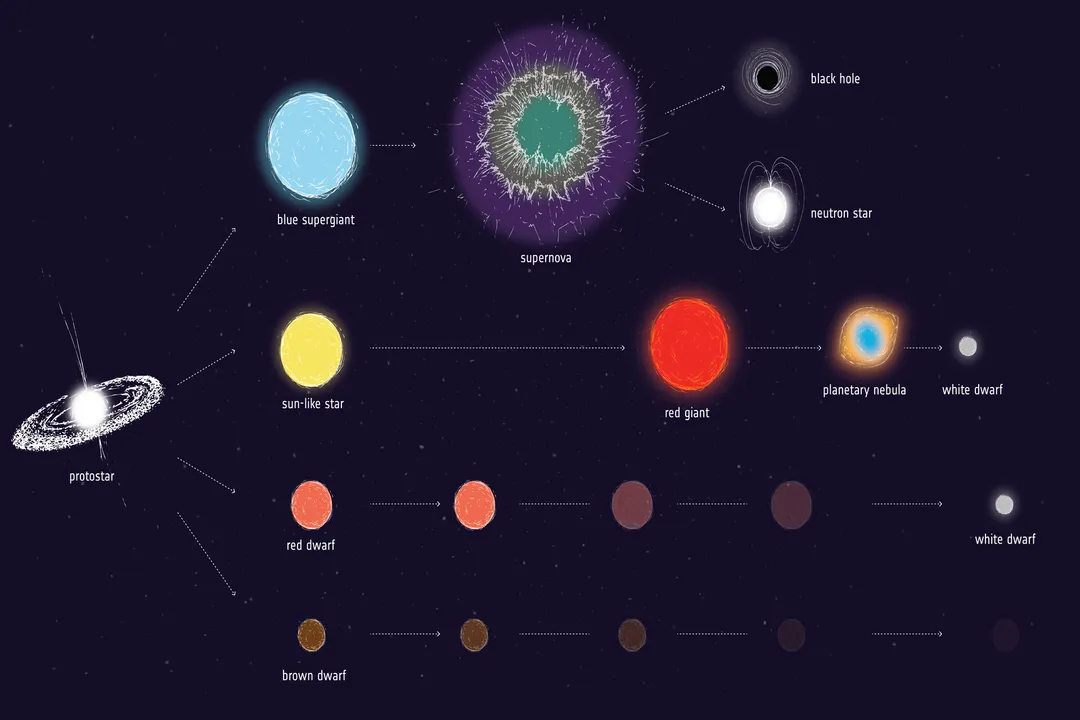
Every star begins inside a nebula—a vast, cold, and diffuse region of gas and interstellar dust. These clouds are mostly hydrogen, the simplest and most abundant element in the universe. Gravity acts as the architect here, pulling pockets of gas and dust inward. [5] As these pockets compress, they become denser and hotter, forming a protostar. [7]
During this early phase, the protostar is not yet a true star. It is shrouded in a cocoon of dust, glowing from the heat generated by gravitational contraction rather than nuclear reactions. As the core temperature climbs toward millions of degrees, the hydrogen atoms begin to overcome their natural repulsion, setting the stage for fusion. [6] When the core becomes hot and dense enough to sustain hydrogen fusion, the star enters the main sequence, the longest and most stable phase of its existence. [3]
# Main Sequence
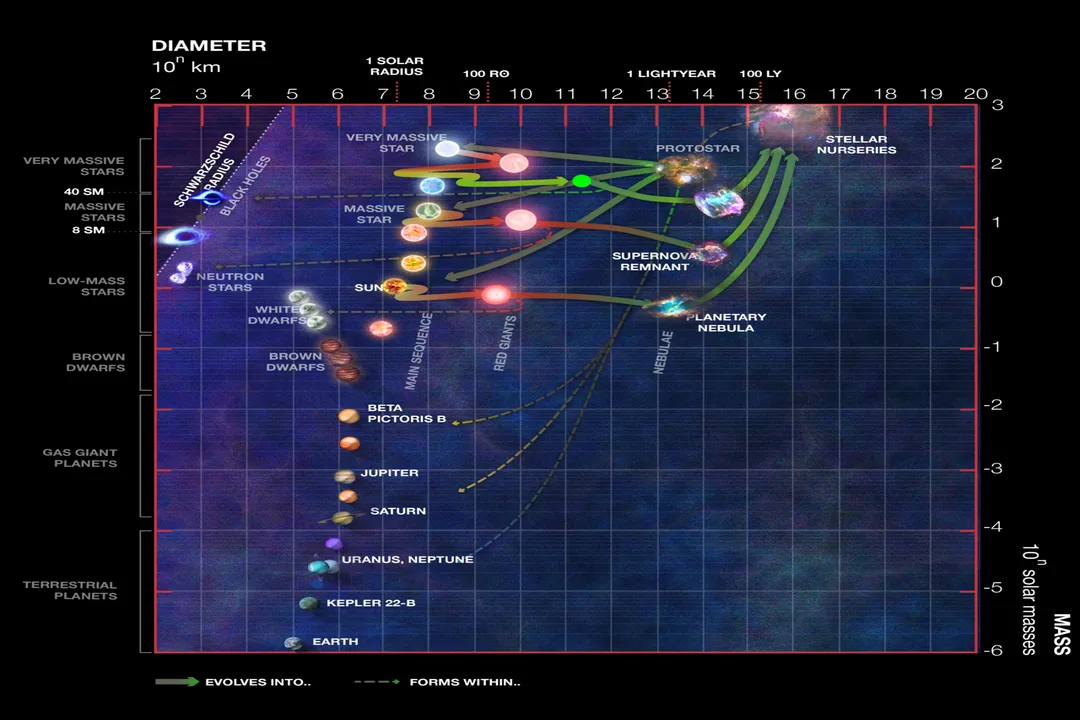
The main sequence is essentially the "adulthood" of a star. In this phase, the star finds a delicate balance known as hydrostatic equilibrium. [4] The energy released by fusion in the core pushes outward, perfectly counteracting the crushing inward weight of the star's own gravity. [5][7]
A star’s behavior on the main sequence is dictated almost entirely by its mass. The more massive a star, the more pressure it exerts on its core, and the faster it must burn its hydrogen fuel to maintain equilibrium. [3] This creates a counterintuitive reality in astronomy: the most massive, brightest stars are the ones that live the shortest lives, while small, dim stars can remain in this state for trillions of years. [6][7]
# Mass Effects
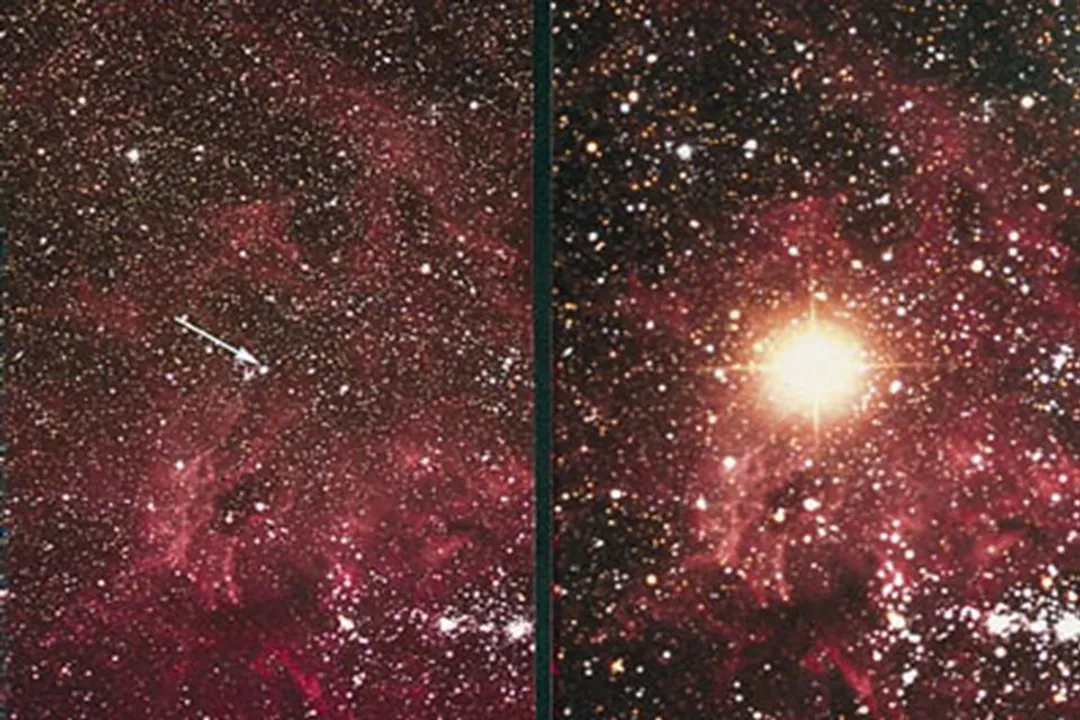
To understand stellar evolution, one must look at how initial mass determines the trajectory of a star. This differentiation is the primary driver of all subsequent changes. [1]
| Star Category | Mass (Relative to Sun) | Relative Lifespan | Primary End State |
|---|---|---|---|
| Red Dwarf | < 0.5 | Trillions of years | White Dwarf |
| Solar-type | ~1.0 | 10 Billion years | White Dwarf |
| Massive Star | > 8.0 | Millions of years | Neutron Star/Black Hole |
Note: Lifespans vary based on chemical composition, but mass remains the dominant variable.
Looking at this, one can derive a useful perspective on "cosmic fuel economy." Think of a massive star like a high-performance sports car with a massive engine; it possesses significant fuel reserves but consumes them at such a rapid, inefficient rate that it runs dry almost immediately. Conversely, a low-mass red dwarf is like an ultra-efficient subcompact car, sipping its hydrogen fuel so slowly that it remains on the road long after the more glamorous stars have burned out. This is why we have yet to observe any red dwarf stars dying; the universe is simply not old enough for them to have exhausted their supply. [2]
# Red Giants
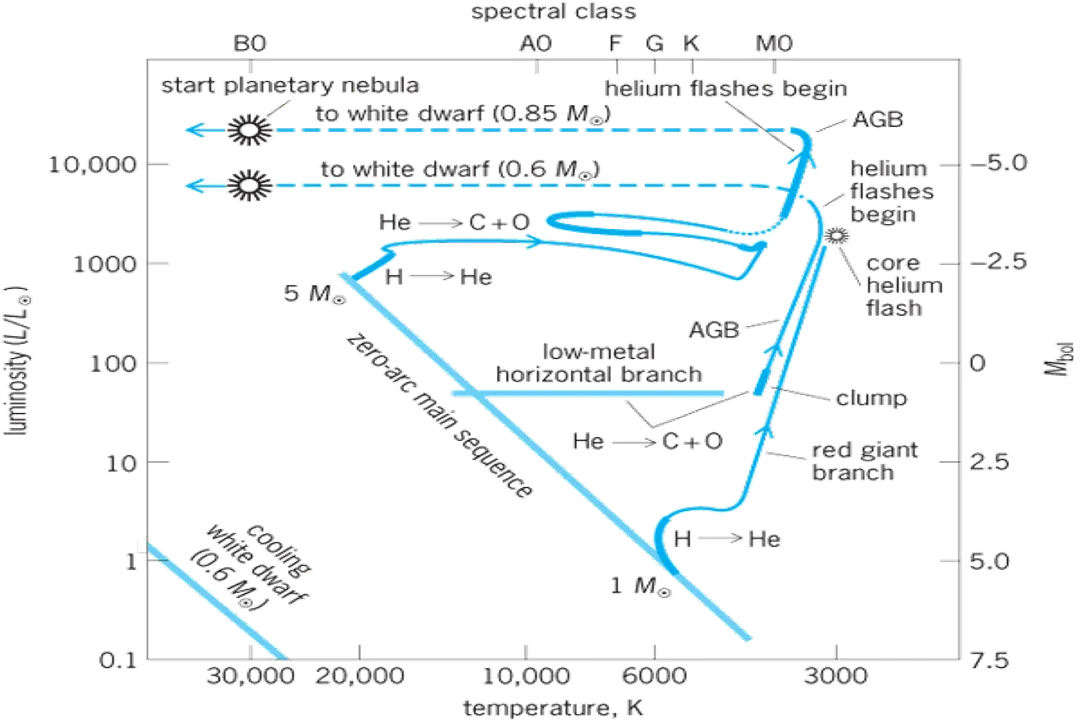
When a star runs out of hydrogen in its core, the equilibrium is shattered. [5] Gravity gains the upper hand, crushing the core further. This contraction generates enough heat to ignite hydrogen fusion in a shell surrounding the core. [3]
As the core shrinks, the outer layers of the star expand and cool, turning the star into a red giant or supergiant. [4] The star grows significantly in size, often engulfing nearby planets. For a star like our Sun, this phase will eventually lead to the shedding of its outer layers, creating a beautiful, glowing shell known as a planetary nebula. [7] The core remains behind, shrinking into a white dwarf—a dense, hot object about the size of Earth but with the mass of a star. [1][6]
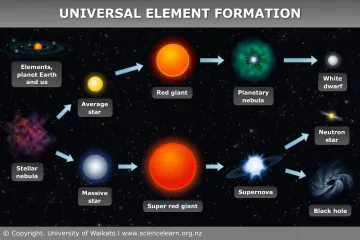
# Supernova Events
The death of a massive star is significantly more dramatic. When these giants exhaust their hydrogen, they do not stop at fusing helium. Their gravity is so intense that they continue to crush the core, allowing them to fuse heavier and heavier elements: carbon, neon, oxygen, silicon, and finally iron. [4]
Once iron is formed, the star is in trouble. Fusing iron consumes energy rather than releasing it, meaning the outward pressure vanishes instantly. [5] In a fraction of a second, the core collapses, and the outer layers rebound, resulting in a supernova—an explosion so violent it can briefly outshine an entire galaxy. [3] This event scatters heavy elements back into space, enriching the surrounding interstellar medium and providing the raw materials for future generations of stars and planets. [8][9]
# Final Remnants
After the dust settles from a supernova, only the core remains. If the original star was massive enough, this remnant is not a white dwarf. Instead, the core collapses further until protons and electrons are crushed together to form a neutron star—an object so dense that a teaspoon of its material would weigh billions of tons. [6]
If the core is even more massive, not even the density of neutrons can stop the collapse. Gravity wins completely, shrinking the core into a point of infinite density: a black hole. [1][10] This is the absolute conclusion for the most massive stars in the cosmos. These objects defy conventional physics, creating regions where gravity is so strong that not even light can escape.
The cycle of stellar evolution is not just a process of destruction; it is a process of recycling. The gas clouds that formed the first stars were made of hydrogen and helium. The stars that died enriched the universe with carbon, nitrogen, oxygen, and iron. Every atom of iron in our blood or calcium in our bones was manufactured in the cores of stars that lived and died long before our solar system formed. We are, in a very literal sense, composed of the leftovers of stellar evolution. [2][4]
#Videos
What Is Stellar Evolution? | Facts About The Lifecycles of ...
Related Questions
#Citations
Stellar evolution
Stellar Evolution
Stellar Evolution
Stellar Evolution | COSMOS
Stellar Evolution
Stellar evolution
Stellar Evolution - University of Michigan [umich.edu]
What Is Stellar Evolution? | Facts About The Lifecycles of ...
ESA - Stellar evolution
Chandra :: Multimedia :: Stellar Evolution Activity