What is a theoretical stellar remnant?
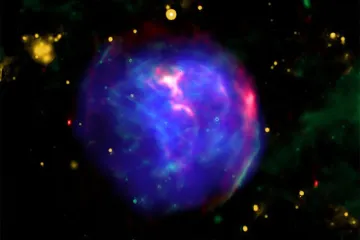
When a star reaches the end of its life, it ceases to be an active engine of nuclear fusion. The light fades, the heat dissipates, and what remains is a physical object known as a stellar remnant. [2][4] These objects represent the final stage of stellar evolution, where the gravitational force that once struggled against the outward pressure of fusion finally dictates the structure of the remaining core. [5][9] In this state, a star no longer generates energy through nuclear reactions, meaning its properties are defined entirely by its mass and the quantum mechanical forces that prevent total collapse. [3]
# Star Death
The life of a star is a constant tug-of-war between gravity pulling inward and the outward force of thermal pressure generated by nuclear fusion. [9] As long as a star has fuel to burn, it remains stable. However, once the hydrogen is consumed, the star moves on to fusing heavier elements until it hits an iron core, at which point fusion can no longer provide the necessary outward pressure. [5]
The specific fate of the star depends almost entirely on its initial mass. [2] Stars with a mass similar to our Sun will shed their outer layers, creating a planetary nebula, while the core remains behind. [5] More massive stars experience cataclysmic supernova explosions, leaving behind an incredibly dense, compact object. [8][9] The remnant is the "corpse" of the star, a high-density environment where standard chemistry and biology are impossible, and only the laws of extreme physics apply. [2]
# Remnant Types
Stellar remnants are categorized by their final mass and the mechanism that keeps them from collapsing into a singularity. The three primary types are white dwarfs, neutron stars, and black holes. [2][5]
- White Dwarfs: These form from low-to-medium mass stars like the Sun. [5] They are about the size of Earth but contain the mass of a star, making them incredibly dense. [2] They are supported against gravity by electron degeneracy pressure. [9]
- Neutron Stars: When a high-mass star collapses, the core is crushed so intensely that protons and electrons merge into neutrons. [5][8] These are about the size of a city but contain more mass than the Sun. [2] They are supported by neutron degeneracy pressure. [9]
- Black Holes: If the remaining core mass exceeds a certain threshold, even neutron degeneracy pressure fails. [9] The core collapses indefinitely, creating a region where gravity is so strong that not even light can escape. [5]
# Degeneracy Pressure
One of the most fascinating aspects of stellar remnants is the reliance on quantum mechanics. Standard matter, like the gas in our atmosphere or the solid ground beneath us, is held up by thermal pressure or electromagnetic repulsion. [5] Inside a stellar remnant, however, these forces are insufficient.
Instead, objects like white dwarfs and neutron stars rely on the Pauli Exclusion Principle. [9] This principle states that two fermions (particles like electrons or neutrons) cannot occupy the same quantum state simultaneously. [5] When gravity tries to squeeze these particles closer together than allowed, the particles exert a "degeneracy pressure" that stops the collapse. [9] This creates an incredibly stable, albeit high-density, configuration. For a white dwarf, this limit is the Chandrasekhar limit, approximately 1.4 times the mass of the Sun. [5][9] If a white dwarf gains more mass and crosses this limit, it will continue to collapse into a neutron star or a black hole. [5]
| Remnant Type | Typical Mass | Supporting Mechanism | Density Level |
|---|---|---|---|
| White Dwarf | < 1.4 Solar Masses | Electron Degeneracy | High |
| Neutron Star | 1.4 to ~3 Solar Masses | Neutron Degeneracy | Extreme |
| Black Hole | > 3 Solar Masses | Gravity (Singularity) | Infinite (theoretical) |
# Density Comparisons
To visualize the density of these remnants, consider that a single teaspoon of white dwarf material would weigh as much as an elephant on Earth. [2] This pales in comparison to a neutron star; a teaspoon of neutron star material would have a mass equivalent to a mountain, likely exceeding billions of tons. [5] This extreme packing of matter means that the physics observed in these remnants cannot be replicated in any laboratory environment on Earth, making them natural laboratories for high-energy astrophysics. [8]
# Theoretical Evolution
While we classify these objects into three distinct types, the line between them is often a matter of mass and ongoing environmental factors. For example, a white dwarf in a binary system might siphon material from its companion star. [5] If it accumulates enough mass to push past the stability threshold, it may trigger a Type Ia supernova or collapse into a neutron star. [5][7]
The concept of a stellar remnant is therefore not static. It represents a state of equilibrium, but that equilibrium can be fragile. Understanding how these objects behave involves modeling the equation of state for matter at nuclear densities—a task that remains a significant area of research in theoretical physics. [7] We use these models to predict how stars evolve, and observations of remnants like pulsars (a type of rapidly spinning neutron star) confirm that the theory aligns with the actual mechanics of the universe. [5][9]
# Observational Reality
Identifying these remnants is difficult because they are often faint or dark. White dwarfs are small and dim, making them hard to spot against the backdrop of brighter, active stars. [2] Neutron stars are frequently observed as pulsars because they emit beams of radiation that sweep past Earth like a lighthouse. [5][9] Black holes are detected indirectly, usually by observing the influence of their gravity on nearby stars or by the radiation emitted by matter falling toward their event horizon. [5]
The study of these remnants provides a history of the universe's stellar population. By calculating the number of remnants in a given region, researchers can estimate how many stars have lived and died in that sector over billions of years. [5] It creates a statistical picture of galactic development, showing that while stars may fade, their dense cores remain as long-term witnesses to the history of their home galaxies. [9]
#Videos
An introduction to stellar remnants (ASTR 1000) - YouTube
Related Questions
#Citations
A Review of Stellar Remnants: Physics, Evolution, and Interpretation
Stellar Remnants | Types & Examples - Study.com
Glossary term: Stellar Remnants
Stellar Remnant: Intro to Astronomy Study Guide | Fiveable
Stellar Remnants: Neutron Stars and Black Holes
An introduction to stellar remnants (ASTR 1000) - YouTube
[PDF] Stellar, Remnant, Planetary, and Dark-Object Masses from ...
Stellar Remnants - an overview | ScienceDirect Topics
[PDF] Lecture 10: Stellar remnants