What is an irregular galaxy?
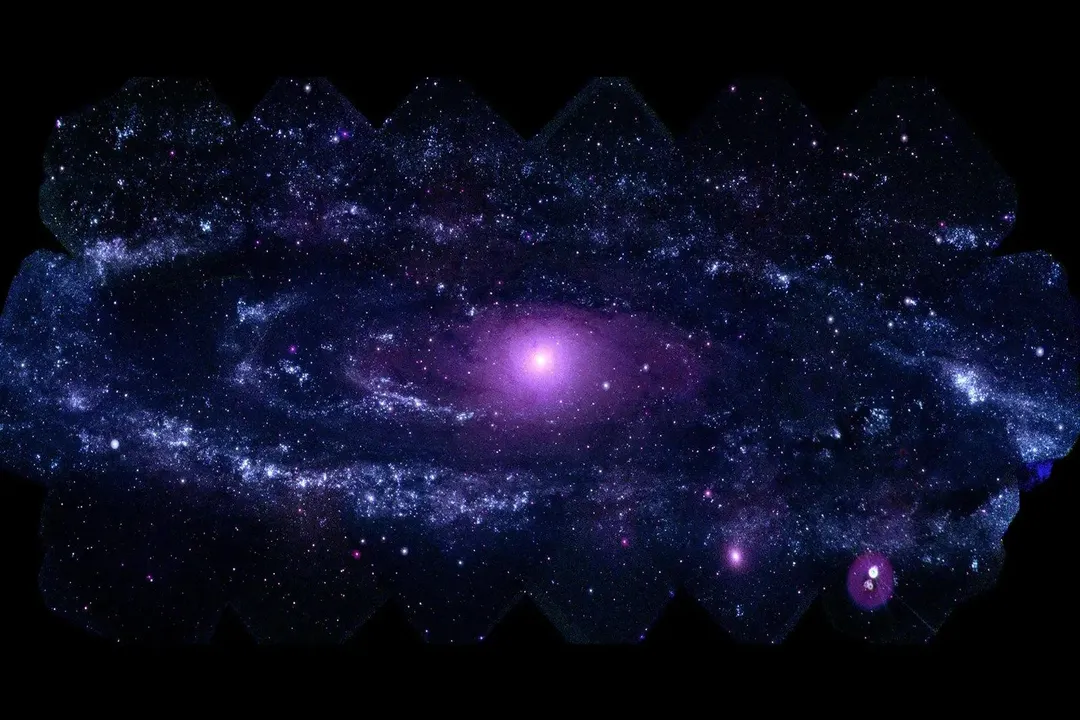
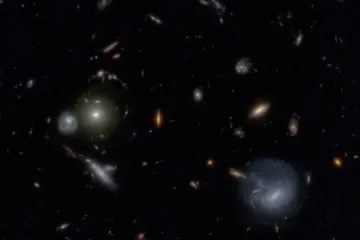
When looking at deep-space imagery, the most famous galaxies often share a certain visual elegance. Spiral galaxies show off perfectly symmetrical arms, and elliptical galaxies appear as smooth, glowing orbs. However, a significant portion of the universe consists of galaxies that do not conform to these tidy structures. [1][3] These are the irregular galaxies. They appear as chaotic, amorphous, or misshapen clouds of gas and stars, lacking the defined symmetry or organized features seen in their larger counterparts. [2][6]
These galaxies represent about 20 to 25 percent of the galaxy population. [1] Because they do not fit into the standard morphological classification systems designed in the early 20th century, they were initially viewed as simple "misfits." Today, astronomers recognize them as active, dynamic environments that offer critical insights into how stars are born and how galaxies interact with their surroundings. [6]
# Definition
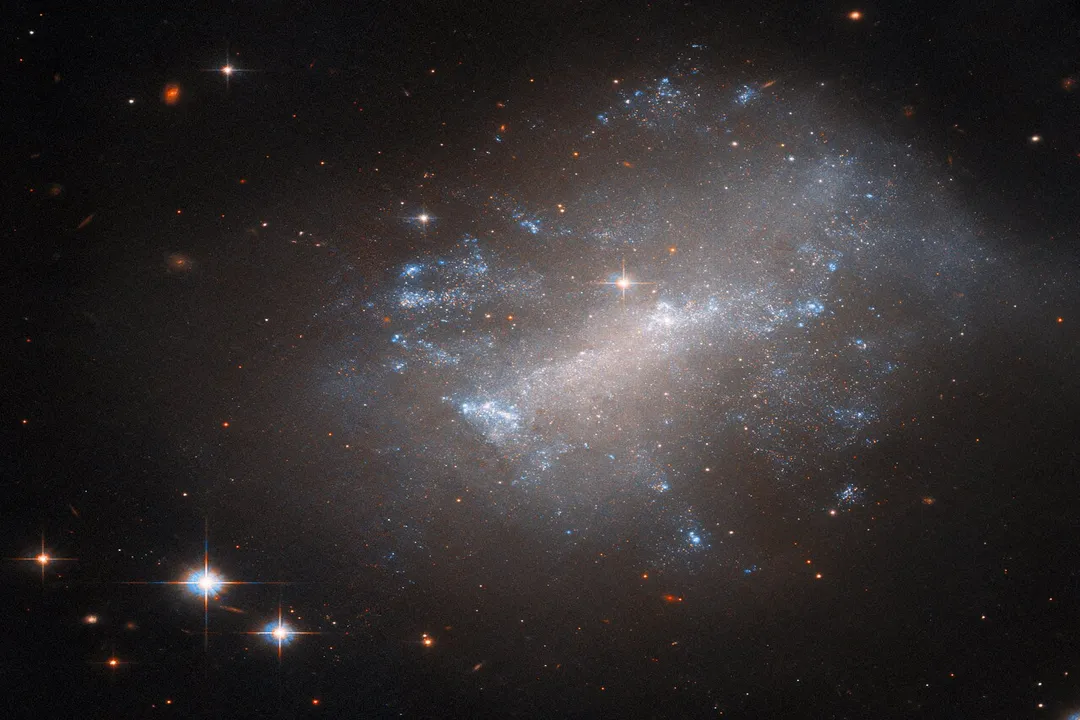
An irregular galaxy is essentially defined by what it lacks: a coherent structure such as a spiral disk or a distinct elliptical core. [1][6] Unlike the Milky Way, which follows a predictable pattern of rotation, irregular galaxies often appear disorganized and asymmetrical. They do not have a central bulge, nor do they possess a clear pattern of rotating arms. [2][10]
Their visual appearance can range from being somewhat organized—where faint traces of structure might exist—to appearing completely shattered and random. [1] This lack of shape is the primary identifying feature. While spiral galaxies might appear somewhat irregular due to orientation, true irregular galaxies remain messy even when viewed from any angle. [3]
# Classification
Because these galaxies vary wildly in appearance, astronomers often divide them into specific categories to better study their properties. The classification system generally splits them based on how much structure they retain or how distorted they appear. [7]
- Irr I (Irregular Type I): These galaxies show some small amount of structure, such as faint traces of spiral arms or a disk, but they are not organized enough to be fully classified as spirals. [1][7] They often contain many bright, young stars and large clouds of gas and dust.
- Irr II (Irregular Type II): These are the truly chaotic ones. They show absolutely no discernible symmetry or structural pattern. [1] Their appearance is often the result of significant gravitational distortion or collisions. [6]
- dIrr (Dwarf Irregular): Many irregular galaxies are also "dwarf" galaxies, meaning they are much smaller than the Milky Way. These are very common in the universe and are often responsible for much of the observed irregular morphology. [1][7]
This classification is not necessarily permanent. A galaxy might evolve from one type to another based on its interactions with nearby massive galaxies. [6]
# Formation
The shape of a galaxy is rarely static. The existence of irregular galaxies is frequently tied to external forces, particularly gravity. When two galaxies pass close to one another, the gravitational tidal forces can pull stars and gas out of their original orbits, warping their shapes. [1][6]
If a smaller galaxy is pulled into the gravitational field of a much larger one, it may not be destroyed immediately. Instead, it gets stretched, torn, and deformed. This process turns a once-orderly system into a chaotic irregular galaxy. [3] In some cases, these galaxies are the remnants of collisions that have not yet settled into a new, stable shape.
In other instances, irregular galaxies may have simply been born this way. Some galaxies never develop the density or rotational speed required to flatten into a disk, and if they lack the mass to form a stable elliptical shape, they remain in a persistent state of disorganization. [6]
# Star Formation
One of the most striking characteristics of irregular galaxies is their rate of star formation. Because they are often rich in gas and dust, they act as massive nurseries for new stars. [1][6]
In a mature spiral galaxy, much of the gas has already been converted into stars, or the distribution is controlled by the galaxy's rotation. In irregular galaxies, the lack of central organization means gas can be compressed in unpredictable ways. When a galaxy is distorted by gravity, the gas clouds collide and collapse more frequently, triggering intense bursts of star formation. [6] These areas, known as H II regions, glow brilliantly. Consequently, irregular galaxies often appear bluer than elliptical galaxies, as they are populated by hot, young, short-lived stars rather than older, cooler, reddish stars. [8]
# Comparison
Understanding how irregular galaxies differ from the more "standard" galactic types is easier when viewing their traits side by side.
| Feature | Spiral Galaxy | Elliptical Galaxy | Irregular Galaxy |
|---|---|---|---|
| Shape | Flattened disk with arms | Rounded or elongated | Amorphous, chaotic |
| Star Age | Mixed (young and old) | Mostly old | Mostly young |
| Gas Content | High | Low | Very High |
| Star Formation | Ongoing | Minimal | Intense |
| Symmetry | High | High | Low or None |
This table highlights why irregular galaxies are so scientifically valuable. While elliptical galaxies are often described as "red and dead" due to their lack of active star creation, irregular galaxies are "blue and busy," providing a living laboratory for studying stellar evolution in real-time. [8]
# Notable Examples
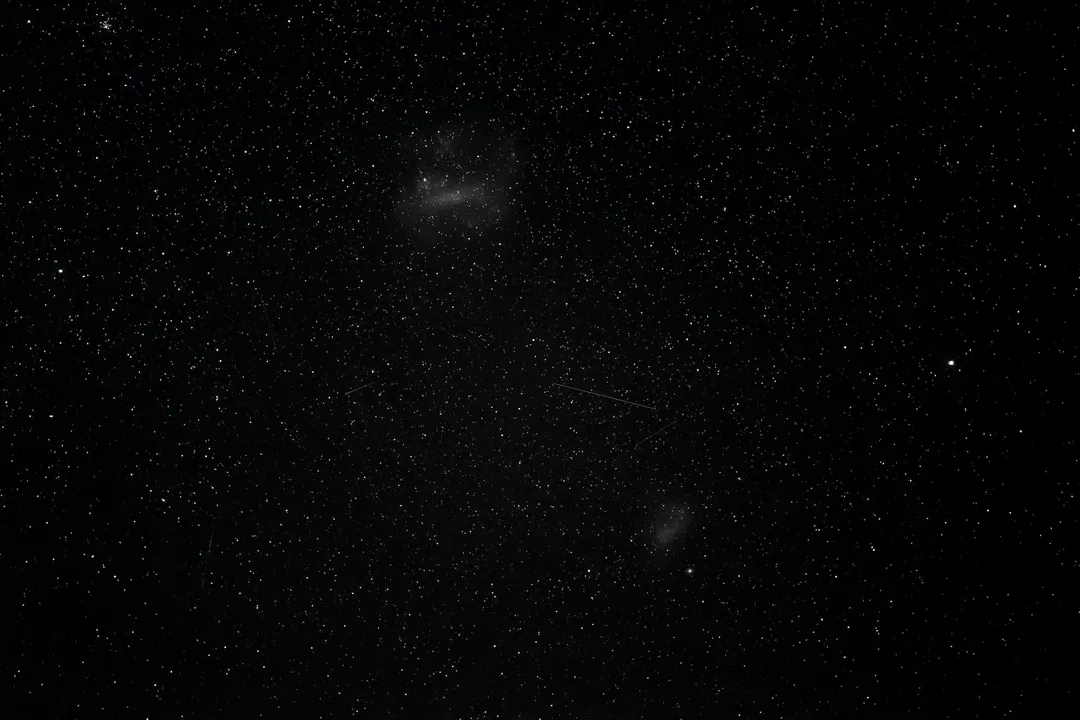
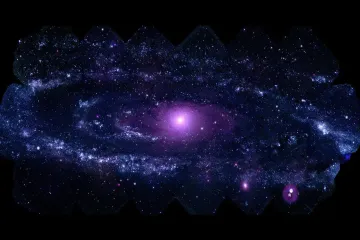
Perhaps the most famous irregular galaxies are the Magellanic Clouds—the Large Magellanic Cloud (LMC) and the Small Magellanic Cloud (SMC). These are satellite galaxies that orbit the Milky Way and are visible to the naked eye from the Southern Hemisphere. [1][2]
These two galaxies have been heavily influenced by the gravitational pull of the Milky Way. The "Magellanic Stream," a long trail of gas stripped from these galaxies, is a direct result of their interaction with our own galaxy. [6] The LMC and SMC serve as primary case studies for astronomers to understand how tidal stripping works and how dwarf galaxies interact with their larger hosts. [4]
# Observational Tips
For amateur astronomers interested in observing these objects, the challenge is that they often appear faint and diffuse. Unlike the distinct arms of a spiral galaxy, an irregular galaxy often looks like a subtle, smudge-like patch of light in the eyepiece. [2]
- Location: Start with the Large and Small Magellanic Clouds if you are in the Southern Hemisphere. They are bright and easy to spot.
- Equipment: A telescope with a wide field of view is better than high magnification. Irregular galaxies are often spread out; high power will only reveal a blurry, unhelpful view.
- Conditions: Use a dark-sky site. Because these galaxies often have low surface brightness, light pollution will wash them out much faster than it would a compact planetary nebula or a bright star cluster.
- Avoid over-focusing: Do not expect to see "arms" or "bulges." Look for variations in brightness across the cloud. Those variations often indicate pockets of gas or clusters of young, blue stars, which are the defining traits of an irregular galaxy.
# Scientific Value
Why should we care about galaxies that seem to lack the "proper" design? Irregular galaxies provide essential clues about the history of the universe. They are the leftovers of galactic formation and the victims of galactic "cannibalism," where larger galaxies consume smaller ones. [6]
By studying the composition of irregular galaxies, scientists can determine the chemical makeup of the universe at different stages. Because these galaxies are active star-producers, the light they emit contains signatures of the chemical elements being forged in their hot, young stars. [1][6] They act as a snapshot of cosmic evolution, showing what happens when gravity dictates the shape of a galaxy rather than the smooth, stabilizing forces that create the orderly spirals we see elsewhere.
They also challenge the idea that galaxies have a fixed lifecycle. The existence of irregulars suggests that galaxies are fluid entities, capable of changing shape, size, and classification over billions of years. They serve as a reminder that the universe is not just a collection of static objects, but a dynamic, changing system where the only constant is the gravitational pull shaping the chaos into new structures. [8]
#Videos
What is an Irregular Galaxy? - YouTube
Related Questions
#Citations
Irregular galaxy - Wikipedia
What is an irregular galaxy? - Cool Cosmos - Caltech
Galaxy Types - NASA Science
A dishevelled irregular galaxy - ESA/Hubble
What is an Irregular Galaxy? - YouTube
Formation and Types of Irregular Galaxies - ThoughtCo
Irregular Galaxies
A Little Strange: Facts About Irregular Galaxies - Revolutionized
What's the difference between an irregular galaxy and a peculiar ...
IRREGULAR GALAXY Definition & Meaning - Dictionary.com