What is Amazon rocket company?
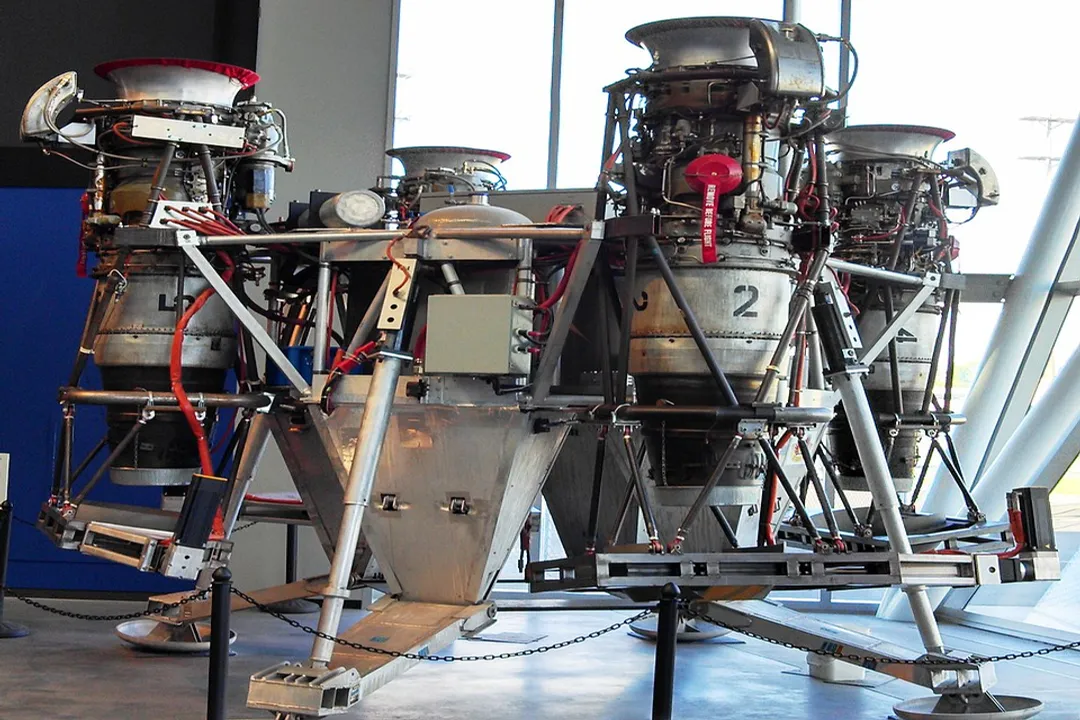
The organization commonly referred to as the "Amazon rocket company" is Blue Origin, a private American space technology firm founded by Amazon multibillionaire Jeff Bezos. Established on September 8, 2000, the company initially operated with an extremely low public profile, financed by Bezos's personal investments. Its headquarters are situated in Kent, Washington, though its operational footprint spans multiple states. Blue Origin operates under the guiding principle of working For The Benefit of Earth. [2]
# Company Beginnings
The early years of Blue Origin were shrouded in relative secrecy, a notable contrast to the public nature of some of its contemporary aerospace ventures. Its genesis was purely Bezos-funded, with a significant marker occurring in 2006 when the company purchased land north of Van Horn, Texas, to establish Launch Site One for its suborbital missions. Early hardware testing began with vehicles like Charon in 2005, which tested autonomous guidance using jet engines before moving to rocket-powered development vehicles like Goddard.
The path to orbit was always planned as an incremental progression, building upon the success of its suborbital work. This measured approach saw the company develop a suite of engines, from the early BE-1 and BE-2 prototypes to the more advanced BE-3 family, culminating in the public unveiling of its orbital vehicle intentions in 2015 and the subsequent naming of the heavy-lift rocket, New Glenn, in 2016. The dedication of capital is substantial; by 2017, it was reported that Bezos was channeling approximately $1 billion annually from Amazon stock sales into the company, underscoring the long-term financial commitment required for these endeavors. As of 2023, the company had secured "billions of dollars in orders" alongside hundreds of millions in revenue.
# Suborbital Flights
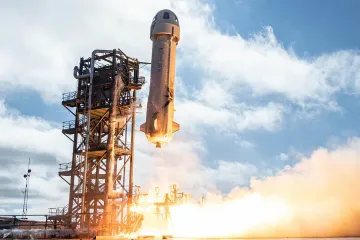
The company’s first operational system is the New Shepard vehicle, named after the first American in space, Alan Shepard. This rocket system is specifically designed for suborbital space tourism and customer payloads. New Shepard is engineered for complete reusability, featuring a capsule that carries up to six passengers or cargo to the conventional edge of space—the Kármán line at 100 kilometers altitude—and a booster that performs a vertical takeoff and landing (VTVL) back at its Texas launch site.
The booster is powered by a single BE-3PM engine, which produces about 490 kilonewtons of thrust at takeoff and is capable of throttling down significantly to enable controlled landings. Following its first uncrewed landing milestone in 2015, the company achieved its first crewed flight, NS-16, on July 20, 2021, which carried Jeff Bezos himself across the Kármán line. The New Shepard program has continued with numerous crewed and uncrewed missions, experiencing a set-back with an uncrewed flight failure in September 2022 (NS-23) due to a thermal-structural issue in the BE-3 nozzle, but successfully returned to flight by late 2023. For passengers, the experience offers a few minutes of weightlessness before the capsule returns via parachutes.
One interesting observation about Blue Origin's development history is the clear demarcation between their two main vehicle lines. The New Shepard program progressed step-by-step, testing engine variants (like the BE-3) and operational concepts (like VTVL and in-flight aborts) in a relatively controlled, high-cadence manner. This iterative experience likely served as a crucial, low-stakes proving ground that informed the massive engineering leap required for the orbital New Glenn vehicle, a transition that appears less incremental than the development path taken by some competitors.
# Orbital Launch
To compete in the orbital launch market, Blue Origin developed the New Glenn vehicle, a heavy-lift launch vehicle named in honor of astronaut John Glenn. Design work for New Glenn commenced around 2012, and its initial configuration illustrations were released in 2016. A defining feature of this rocket is its sheer size and power, boasting a 7-meter (23-foot) diameter and a first stage powered by seven BE-4 engines. The payload fairing is touted as having twice the volume of any commercial launch system.
The path to its first launch was marked by delays, but on January 16, 2025, Blue Origin successfully launched New Glenn into orbit from Launch Complex 36 (LC-36) at the Cape Canaveral Space Force Station. The initial mission deployed the Blue Ring Pathfinder test satellite. True to the company’s reusability focus, the first stage booster successfully landed on a dedicated drone ship, the Jacklyn, in the Atlantic Ocean following the launch. The vehicle is designed to be fully reusable in its first stage, with conceptual work underway to potentially make the second stage reusable as well, under the codename "Project Jarvis". New Glenn has also secured crucial government business, winning National Security Space Launch (NSSL) contracts. In November 2025, it performed its first NASA mission, launching the ESCAPADE science satellites to study Mars' atmosphere.
# Engine Manufacturing
Blue Origin is not just a launch provider; it is a key supplier of advanced rocket propulsion, which is fundamental to both its own vehicles and the broader American launch industry. The company manufactures several engine types at its Blue Engine facility in Huntsville, Alabama.
The most commercially significant engine is the BE-4, a powerful engine utilizing liquid oxygen and liquified natural gas (LOX/LNG) that generates 2,400 kilonewtons of thrust. The success of the BE-4 is central to Blue Origin's business structure. It powers the first stage of the New Glenn vehicle, and critically, it is the main engine for United Launch Alliance's (ULA) Vulcan Centaur rocket, replacing older Russian-made RD-180 engines. ULA performed a successful Flight Readiness Firing of the Vulcan Centaur using two BE-4s in June 2023. The delivery of the first BE-4 engines to ULA in 2022 marked a major industrial milestone. The BE-3 family of engines powers the New Shepard system.
Having an engine line that supports external customers like ULA provides a stabilizing commercial revenue stream that helps fund the capital-intensive development of their own two-stage rockets like New Glenn. This dual role as both competitor and supplier—offering the BE-4 to customers who also fly on competitor rockets—is a complex market position that offers significant revenue diversification.
# Lunar Presence
The company’s vision extends well beyond Earth orbit, encompassing deep space objectives, most notably through the Blue Moon lunar lander program. Blue Origin first unveiled plans for this crew-capable lander in May 2019. The lander is designed for soft landings, capable of delivering up to 3,600 kilograms to the lunar surface in its standard configuration, with a stretched variant able to carry 6,500 kilograms.
Blue Moon is designed to be powered by the BE-7 engine, a liquid oxygen/liquid hydrogen engine currently under development. After an initial contract loss to SpaceX for NASA’s Human Landing System (HLS) for early Artemis missions, Blue Origin secured a separate, major contract in May 2023. This $3.4 billion contract tasks the company with developing and deploying the Blue Moon landing system for the Artemis V mission, which includes an uncrewed test followed by a crewed Moon landing anticipated for 2029. The company is also exploring the use of propellants that could potentially be manufactured on the Moon, an ambitious goal tied to their Blue Alchemist project, which aims to produce solar cells from lunar regolith.
# Expanding Infrastructure
Blue Origin is also deeply involved in creating the infrastructure for the next generation of space activities, both in orbit and on the ground.
# Orbital Stations
The company is part of the Orbital Reef partnership, an endeavor with groups like Sierra Space and Boeing to design a commercial space station in Low Earth Orbit (LEO). This project, envisioned as a modular "business park," aims to accommodate tourism, research, and in-space manufacturing, designed to dock with various existing spacecraft like Dragon 2 and Starliner. NASA has provided significant funding toward the design of this future destination.
# Vehicle Logistics
To support its expanding operational tempo, Blue Origin has established numerous facilities across the country. Launch Site One in Texas remains the hub for New Shepard launches. In Florida, they operate the Orbital Launch Site (OLS), which involved converting Launch Complex 36 (LC-36) for New Glenn orbital launches. Furthermore, to support polar orbits, they have leased Space Launch Complex 9 (SLC-9) at Vandenberg Space Force Base. The engine production capability in Huntsville is a dedicated manufacturing powerhouse for the BE-4 and BE-3U engines.
This physical expansion reveals a calculated strategy to manage different mission classes from dedicated, optimized locations. It is a wise operational choice to separate the high-frequency suborbital operations in the sparsely populated West Texas range from the complex, vertically integrated assembly and high-power orbital launches conducted on Florida’s Space Coast, reducing potential inter-program interference and logistical bottlenecks.
# Looking Ahead
The portfolio of work indicates a push toward becoming a key architect of long-term space infrastructure, not just a launch service provider. Beyond the crewed lunar lander, Blue Origin is developing the Blue Ring vehicle, intended for orbital logistics and delivery services. They are also participating in DARPA's DRACO program, focusing on nuclear rocket technology to drastically cut travel time for deep space exploration, such as future crewed missions to Mars. This includes developing propulsion systems like the Power Adjusted Demonstration Mars Engine (PADME) in conjunction with other contractors.
In essence, Blue Origin is a multi-pronged space enterprise founded by Jeff Bezos, moving from its secretive origins into a major player in both the burgeoning space tourism sector with New Shepard and the heavy-lift orbital market with New Glenn, all while working toward the larger, government-backed goals of returning humans to the Moon and developing foundational off-world resource technology. [2] The company’s current phase represents a transition from long-term development funded by private wealth to becoming an established aerospace contractor with billions in revenue-generating contracts.
Related Questions
#Citations
Blue Origin - Wikipedia
Blue Origin: Home