What are the main characteristics of the moon?
The Moon, Earth’s only natural satellite, is a silent, familiar celestial neighbor whose characteristics shape our tides and light our nights. It is a world defined by stark contrasts: brilliant sunlight meeting absolute darkness, ancient scars juxtaposed against smooth plains, and a near-perfect synchronization with its parent planet. [2][5] Understanding this body requires looking past its steady appearance in our sky to examine its size, geological makeup, environmental extremes, and its unique gravitational relationship with Earth. [1][3]
# Lunar Dimensions

The Moon holds a significant place in the Solar System relative to its host planet; it is remarkably large when compared to Earth. Its diameter measures approximately 3,474 kilometers (about 2,159 miles), [1] which is roughly one-quarter the size of Earth. [5] This ratio of satellite size to planet size is unusual among the major planets in our system. [3] In terms of mass, the Moon accounts for only about $1.2$ percent of Earth’s mass. [1] This lower mass directly translates to a much weaker gravitational pull, only about one-sixth () of what we feel here on our home world. [5]
This gravitational difference is a key characteristic that influences everything from surface features to future human exploration. For an astronaut standing on the lunar surface, any jump would carry them six times higher or further than it would on Earth, making movements slow and deliberate. [5] Furthermore, the Moon’s density is considerably lower than Earth’s, which speaks volumes about its internal composition—it lacks the large, dense metallic core that dominates our planet’s interior. [2]
# Orbital Mechanics
One of the most fascinating and defining characteristics of the Moon is its synchronized orbit around Earth, often referred to as tidal locking. [2][3] This means the Moon rotates on its axis at the exact same rate that it orbits our planet. [3] The practical consequence of this is profound: we only ever see one side of the Moon from Earth—the near side. [5] The far side, often mistakenly called the "dark side" (which is inaccurate, as it receives just as much sunlight over the course of a lunar month), remains perpetually hidden from direct view by observers on Earth. [3]
The time it takes for the Moon to complete one full orbit around Earth, measured against the distant stars (the sidereal month), is about $27.3$ Earth days. [2][3] However, the cycle of phases we observe, from new moon to new moon (the synodic month), takes slightly longer, averaging about $29.5$ days. [3] This small difference arises because the Earth is simultaneously moving in its own orbit around the Sun, meaning the Moon has to travel a little extra distance to catch up to the same alignment relative to the Earth-Sun line. [2]
Consider the constancy of this synchronization. Because the rotation period matches the orbital period, the length of a lunar "day" (sunlight followed by darkness) experienced by a fixed point on the near side is also about $29.5$ days long. [3] This prolonged exposure to direct sunlight, followed by an equally long period of cold darkness, creates the massive thermal challenges that any equipment or visitor must contend with. [7]
# Surface Features
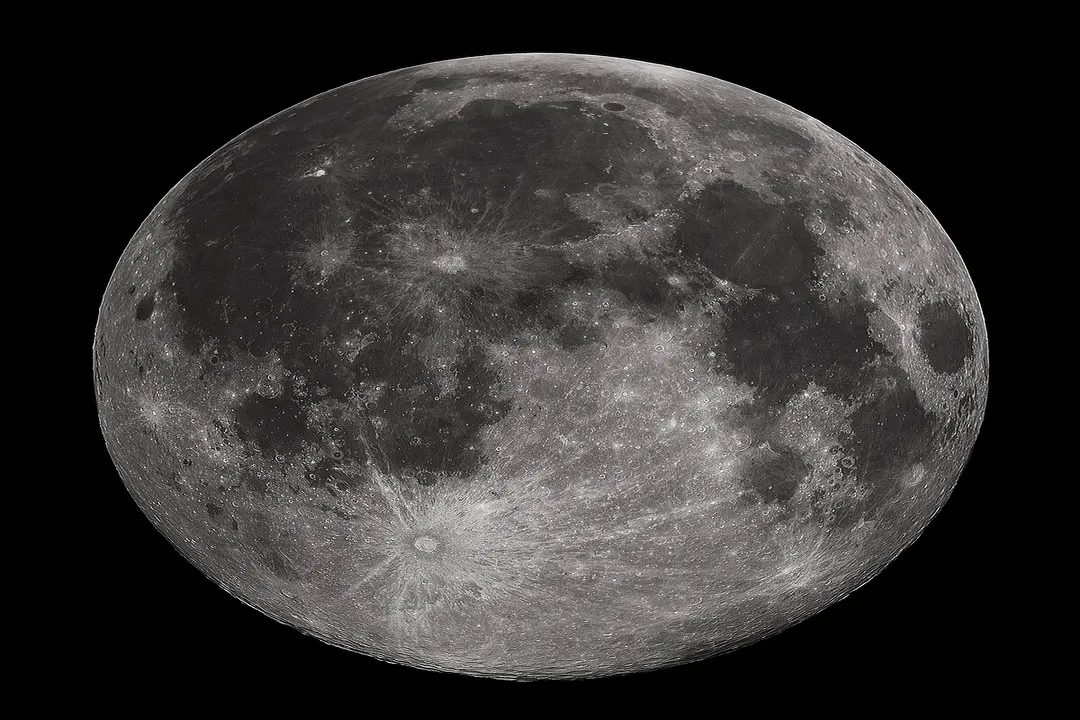
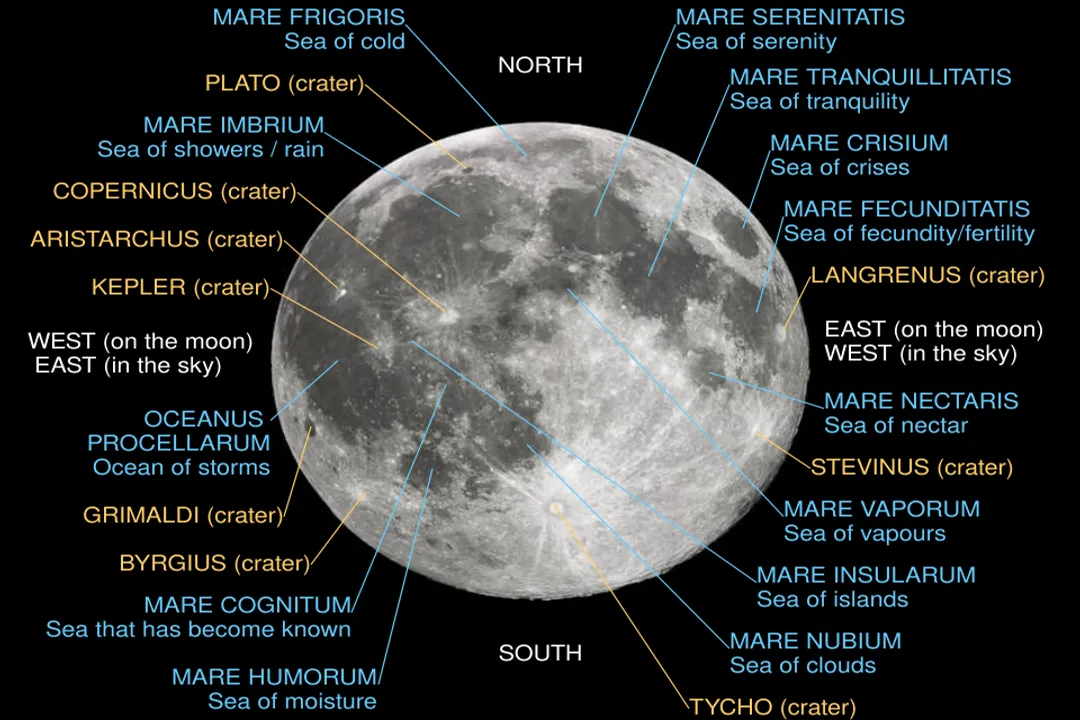
The lunar surface presents a dramatic, unchanging landscape sculpted only by impacts over billions of years, as there is virtually no erosion from wind or water. [3][7] The surface is broadly divided into two principal types of terrain: the darker plains, known as maria (Latin for seas), and the lighter, heavily battered regions called the terrae, or highlands. [1][7]
# Dark Plains
The maria are vast, relatively flat plains that cover about $17$ percent of the Moon’s surface. [1] Early astronomers mistook these dark areas for bodies of water, hence the name "seas". [7][8] Geologically, these features are actually immense basaltic lava flows that welled up from the Moon’s interior after major impacts created giant basins early in its history. [1][7] Because they are younger than the highlands—forming perhaps $3$ to $3.8$ billion years ago—they have had less time to accumulate impact craters, making them appear smoother. [7]
# Highlands and Craters
In stark contrast, the lunar highlands are rugged, mountainous, and ancient, representing the Moon's original crust. [1] These regions are saturated with impact craters of all sizes, a testament to an intense period of bombardment early in the Solar System’s history. [7] These craters are perhaps the Moon’s most iconic feature, ranging from small bowl shapes to massive impact basins several hundred kilometers across. [8] The sheer density of these features provides planetary scientists with a clock, allowing them to date surface events relative to one another. [7]
Beneath the surface features lies the regolith, a layer of dusty, broken rock fragments and soil created by billions of years of micrometeorite impacts pulverizing the surface rock. [7] This fine, abrasive layer can be quite deep in places, sometimes covering meters of solid bedrock. [7]
If we were to create a simplified cross-section comparison based on average data, it highlights the difference in composition and age:
| Feature | Relative Location | Appearance | Approximate Age | Dominant Process |
|---|---|---|---|---|
| Maria | Low-lying basins (near side dominant) | Dark, relatively smooth | Younger ( Billion Years) | Volcanic Basalt Flooding |
| Highlands (Terrae) | Elevated terrain (near and far sides) | Bright, heavily cratered | Older ( Billion Years) | Early Crust Formation & Bombardment |
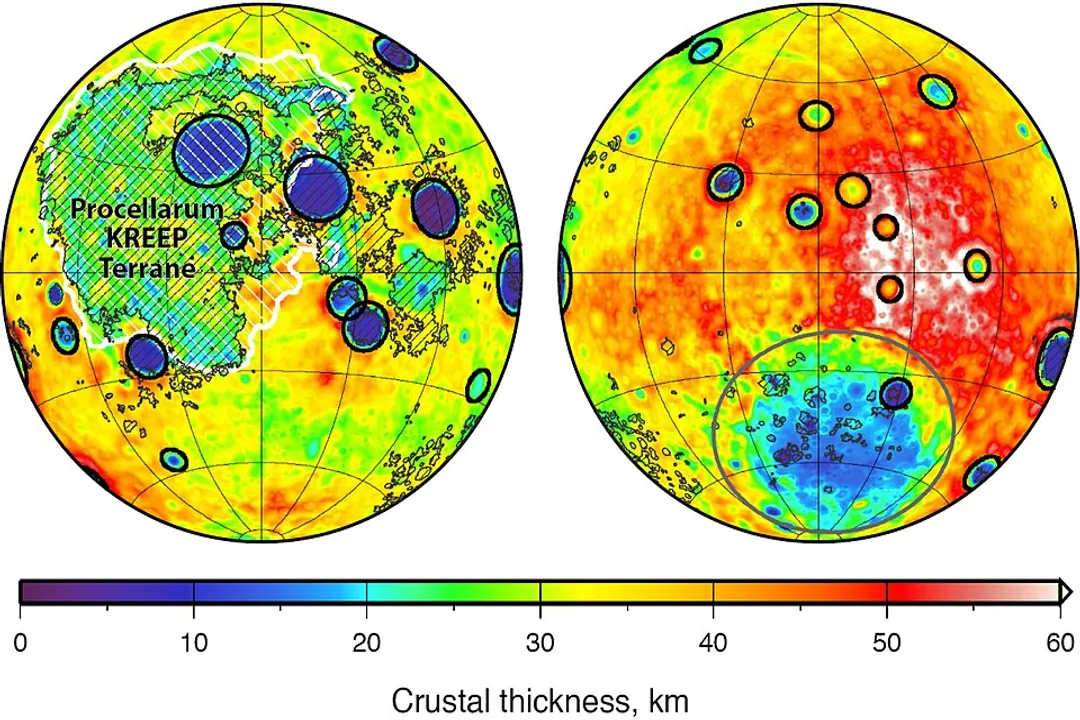
This fundamental geological division, particularly the near-side dominance of the smoother maria, is thought by some researchers to be linked to the differential thinning of the crust caused by Earth's tidal forces over eons, resulting in weaker crust on the near side where magma could more easily erupt. [2]
# Environmental Extremes
The Moon’s near total lack of a permanent, substantial atmosphere is perhaps its most challenging environmental characteristic. [1][3] What little atmosphere exists is extremely tenuous, referred to as a surface-bound exosphere, composed of gases like argon, neon, and helium that are constantly being supplied by solar wind and outgassing from the surface. [1][3]
Because there is no significant atmosphere to trap heat or distribute it around the globe, the surface temperatures swing dramatically between day and night. [7] During the lunar day, when the Sun is high, temperatures can soar to about (). [1] When that same location rotates into darkness, the temperature plummets rapidly to around (). [1] This extreme, abrupt shift in thermal conditions subjects rocks to immense stress, contributing to the breakdown of surface material into the fine regolith over time. [7] This is a perfect illustration of how the absence of insulating air amplifies the difference between illumination and shadow far beyond what terrestrial environments experience, even in the hottest deserts or coldest polar regions on Earth. [3][7]
The absence of an atmosphere also means there is no sound transmission, no weather, and no protection from cosmic radiation or the constant rain of micrometeorites. [3][8]
# Internal Structure
While it is a solid body, the Moon possesses internal layers, although they differ significantly from Earth’s structure. [2] Scientists have deduced its interior structure primarily through seismic data collected during the Apollo missions. [2]
The Moon is structured with a crust, a mantle, and a small core. [2][3] The crust is thought to be thicker on the far side than on the near side—a characteristic possibly linked to the uneven distribution of the maria. [2] Below this crust lies the mantle, which makes up the bulk of the Moon's volume. [2] At the very center is a small core, which is believed to be partially molten, though its size is proportionally much smaller than Earth’s core. [2][3]
The formation of this internal structure is tied directly to its origin story. The prevailing scientific explanation is the Giant Impact Hypothesis. [2][3] This theory posits that early in the Solar System’s history, a Mars-sized protoplanet, sometimes called Theia, collided violently with the proto-Earth. [2][3] The resulting debris cloud, composed largely of mantle material from both bodies, eventually coalesced under gravity to form the Moon. [2] This violent beginning explains why the Moon’s composition is similar to Earth’s crust and mantle but notably depleted in iron (accounting for its small core). [2]
# Gravitational Relationship with Earth
The Moon’s influence on Earth is fundamental to life as we know it. Its gravitational pull is the primary driver of the ocean tides on our planet. [2][5] While the Sun also exerts a tidal force, the Moon’s proximity makes its effect roughly twice as strong. [2]
Beyond the tides, the Moon plays a less obvious but crucial role in stabilizing Earth’s environment. [5] It helps keep our planet’s axial tilt relatively steady over long timescales. [5] Without this massive, orbiting companion, Earth’s axial tilt would wobble chaotically over millions of years, leading to extreme and unpredictable swings in climate that would likely inhibit the development of complex life forms. [5]
The phenomenon of tidal locking, where the Moon always shows us the same face, provides a unique setup for scientific observation that is often overlooked in discussions of lunar geography. Because the far side of the Moon is permanently shielded from Earth's electromagnetic noise and light pollution, it represents an ideal, radio-quiet location for deploying sensitive deep-space radio telescopes. This quiet environment could allow astronomers to detect incredibly faint signals from the very early universe, signals that would be completely washed out by terrestrial interference if observed from Earth or even the near side. [9]
# Observing the Poles and Shadows
When studying the Moon, the topography near the poles offers a unique contrast to the equatorial regions. Because of the Moon’s slight axial tilt—about $1.5$ degrees relative to its orbital plane—some areas near the poles remain in near-perpetual shadow. [1] These permanently shadowed regions (PSRs) are incredibly cold and have been identified as potential reservoirs for water ice mixed within the lunar soil. [1] The combination of extreme cold and isolation from solar heating makes these PSRs scientifically fascinating targets for future missions seeking resources. [1]
Conversely, peaks near the poles that rise above the surrounding terrain might experience nearly continuous sunlight. These sunlit peaks, referred to as "peaks of eternal light," offer stable, high-temperature environments ideal for solar power generation for any long-term lunar base, providing a reliable energy source free from the dramatic day/night cycle experienced elsewhere. [1]
# The Moon's True Color
While the Moon often appears stark white or yellow-white in the night sky, its actual surface color is much darker. [8] If you were standing on the surface, the Moon would appear a dull, dark gray, much like asphalt or charcoal. [8] This dark appearance is due to the mineral composition of the surface rock and the ancient, weathered regolith. [7] The bright, familiar glow we see from Earth is entirely due to the brilliant reflection of sunlight off this surface, magnified by the contrast against the deep black of space. [8]
In summary, the Moon is characterized by its geological dichotomy of light highlands and dark maria, its lack of atmosphere leading to temperature extremes, its complete tidal lock with Earth, and its significant, stabilizing influence on our planet’s climate. Every aspect, from its density to its cratered surface, tells the story of its violent birth and its long, lonely evolution in orbit. [2][3]
#Videos
The Moon - Its Characteristics and Impacts on Earth - YouTube
Related Questions
#Citations
Moon Facts - NASA Science
Moon | Features, Phases, Surface, Exploration, & Facts | Britannica
Moon - Wikipedia
What are the characteristics of the moon? - Quora
The Moon: Features and exploration | Canadian Space Agency
The Moon - Its Characteristics and Impacts on Earth - YouTube
Surface features of the Moon | Institute of Physics
Facts about the Moon! - National Geographic Kids
What unique characteristics or at least that differentiate it from other ...