What are the main characteristics of Jupiter?

Jupiter stands unrivaled in our solar neighborhood, a behemoth whose very presence shapes the orbits and evolution of the smaller worlds around it. It is not just the largest planet; it is a world of extremes, characterized by incredible scale, ferocious internal dynamics, and a complex satellite system that rivals a miniature solar system in its own right. [1][2][3] Understanding its main characteristics requires diving deep into its composition, atmosphere, and powerful fields, revealing why this gas giant is often considered the anchor of the Sun's planetary family. [3]
# Giant Size

Jupiter’s most immediate defining feature is its sheer magnitude. It holds the title of the solar system's largest planet by a considerable margin. [1][3] Its diameter is estimated to be about 142,984 kilometers, [1] making it more than eleven times the diameter of Earth. [2] Scale comparisons often fall short, but one way to visualize this is that if Jupiter were hollowed out, every other planet in the solar system—Mercury, Venus, Earth, Mars, Saturn, Uranus, and Neptune—could fit inside with room to spare. [2][3]
Even more striking than its size is its mass. Jupiter possesses more than twice the mass of all the other planets in the solar system combined. [2][3] This tremendous gravitational influence means that, aside from the Sun, Jupiter is the single most massive object orbiting our star. [3] If Jupiter were about 80 times more massive, it might have had enough internal pressure and temperature to initiate nuclear fusion, potentially turning it into a star rather than a planet. [6] Interestingly, although it is massive, Jupiter is less dense than the other gas giant, Saturn, suggesting a lower concentration of heavier elements relative to its overall volume. [2][3] Considering its immense mass distributed over such a vast volume, it’s fascinating to realize that if you could somehow find a surface to stand on, the force of gravity there would be nearly two and a half times that experienced on Earth. [3]
# Fast Spin
Despite its enormous size, Jupiter is the fastest spinning planet in the solar system. [1][3] A single rotation on its axis takes less than ten hours to complete, roughly 9 hours and 55 minutes. [1][3] This rapid rotation has profound effects on the planet’s shape, causing it to bulge noticeably at the equator and flatten at the poles—a feature known as oblateness. [3]
This swift rotation rate dictates the planet's most visible features: its bands and zones. [7] While its orbital period around the Sun is much longer, taking nearly 12 Earth years to complete one revolution, [1][3] its internal day is remarkably short. [3] This rapid spin acts as a powerful mixer for the atmosphere, churning its gaseous layers and contributing to the distinct, parallel bands of color seen across its surface. [7]
# Cloud Layers

Jupiter is a quintessential gas giant, meaning it lacks a solid surface to stand on in the way Earth or Mars does. [6] Instead, its visible features are the tops of incredibly deep, turbulent cloud layers. [6] These clouds are primarily composed of frozen ammonia crystals, ammonium hydrosulfide, and water ice, stacked into distinct horizontal features. [1][7]
The atmosphere is overwhelmingly composed of hydrogen and helium, mimicking the composition of the Sun, though with slightly higher concentrations of heavier elements. [2][3]
The visible structure presents as alternating light-colored regions called zones and darker regions called belts. [7] The zones are areas of rising, cooler gas, which forms bright white or pale cloud tops, while the darker belts are regions where gas is sinking and warming, revealing lower, darker cloud layers. [7] These features are not static; they move relative to each other, often forming massive vortices where they meet. [7]
# Great Spot
The most famous feature etched onto Jupiter’s atmosphere is undoubtedly the Great Red Spot (GRS). [1][2] This is perhaps the longest-lived, most powerful storm known in the solar system. [1][7] It is an immense anticyclonic storm—a high-pressure system rotating counter-clockwise in the southern hemisphere. [2]
For centuries, observers have tracked this swirling vortex. [2] While measurements from modern spacecraft like Voyager and Galileo have revealed that the GRS is shrinking over time, it remains colossal, large enough to swallow the Earth whole when it was last measured at its widest. [1] The reddish-brown hue of the storm is thought to be caused by chemical compounds within the clouds, possibly containing sulfur or phosphorus, which are swept up from lower, warmer altitudes by the storm’s intense circulation. [7] The sheer scale of atmospheric dynamics required to sustain a storm feature like the GRS for hundreds of years speaks volumes about the energetic circulation within Jupiter’s deep atmosphere. [7]
# Strong Magnet
Jupiter possesses a magnetic field that is spectacularly powerful, dwarfing that of any other planet except the Sun. [2][3] This field is approximately 20,000 times stronger than Earth’s magnetic field. [1] This immense magnetosphere extends millions of kilometers into space, far past the orbit of the Moon. [3]
This powerful magnetic shield traps a huge amount of charged particles, creating intense radiation belts surrounding the planet. [1][3] Navigating these belts is a significant engineering challenge for any spacecraft sent to study Jupiter up close, as evidenced by the radiation-hardened electronics required for missions like Juno. [3] The source of this field is believed to be a massive layer of liquid metallic hydrogen deep within the planet, generated under extreme pressure, which churns like a gigantic dynamo. [2][3] The magnetic poles of Jupiter are also significantly tilted relative to its rotational axis, unlike Earth’s, adding another layer of complexity to its magnetic geometry. [3]
# Internal Power
A characteristic that sets Jupiter apart from the terrestrial planets is its internal energy source. Jupiter radiates significantly more heat out into space than it absorbs from the Sun. [3] This surplus energy is residual heat left over from the planet’s formation billions of years ago, combined with heat generated by the slow, steady gravitational contraction of the planet over time. [3] This internal heating drives the powerful atmospheric convection, powering the strong winds and contributing to the perpetual turbulence seen in its cloud tops. [3] If we consider the planet’s average density, which is about 1.33 grams per cubic centimeter, [2] it is relatively low for such a massive object. This low density implies that the majority of its mass is held in extremely light elements (hydrogen and helium) squeezed into dense fluid states, rather than in a proportionally large rocky core like Earth possesses. [2][3]
# Many Satellites
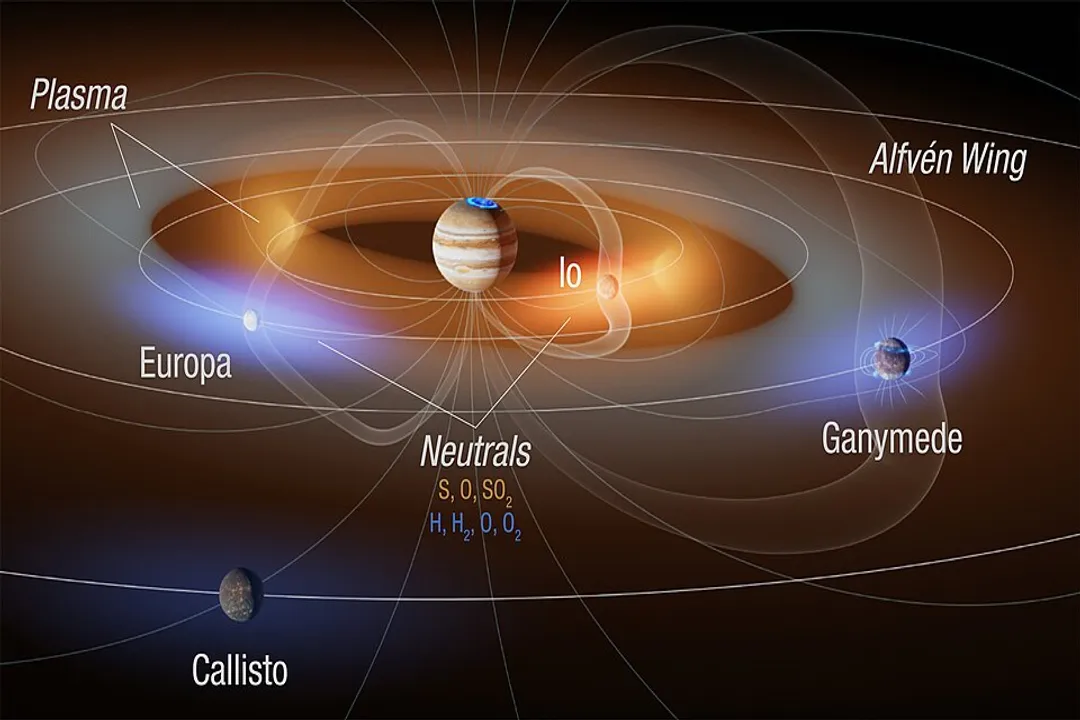
Jupiter acts as the gravitational center for a bustling system that includes at least 95 confirmed moons. [1][3] This collection of orbiting bodies is so vast that it often requires the focus of dedicated research programs, as several of these moons hold compelling scientific interest in their own right. [1]
The most famous are the four large Galilean moons, discovered by Galileo Galilei in 1610: Io, Europa, Ganymede, and Callisto. [1][3]
- Io is the most volcanically active world in the entire solar system, constantly reshaped by sulfurous plumes due to the immense tidal forces exerted by Jupiter. [1]
- Europa is of particular interest because scientists believe it harbors a vast saltwater ocean beneath its icy crust, making it a prime candidate in the search for extraterrestrial life. [1][3]
- Ganymede is unique as the largest moon in the solar system, even bigger than the planet Mercury, and is the only moon known to possess its own intrinsic magnetic field. [1][3]
- Callisto is heavily cratered and appears geologically ancient and relatively inactive. [1]
Studying the interaction between these moons and Jupiter reveals complex orbital resonances and tidal heating mechanisms that govern planetary systems across the cosmos. [1]
# Faint Rings
While Saturn often steals the spotlight with its magnificent, bright ring system, Jupiter also possesses one, though it is far more tenuous and difficult to observe. [3] Jupiter’s rings are composed mainly of fine dust particles blasted off its inner moons by micrometeoroid impacts. [3] This material is dark and subtle, unlike the bright, icy particles that make up Saturn’s rings. [2] The ring system is actually composed of three main sections: the faint main ring, and two more diffuse outer structures called the gossamer rings. [2] Because the particles are so dark and sparsely distributed, ground-based telescopes rarely detect them, requiring specialized imaging from spacecraft passing through the plane of the rings to confirm their existence. [3]
# Observational History
Jupiter has been known since antiquity, visible to the naked eye as a very bright, steady point of light. [3] Its constant appearance, contrasting with the wandering stars, helped establish it as a celestial body of significance in early astronomy. [3] Its transit across the sky was tracked by nearly every ancient civilization, often being associated with supreme deities, reflecting its overwhelming dominance in the heavens. [3] Even in the modern era, dedicated observation has been ongoing, not just with robotic probes, but through consistent monitoring by amateur and professional astronomers alike, contributing to our long-term data on its atmospheric movements. [7] This continuous, centuries-long visual record provides a unique baseline for understanding the slow evolutionary changes in its storm systems.
Related Questions
#Citations
Jupiter Facts - NASA Science
Jupiter - Wikipedia
Jupiter | Facts, Moons, Rings, Temperature, Size, & Color | Britannica
ESA - Facts about Jupiter - European Space Agency
Jupiter's Characteristics and Features - Facebook
What are the main characteristics of the planet Jupiter? - Quora
General Features of Jupiter
What Is Jupiter? (Grades 5-8) - NASA
Top 10 Facts about Jupiter! - the UK's children's radio station