Is the ecliptic a real thing?

The question of whether the ecliptic is a real thing often arises because we associate "real" with something tangible we can touch, like a planet or a star. However, in astronomy, many of the most essential reference points are geometric constructs—imaginary lines and planes projected onto the vast sphere of the sky. The ecliptic is perhaps the most fundamental of these projections, and yes, it is profoundly real in its meaning: it is the precise, physical plane upon which the Earth orbits the Sun.
This plane, when extended outward, creates a great circle on the celestial sphere that marks the apparent annual journey of the Sun across our fixed background stars. It serves as the backbone for mapping our solar system, connecting the Earth's physical motion to what we observe from our perspective on the ground. The ecliptic is not just a historical curiosity; it is the cosmic road map that dictates seasons, locates the planets, and is the very stage upon which eclipses are set.
# Orbital Plane Foundation
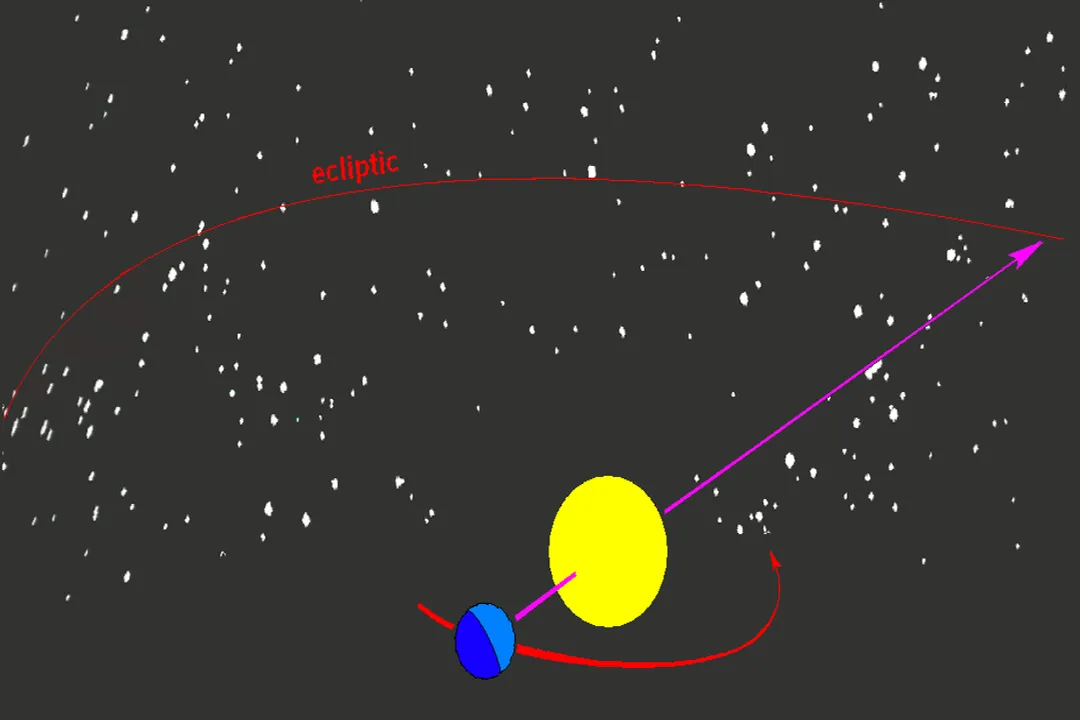
To truly grasp the ecliptic, we must look at the mechanics of our home, Earth. The ecliptic is simply the name given to the geometric plane defined by Earth’s orbit around the Sun. Imagine a gigantic, flat dinner plate extending infinitely outward from the Sun, with the Earth tracing its path perfectly around the rim—that plate defines the ecliptic plane.
This physical reality has profound consequences for our viewing experience. Because the Sun is always in the plane of Earth’s orbit, we see it appear to travel along that projection on the celestial sphere throughout the year. Since Earth completes one full revolution in roughly $365.25$ days, the Sun moves about eastward along the ecliptic each day. This steady, predictable motion is what causes our annual cycle of seasons and allows ancient astronomers to track time reliably. The ecliptic is therefore less about a path in the sky and more about a path through space that our planet dictates.
# Celestial Geometry
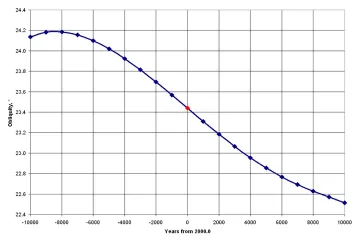
While the ecliptic is the plane of Earth's journey, it does not align perfectly with the imaginary reference lines we use for defining north and south on the sky. Earth’s rotational axis is tilted relative to this orbital plane. This tilt, known scientifically as the obliquity of the ecliptic, is currently about .
If you project the Earth’s equatorial plane outward, it intersects the celestial sphere to form the celestial equator. Because of the tilt, the celestial equator and the ecliptic cross each other at two specific points known as the equinoxes—the March (vernal) equinox and the September equinox. At these moments, the Sun appears to cross the celestial equator, leading to nearly equal hours of day and night globally.
The ecliptic plane itself is far more stable over short timescales than the celestial equator. While the equator’s orientation shifts due to lunisolar precession over a 26,000-year cycle, the ecliptic plane shifts much more slowly due to planetary perturbations. For precise celestial mapping, the ecliptic is often chosen as the more "fixed" reference system because it changes position relative to the distant background stars at only about one-hundredth the rate of the celestial equator.

# The Solar Neighborhood

One of the most compelling aspects confirming the reality of the ecliptic plane is how closely other major bodies in our Solar System adhere to it. When we observe the Sun, Moon, and planets near each other in the night sky, it is not coincidence; it is a result of shared origins.
Our entire Solar System condensed from a vast, spinning cloud of gas and dust that flattened into a disk—a protoplanetary disk. The Sun formed at the center, and the planets coalesced within that flattened plane. This historical process means that the orbital planes of almost all major planets are inclined by only a small amount relative to the Earth’s orbital plane. Jupiter's orbit, for instance, is extremely close to the ecliptic plane, contributing heavily to the definition of the Solar System’s invariable plane (a theoretical plane based on total angular momentum). For practical observation, the ecliptic is preferred as the reference plane due to its convenient definition via the Sun’s apparent motion.
This common geometry is why, if you scan the sky along the Sun’s track, you are almost guaranteed to see the Moon and the planets lined up nearby.
# Eclipses and Nodes
The very name ecliptic is derived from the word eclipse, meaning "to fail to appear" or "to be hidden". This stems from the observation that the Sun is always on the ecliptic, and eclipses (solar or lunar) can only occur when the Moon, which orbits Earth on a plane tilted by about relative to the ecliptic, crosses the ecliptic plane at the exact moment it is aligned with the Sun (new moon, causing a solar eclipse) or opposite the Sun (full moon, causing a lunar eclipse). These crossing points are known as nodes. If the Moon followed the ecliptic perfectly, we would experience an eclipse every month.
# The Zodiac Band
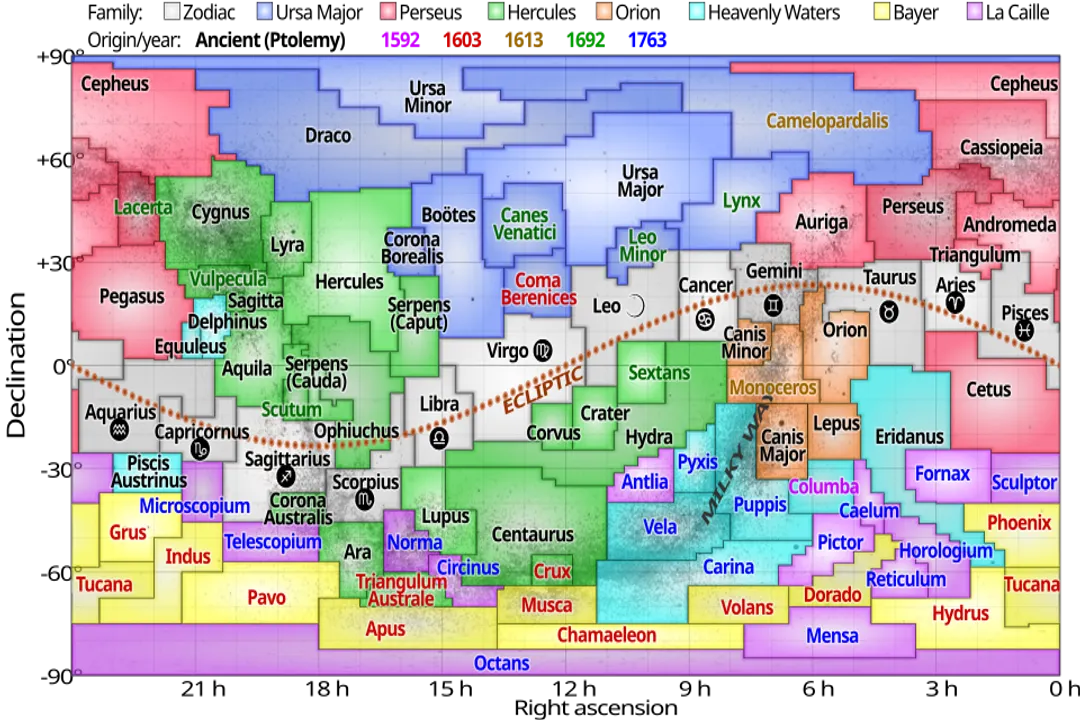
When ancient sky-watchers charted the Sun's yearly path (the ecliptic), they noted that a distinct band of constellations always lay along this track. This belt is the Zodiac, derived from the Greek for "animal circle," as many of the featured constellations feature animals like the Lion (Leo) or the Bull (Taurus).
While the ecliptic runs precisely down the middle of this region, the actual sky visible near the path is slightly wider, spanning about in celestial latitude. It is an important demarcation line; if you are searching for a planet or the Moon, you know exactly where to look: along the ecliptic's established line.
What is fascinating is how our current understanding of constellation boundaries differs from the historical convention of the "Twelve Signs." The ecliptic currently passes through thirteen recognized constellations, including Ophiuchus, the Serpent Holder. The Sun actually spends significantly more time in Ophiuchus than it does in Scorpius, yet the latter is traditionally retained as one of the twelve zodiacal constellations, while Ophiuchus is excluded from horoscopic systems. This highlights the difference between the real, measurable path of the ecliptic and the traditional, culturally defined band of the Zodiac.

# Seasonal Appearance
Though the ecliptic plane is a fixed orientation in space relative to the Solar System's formation disk, its appearance in our local sky shifts dramatically with the seasons. This is a direct consequence of Earth’s axial tilt relative to that plane.
When the Northern Hemisphere tilts toward the Sun (summer), the Sun's apparent path along the ecliptic is traced high in the sky, resulting in longer daylight hours and higher solar angles at noon. Conversely, during Northern Hemisphere winter, the Sun follows a much lower arc across the sky, staying closer to the horizon, because the Earth’s tilt carries the ecliptic path lower relative to our local horizon.
To ground this abstract concept, consider this observational point: If you watch the eastern horizon in the early spring evening—shortly after sunset around the March equinox—the ecliptic path cutting across the sky appears almost perpendicular to the horizon. Now, skip ahead to the early autumn evening—shortly after sunset around the September equinox. The ecliptic will appear to skim across the horizon at a much shallower angle. This difference in the angle at which the ecliptic meets the horizon, seasonally and hourly, is the visual manifestation of our planet’s axial tilt relative to its orbit.
# Visualizing Our Local Plane
When we consider the ecliptic, we are defining the structure of our immediate Solar System family. To gain a better appreciation of its nature, it helps to compare it to a much larger structure we see overhead: the Milky Way. The Milky Way galaxy, where we reside, is a vast disk, and its plane—the Galactic Plane—is visible in the sky as a faint, cloudy band of countless stars. If the ecliptic were the Earth’s local street, the Galactic Plane would be the massive highway system running through our entire city.
What is key is that the ecliptic plane is not the Galactic Plane. The ecliptic contains only the Sun, Earth, and the planets that formed within that original solar nebula. The stars of the Milky Way, however, are light-years away, orbiting the galactic core, and their plane is tilted relative to our local orbital plane. Therefore, while planets stick close to the ecliptic, an object orbiting high above or below the ecliptic plane (like some distant comets or even the distant stars of the Milky Way itself) can appear far away from the Sun’s path in our sky. The ecliptic is a marker of local structure, whereas the Milky Way reveals galactic structure.
For the modern skywatcher, the ecliptic serves as an excellent navigational aid. If you are searching for Jupiter, Mars, or Saturn, you do not need to scan the entire heavens. You simply need to locate the path the Sun took over the last year. If you can mentally trace that line—especially at dawn or dusk when the sky is dark enough to see planets but the Sun is close enough to define the plane—you can quickly pinpoint where the action is in the Solar System. It is a practical tool connecting the physics of orbit to the art of stargazing.
# Coordinates and Precision
Because the ecliptic is so central to the dynamics of the Solar System, astronomers developed a coordinate system based on it, known as ecliptic coordinates. This system specifies an object's position using longitude and latitude measured relative to the ecliptic plane. Ecliptic longitude tracks the object's position along the circle of the ecliptic, starting from the March equinox (the First Point of Aries) and moving eastward in the direction the Sun travels. Ecliptic latitude measures how far north or south of the ecliptic an object lies, perpendicular to the plane.
Using this system allows for high precision when calculating the positions of solar system bodies, as their orbits are inherently defined by this fundamental plane. While other coordinate systems exist (like the equatorial system, based on the celestial equator), the ecliptic system is convenient for anything gravitationally bound to the Sun. It is a way of saying, "We are measuring location based on the map of our own house, rather than the map of the sky at large".
The fact that the Sun’s apparent path is the ecliptic, combined with the fact that our planets faithfully follow this plane, confirms that the ecliptic is far more than just an arbitrary line drawn by ancient observers. It is a direct, geometric manifestation of Earth’s orbit translated onto our celestial view. It is real because the physical path we travel dictates the line we see projected overhead.
Related Questions
#Citations
Ecliptic - Wikipedia
In astronomy, what exactly is the ecliptic? : r/explainlikeimfive - Reddit
The ecliptic is the sun's path in our sky - EarthSky
MOVA Geography: The Ecliptic
How the Ecliptic and the Zodiac Work - Space