Is a star a source of light energy?
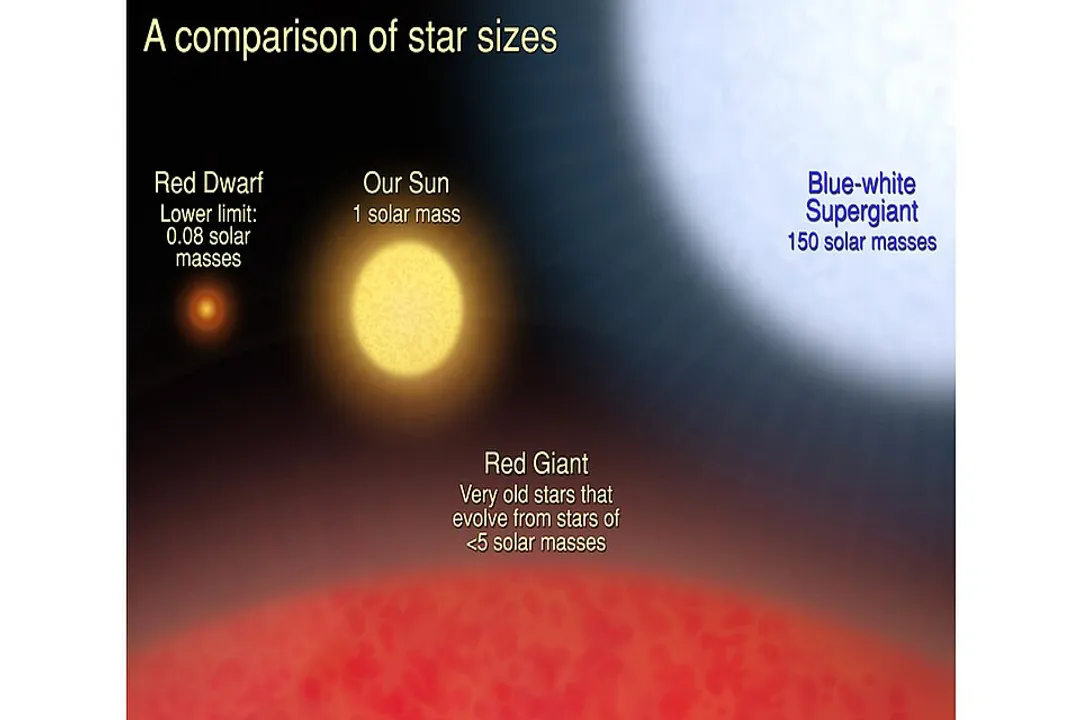
Stars are, by definition and physical reality, powerful sources of light and heat energy in the cosmos. [4][6] This ability to generate energy isn't a magical quality but rather the result of incredibly intense physical processes occurring deep within their cores. [8] When we look up at the night sky, nearly every point of light we see is a celestial body generating its own illumination through staggering internal pressures and temperatures. [5][6] The Sun, our nearest star, is the most obvious example, bathing our planet in the electromagnetic radiation we perceive as warmth and sunlight. [1][8]
# Stellar Furnaces
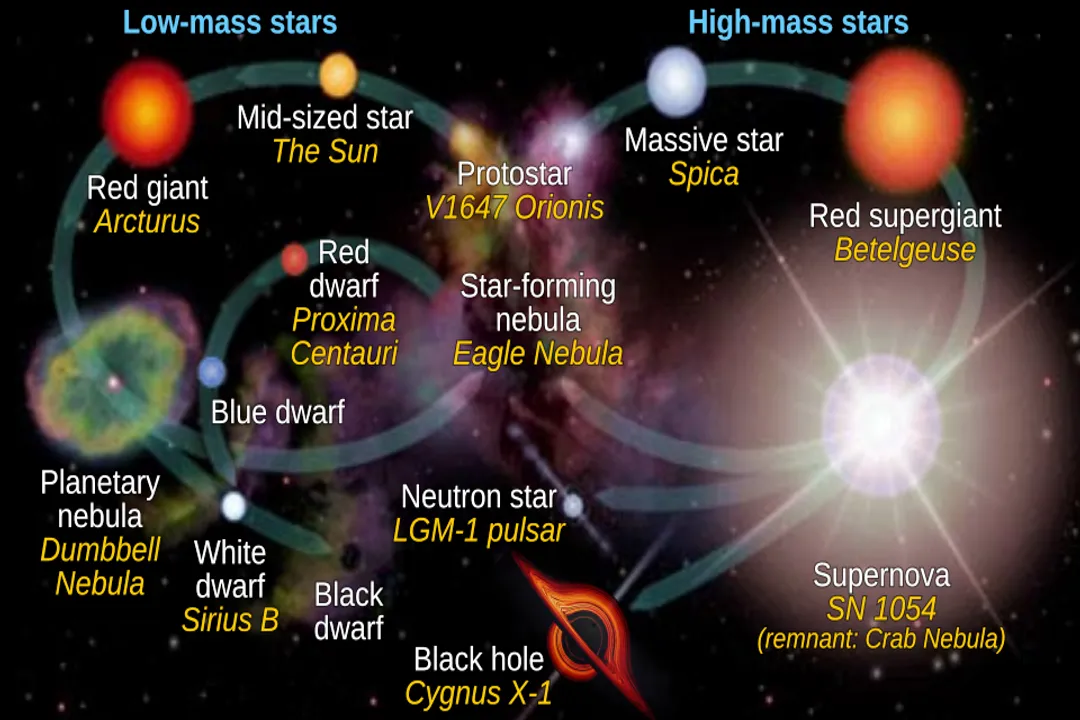
The defining characteristic that makes a star a light source is its core mechanism: nuclear fusion. [8] A star begins its life as a massive cloud of gas and dust, primarily hydrogen, which collapses under its own gravity. [4] As this mass compresses, the temperature and pressure at the center rise dramatically. [6]
When the core temperature reaches approximately 15 million degrees Celsius, the conditions become extreme enough to force hydrogen nuclei to fuse together, creating helium nuclei. [8] This process, the proton-proton chain reaction, is the engine of the star. [6] Crucially, the mass of the resulting helium nucleus is slightly less than the total mass of the original hydrogen nuclei that went into it. [8] That "missing" mass has not vanished; it has been converted directly into a tremendous amount of energy according to Albert Einstein’s famous equation, . [8] This energy is what eventually escapes the star as photons, the particles that make up light, as well as other forms of radiation, including heat. [1][8]
It is the continuous, self-sustaining nature of this fusion reaction that allows a star to shine for billions of years. [4] If a celestial body does not achieve the necessary mass and core temperature to initiate and sustain this fusion—say, an object around 13 times the mass of Jupiter—it fails to become a true star and instead settles into the category of a brown dwarf, an object that glows faintly from residual heat but lacks the true thermonuclear power source. [4] This minimum mass threshold is a fundamental differentiator: true light and energy generation begins where fusion ignites.
The sheer gravitational requirement to initiate this process dictates whether a cosmic object is merely a large ball of gas or a genuine, long-term emitter of light energy. A star must be massive enough to win the cosmic tug-of-war against expansion; if gravity wins the initial collapse and creates the necessary internal furnace, light production is guaranteed. [4]
# Energy Spectrum
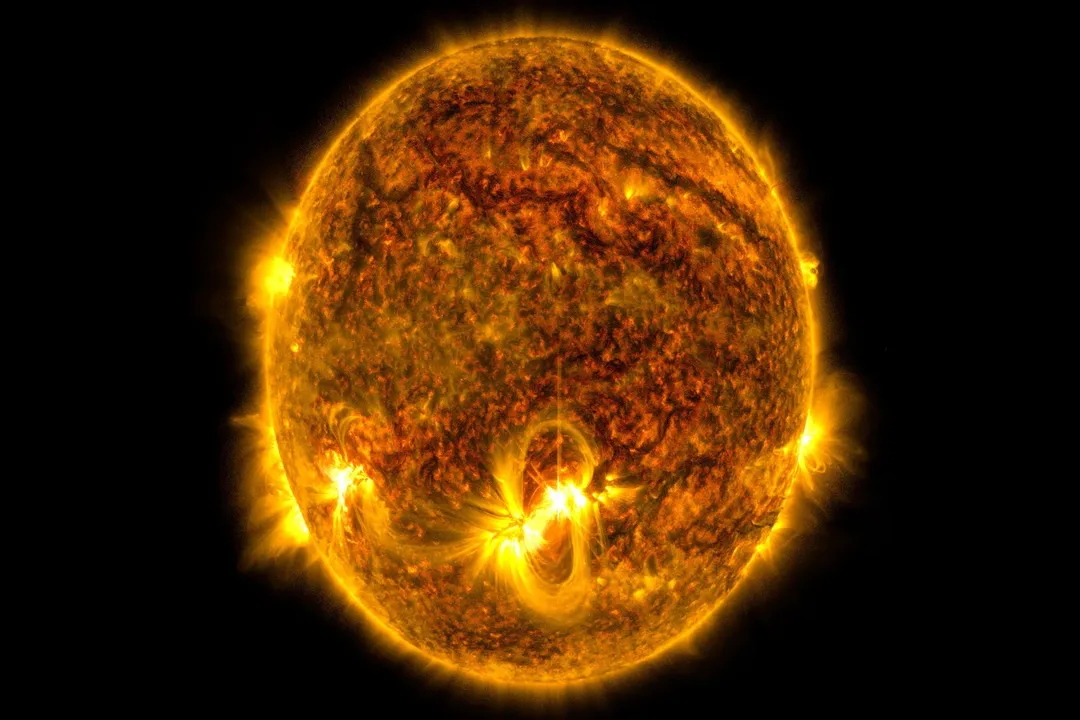
The energy released in a star’s core doesn't immediately emerge as visible light. Instead, it begins as high-energy gamma rays. [8] These photons then undergo a long, slow process of being absorbed and re-emitted countless times by the dense layers of plasma within the star. [8] With each interaction, the photons lose a tiny bit of energy, shifting their wavelength toward the cooler, less energetic end of the spectrum. [8]
By the time this energy finally reaches the star's surface, the photosphere, much of it has cooled enough to be emitted as visible light, infrared radiation (heat), and ultraviolet radiation. [1][8] The resulting light spectrum emitted by a star tells astronomers a great deal about its surface temperature and composition. [4] Hotter stars, like massive blue giants, emit more light in the blue and ultraviolet parts of the spectrum, whereas cooler stars, such as red dwarfs, peak in the red and infrared regions. [4] The vast majority of the energy output, however, travels across space as electromagnetic waves of various frequencies. [8]
The power output of stars varies wildly. Our Sun outputs an immense amount of energy constantly, about watts, which is measured as its luminosity. [1] This dwarfs nearly everything else in our local system, yet, compared to hypergiants, the Sun is relatively modest. This continuous, powerful output over eons confirms the star’s role as a primary, reliable energy producer.

# Beyond Emission
While stars are the primary, self-powered sources of light in the universe, it is important to recognize that they are not the only things that shine. [2] If stars were the only sources, the night sky would be utterly black save for the pinpricks of distant suns.
Light that reaches us in the universe can be broadly categorized into two types: emitted light and reflected light. [3] Stars emit their own light through fusion. [5] Planets, moons, and asteroids, however, do not possess the internal heat and pressure to sustain fusion; they are not stars. [6] The light we see coming from Jupiter or the Moon is entirely reflected sunlight. [3] In effect, these bodies act as passive mirrors, catching the energy output of their parent star and sending a portion of it back into space, including toward Earth. [2]
Consider the perspective from Earth on a clear night. The light from the Moon is dramatically brighter than the light from any other celestial object, solely because it is so close and reflecting our local star’s light efficiently. [3] Even in the deepest regions of space far from any star, there is a faint, diffuse background glow, often referred to as the extragalactic background light, which is composed of the combined, redshifted light from all the galaxies in the observable universe. [2] Therefore, while stars provide the genesis of nearly all the light we observe, that light can be modified, redirected, or aged by intervening objects before it reaches an observer.
To put the dominance of stellar output into perspective, if we consider the energy striking Earth, the Sun accounts for virtually all non-terrestrial energy input.
| Source of Light/Energy | Mechanism | Dominance for Earth Observation |
|---|---|---|
| Our Sun | Nuclear Fusion (Emission) | Over 99.999% of incident solar radiation [1] |
| Other Stars | Nuclear Fusion (Emission) | Faint point sources due to distance |
| Planets/Moon | Reflected Sunlight | Significant in the night sky, but zero intrinsic energy |
| Nebulae/Gas Clouds | Scattered Starlight/Minor Emission | Generally too faint to be perceived visually without telescopes |
If you were to measure the total energy flux hitting a sensor located between Earth and Mars, over 99.999% of that energy would be attributable to the Sun's ongoing fusion process. [1] The combined light of every other star in the Milky Way galaxy arriving at that same spot would be an almost negligible fraction by comparison. This underscores that while the universe is filled with stars, our immediate experience of light is dominated by our single, closest stellar engine.
# Cosmic Scale
The appearance of a star as a source of light is heavily dependent on distance. [1] A star’s intrinsic luminosity—the actual energy it radiates—is fixed by its mass and age. [4] However, the intensity of the light we receive diminishes rapidly with distance, following the inverse-square law. [1] This means that the light from the nearest star system, Proxima Centauri, appears incredibly dim compared to the Sun, despite Proxima Centauri being an active source of light energy itself. [4]
When we look at the night sky, the stars we see are not necessarily the most powerful emitters in the galaxy, but rather those whose light has not been diffused too much across the vastness of space between us and them. [4] The perception of faintness is therefore more a measure of separation than a measure of energy production failure.
This brings up an interesting consequence of stellar light generation: harvesting potential. The sheer, steady output of a star, particularly one like our Sun, represents an astronomical energy source. [9] While humans currently focus on terrestrial solar collection, the concept of tapping into a star's energy directly is scientifically intriguing, though logistically immense. [9] The energy radiated into space by a star is essentially "lost" to the star itself and becomes available to anything in its path, which is why we can use it for light, heat, and—theoretically—power generation on a grand scale. [9] This availability across space solidifies the star’s role not just as a light source for vision, but as a fundamental energy delivery system for any planet within its sphere of influence.
Related Questions
#Citations
Star Basics - NASA Science
Are Stars the only source of light in the universe? : r/askscience
What Causes a Star to Shine Brightly? - Lesson - Study.com
Star - Wikipedia
Are stars a light source? - Quora
Do the stars have their own light? - Astronomy & Space
What is the energy source of stars? - Facebook
Star Energy | Physical Geography - Lumen Learning
Can Energy Be Harvested from a Star? - Northrop Grumman