What is the source of light in the emission nebula?
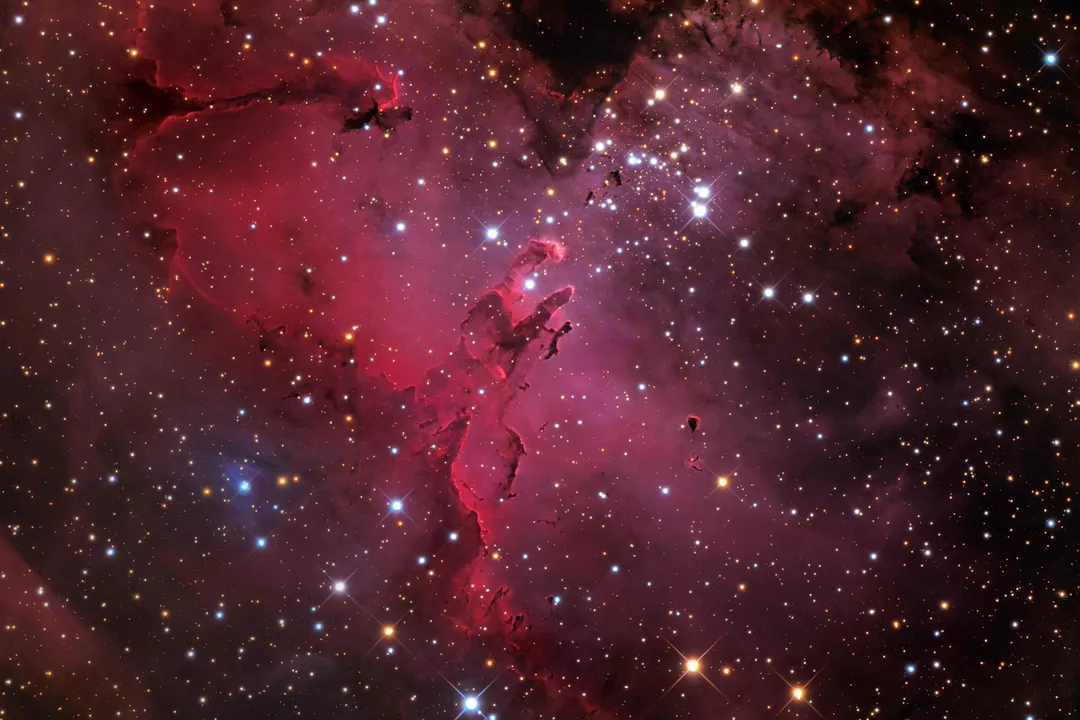
The radiant glow observed in an emission nebula stems from a fascinating, three-step cosmic process involving intense stellar energy and vast clouds of interstellar gas. [3][7] Fundamentally, these nebulae are not simply reflecting the light of nearby stars, like a mirror; they are actively producing their own light through the excitation and subsequent de-excitation of their constituent atoms. [2] This process requires a very specific, energetic environment, making emission nebulae bright beacons in the otherwise dark expanse between the stars. [6]
# Cloud Composition
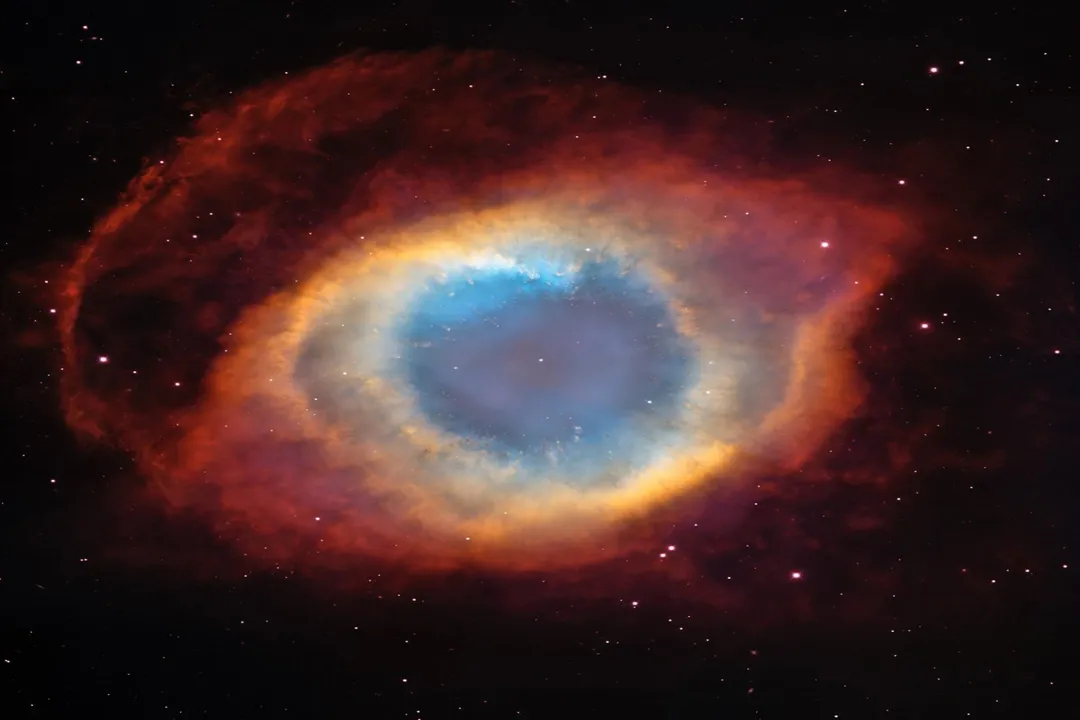
Emission nebulae are primarily vast clouds composed of interstellar matter, consisting mostly of gas, with some dust mixed in. [1][3] The dominant gas is hydrogen, which makes up the overwhelming majority of the material within these stellar nurseries. [1][6] It is this hydrogen gas that provides the raw material for the nebula’s characteristic glow. [1]
The appearance of an emission nebula is intimately tied to the presence of extremely hot, massive stars, usually newly formed ones, either embedded within the cloud or very nearby. [3][8] These stars are the engine driving the entire phenomenon. Without this powerful energy source, the gas cloud would remain largely invisible, simply absorbing background light or scattering it faintly. [5]
# Excitation Energy
The critical element that separates an emission nebula from a reflection nebula—which appears blue because it scatters light from cooler stars—is the sheer energy output of the illuminating source. [5] The stars responsible for lighting up an emission nebula must be incredibly hot, often spectral types O or B, resulting in surface temperatures reaching tens of thousands of degrees. [3]
This intense heat causes the stars to radiate copious amounts of high-energy ultraviolet (UV) radiation. [1][2][9] This UV radiation carries enough energy to completely strip the electrons away from the atoms in the surrounding gas cloud, a process known as ionization. [2][9] Imagine the star firing high-speed bullets at the gas atoms; these "bullets" are photons, and they are energetic enough to knock electrons clear out of their orbits, leaving behind positively charged ions. [2]
A point worth noting is the sheer energy threshold required for this interaction. Simple scattering, seen in reflection nebulae, occurs with longer-wavelength visible light that interacts with dust grains. [5] Ionization, however, requires photons in the UV spectrum, demanding surface temperatures well over 10,000 Kelvin. [9] This difference explains why emission nebulae are often found near the youngest, most massive stellar clusters—only these stars produce radiation powerful enough to ionize the surrounding material on a grand scale.
# Gas Illumination
Once the gas is ionized—meaning the electrons are separated from their parent atoms—the glowing phase begins. [2] This state is unstable; the positively charged ions (like hydrogen nuclei, or protons) will eventually capture a free electron passing by, a process called recombination. [2][9]
When an electron recombines with an ion, it doesn't usually settle directly into the lowest energy level (the ground state) in one jump. [2] Instead, it jumps into a higher energy orbit and then cascades down through several intermediate energy levels, shedding energy at each step in the form of a photon—a particle of light. [2] This entire sequence, from high-energy UV input to the subsequent cascading light emission, is a form of fluorescence. [2]
The key insight here is that the light we see from the nebula is not the original UV light from the star, which is too energetic for our eyes and is often absorbed by the gas itself. [2][9] Instead, the nebula is reprocessing that invisible UV energy into visible light, with specific colors corresponding to the atomic transitions occurring during the recombination cascade. [2]
# Hydrogen Color
The most prominent and defining characteristic of many emission nebulae is their striking reddish or pinkish hue. [1][6] This color arises almost entirely from the spectral signature of the most abundant element present: hydrogen. [1]
When a hydrogen atom’s electron drops from the third energy level () down to the second energy level (), it releases a photon with a specific wavelength of 656.3 nanometers. [1] This wavelength falls squarely in the deep red portion of the visible spectrum, and this particular transition is known as Hydrogen-alpha (). [1] Because there is so much hydrogen in these clouds, the cumulative effect of countless emissions creates the widespread red glow seen in classic objects like the Orion Nebula. [1][6]
While hydrogen dominates the color, other elements contribute subtle, yet important, spectral lines. [9] For instance, doubly ionized oxygen often emits strongly in the blue-green region, and singly ionized sulfur contributes light in the infrared, though these colors are sometimes less dominant or are filtered out in standard visual observations. [9] Astrophotographers often capture these fainter emissions to reveal the nebula's full color palette, contrasting sharply with the visually simple red hue seen by the naked eye or standard telescopes. [7]
# Emission Contrast
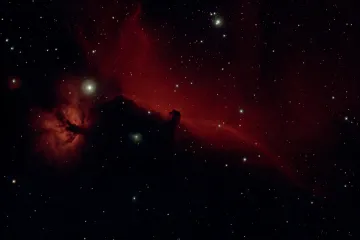
Understanding the source of light requires distinguishing emission nebulae from their reflective counterparts. [5] A reflection nebula, which typically appears blue, shines because fine dust particles within the cloud scatter the blue light from nearby hot stars more efficiently than the red light, a process similar to why our own sky is blue. [5] There is no significant ionization occurring in a pure reflection nebula. [5]
Emission nebulae, conversely, are so energetic that the starlight is absorbed and re-emitted at specific wavelengths. [2][9] We can summarize the primary difference in this table format:
| Feature | Emission Nebula | Reflection Nebula |
|---|---|---|
| Primary Light Mechanism | Ionization and Recombination (Fluorescence) [2][9] | Scattering of Stellar Light [5] |
| Dominant Color (Visual) | Red/Pink () [1] | Blue [5] |
| Required Star Type | Very hot (O or B) for UV output [3] | Hot stars suffice, but UV is not mandatory [3][5] |
Observing an object like the Lagoon Nebula, one can often see regions that are both emitting and reflecting light, showcasing the dynamic interaction between the ionizing radiation, the gas, and the dust within the same complex. [1][7] The presence of both mechanisms in one structure highlights how the intensity and proximity of the central stars dictate which physical process dominates the visual appearance in any given region of the cloud. [7]
#Videos
How Does Ionization Cause Emission Nebulae To Glow? - YouTube
Related Questions
#Citations
Emission nebula - Sun.org
Emission nebula do they really emit light - Cloudy Nights
Hubble's Nebulae - NASA Science
How Does Ionization Cause Emission Nebulae To Glow? - YouTube
A closer look at distant nebulas - USA Maritime
Emission Nebula Facts - The Planets - ThePlanets.org
Nebulae - Bernhard Hubl
Emission nebula - freestarcharts.com
Emission nebula - Oxford Reference