In what constellation is the Sun located?
The Sun, that familiar star dominating our daytime sky, is not floating in empty space devoid of stellar neighbors; rather, it is constantly passing through the established patterns of distant stars we call constellations. [3] Because our Earth orbits the Sun, our viewing angle relative to the rest of the galaxy shifts constantly over twelve months, causing the Sun to appear to drift eastward across the celestial sphere. [8] This apparent movement dictates which specific constellation hosts our star at any given moment. [2][3]
# Ecliptic Path
The key to understanding this annual celestial motion is the ecliptic. [9] This is not a physical line in space but an imaginary projection onto the sky that represents the plane of Earth’s orbit around the Sun. [6] As our planet circles its star, the Sun's apparent track across the background stars traces this great circle, moving roughly half a degree eastward each day. [8] The constellations that the Sun appears to cross are simply those whose boundaries intersect this specific orbital plane. [9]
# Zodiac Connection
Historically, this path has great cultural significance because it slices through a specific band of constellations known collectively as the zodiac. [4][7] These constellations were recognized by ancient observers because they were the only ones that the Sun, Moon, and planets (the major celestial travelers) ever seemed to enter or cross. [6] Therefore, the Sun is primarily found within one of these zodiacal groupings at any time of year. [4]
# Twelve Thirteen
While most people associate the Sun’s movement with the twelve signs of astrology, modern astronomical definitions reveal a slightly more complex reality. [4] Based on the current, precisely mapped boundaries of the 88 official constellations, the Sun actually traverses thirteen constellations over the course of its year-long journey along the ecliptic. [4] The extra constellation that often gets excluded from astrological consideration is Ophiuchus, the Serpent Bearer. [4]
This discrepancy arises because the boundaries for constellations were established based on where the Sun was positioned around two thousand years ago, aligning the sign boundaries with the equinoxes and solstices. [4] Since then, a phenomenon called the precession of the equinoxes—a slow wobble in Earth's axis—has caused the alignment to shift by about a full constellation over that time. [4] Therefore, the dates commonly associated with a specific sign today rarely match the actual celestial territory the Sun occupies. [4]
It is helpful to visualize this misalignment, as the concept of "being in Aries" is now more of a calendrical marker than a direct astronomical observation of stellar placement:
| Astrological Sign | Approximate Date Range (General) | Actual Constellation Crossed (Approximate Period) |
|---|---|---|
| Aries | March 21 – April 19 | Pisces / Aries [4] |
| Taurus | April 20 – May 20 | Aries / Taurus [4] |
| Gemini | May 21 – June 20 | Taurus / Gemini [4] |
| Cancer | June 21 – July 22 | Gemini / Cancer [4] |
| Leo | July 23 – August 22 | Cancer / Leo [4] |
| Virgo | August 23 – September 22 | Leo / Virgo [4] |
| Libra | September 23 – October 22 | Virgo / Libra [4] |
| Scorpio | October 23 – November 21 | Libra / Scorpius / Ophiuchus [4] |
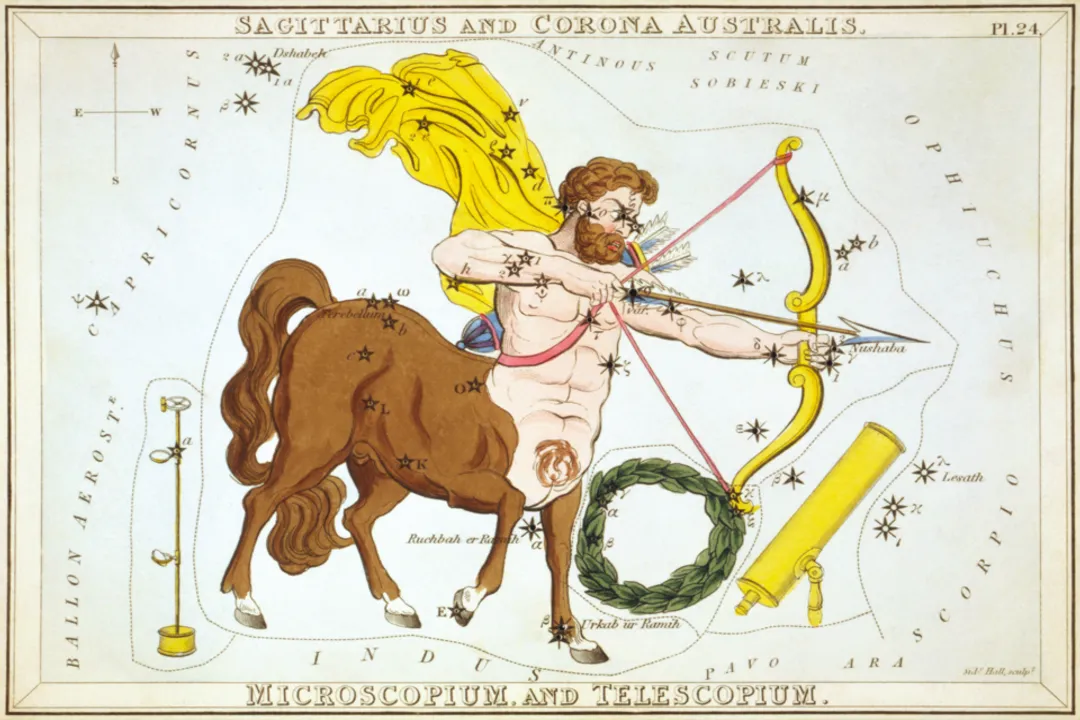
| Sagittarius | November 22 – December 21 | Ophiuchus / Sagittarius [4][5] |
| Capricorn | December 22 – January 19 | Sagittarius / Capricornus [4] |
| Aquarius | January 20 – February 18 | Capricornus / Aquarius [4] |
| Pisces | February 19 – March 20 | Aquarius / Pisces [4] |
# Current Location
To pinpoint where the Sun is located right now, one needs to consult an up-to-date celestial map that uses modern, internationally agreed-upon constellation boundaries. [1] For instance, as the year approaches its end, typically around the winter solstice in the Northern Hemisphere (late December), the Sun is passing through the boundaries of Sagittarius. [5] Sagittarius is a particularly interesting location because it is oriented toward the center of our own galaxy, the Milky Way. [5] When the Sun is in this region, the densest, brightest parts of the Milky Way are conceptually behind the Sun, making them invisible to us during the day. [5]

# Night Sky Context
A common point of confusion is trying to see the constellation the Sun is in. Since the Sun is, by definition, illuminating the sky during the day, the stars of the constellation it currently occupies are completely washed out by our star's brightness. [8] To observe any background constellation clearly, we must look at the portion of the sky opposite the Sun—the sky visible after sunset. [8] This means that if the Sun is currently in Sagittarius, the stars of Gemini (roughly opposite Sagittarius on the celestial sphere) are the ones that will be highest in the sky around midnight. [8] This inverse relationship is a fixed rule of our solar system view: the constellation directly behind the Sun is the one least visible, while the one directly across from it is best seen at our local midnight. [8]
Related Questions
#Citations
The Sun: Complete Information & Live Data | TheSkyLive
Is our sun part of a constellation? Which? : r/askastronomy - Reddit
Does the Sun belong to a constellation? - Astronomy Stack Exchange
Sun's entry into zodiac constellations, 2021 | Astronomy Essentials
Sagittarius (constellation) - Wikipedia
The Path of the Sun | ASTRO 801 - Welcome to EMS Online Courses
Is the sun part of a constellation? - Quora
Understanding Astronomy: The Sun and the Seasons - Physics
Sun's Location on the Ecliptic - SkyMarvels.com