How does something fall out of orbit?
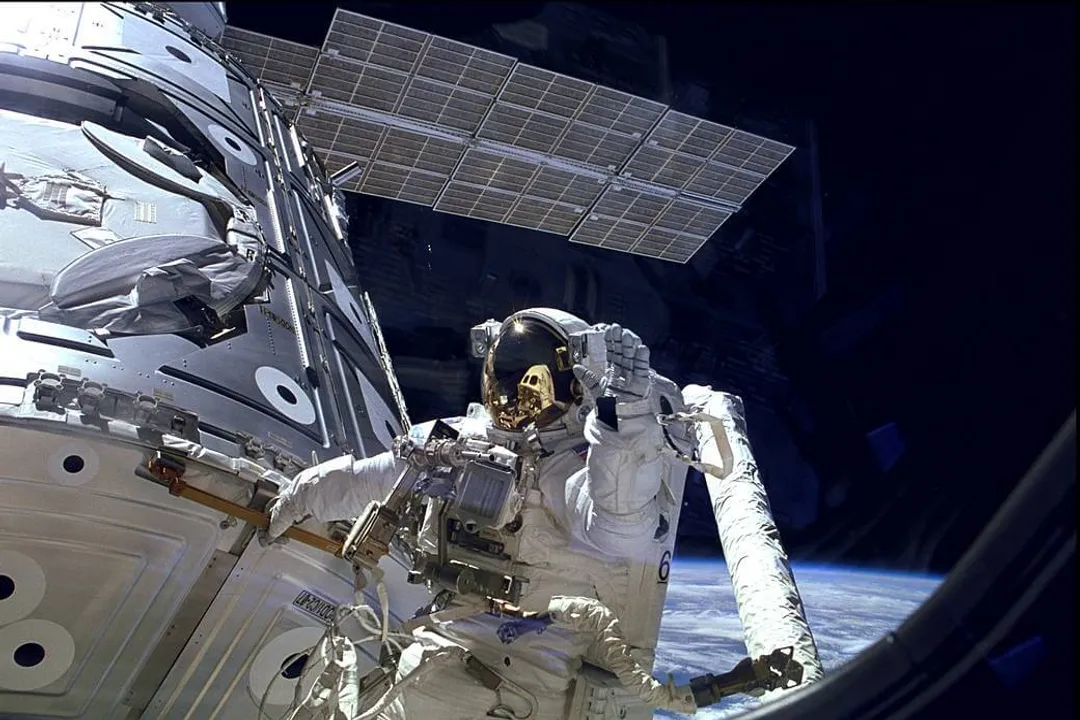
An object in orbit is perpetually falling, yet never hitting the ground, due to a perfect, dynamic balance between its forward velocity and the pull of gravity. For something to truly fall out of orbit—meaning its path curves inward toward the central body—that delicate equilibrium must be upset. This disruption can occur either through a loss of speed or an unintended increase in drag, or by being nudged off course by the gravity of other objects in the system.
# Orbital State
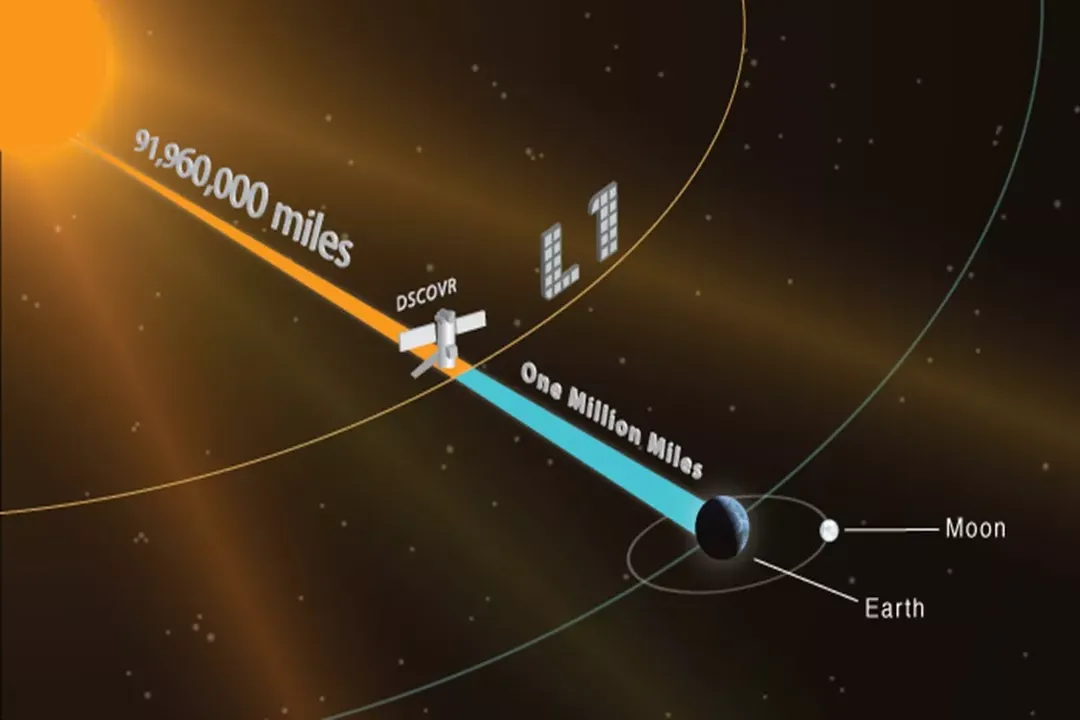
Understanding why something falls requires appreciating what keeps it up. An object maintains orbit because it is moving sideways—tangentially—so quickly that as gravity pulls it down, the curve of the Earth falls away beneath it at the same rate. If you launched a projectile fast enough, it would miss the ground indefinitely. This required speed is relative to the altitude; an object closer to a planet needs a higher tangential velocity to maintain its current path than an object farther away.
When this orbital velocity decreases, the inward pull of gravity becomes dominant relative to the reduced forward momentum, causing the object's path to dip closer to the central mass. Conversely, if an object gained significant speed without changing its altitude radically, it would enter a higher, more elliptical orbit instead of falling down. The mechanisms that cause falling always involve slowing the object down or altering the path through external gravitational forces.
# Atmospheric Friction
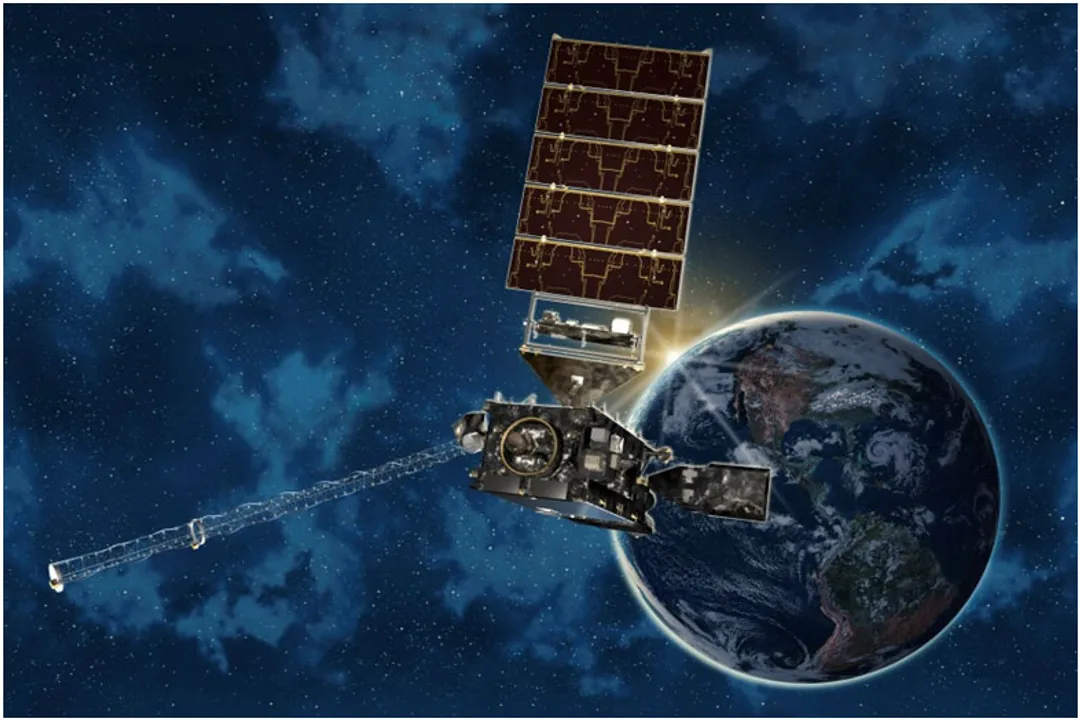
For many objects we track, particularly satellites orbiting relatively close to Earth, the primary culprit for orbital decay is atmospheric drag. Even though space is often described as a vacuum, there are still trace amounts of air molecules present, especially in Low Earth Orbit (LEO), which spans roughly 160 to 2,000 kilometers.
When a satellite plows through this thin atmosphere, these molecules create friction, an effect known as drag. This constant, albeit tiny, resistance saps the satellite’s orbital energy, translating to a slight reduction in its forward velocity. This loss of velocity means gravity wins the tug-of-war more often, causing the orbit to shrink slowly, a process called orbital decay. A satellite in a lower orbit experiences much stronger drag than one in a higher orbit because the atmospheric density is greater there.
This decay isn't always instantaneous; it can take months or even years for an object to lose enough altitude to re-enter the denser layers of the atmosphere where destruction occurs. However, the process accelerates as the orbit lowers. For instance, a satellite whose orbit drops from 800 km to 400 km will experience a dramatically faster rate of decay simply because the air molecules are far more numerous at the lower altitude. This relationship between altitude and drag is essential for spacecraft designers to calculate the projected lifespan of their hardware.
It is interesting to note that the physical characteristics of the object—its shape and density—matter significantly in this scenario. A large, light object with a big cross-section, like an uninflated balloon or a piece of lightweight debris, will decelerate much faster than a small, dense object like a steel ball of the same mass, because it presents a larger surface area to the scant atmosphere. If you imagine two identical objects, one shaped like a streamlined dart and the other like a flat sheet, the flat sheet will slow down more quickly due to higher drag coefficients.
# Perturbing Forces

While atmospheric drag dominates the decay of human-made objects in LEO, objects in higher orbits, or planets themselves, are governed more by gravitational influences from other bodies in the solar system. This is where the simplicity of the two-body problem (just the Earth and the object) breaks down, and the complexity of the multi-body problem arises.
For a planet like Earth, the Moon and the Sun exert continuous gravitational pulls that constantly tug on our orbit. While these forces are usually balanced over a full revolution, long-term interactions can lead to subtle, cumulative shifts. In theory, even the Earth's orbit around the Sun is not perfectly stable forever; the gravitational interactions with Jupiter and Saturn introduce periodic nudges that can, over astronomical timescales, cause the orbit to become slightly more or less elliptical, or slightly change its tilt relative to other planes. These instabilities are what cause orbits to become "chaotic" over millions of years.
For satellites in higher orbits, like those in Geosynchronous Orbit (GEO) or in deep space, these perturbing forces are the main source of deviation from the intended path. The Moon’s gravity, for example, creates a tidal bulge on Earth, and the satellite interacts with this bulge, slowly pulling it away from its desired track. Without correction, these nudges can cause significant drift over time, forcing controllers to fire thrusters to maintain station-keeping, which in turn slightly changes the object's total energy, although these maneuvers are designed to keep the object in orbit, not fall out of it.
One key difference between planetary orbital change and satellite orbital change lies in the timescale and the intended result. Planetary orbital changes are a slow, natural geological or astronomical phenomenon, whereas satellite perturbations are minor deviations that engineers actively fight against to prevent an eventual, undesirable decay or drift into a collision course. If a satellite were to lose all its forward velocity due to a catastrophic failure, gravity would pull it directly toward Earth, but the gravitational model suggests a path toward the primary body is only achieved if that tangential velocity drops to zero, which is highly unlikely unless the object stops completely mid-flight.
# Controlled Descent
Falling out of orbit is sometimes the desired outcome, especially for old satellites or spent rocket stages that pose collision risks. This process must be managed carefully to ensure any debris created upon re-entry burns up safely in the atmosphere or lands in designated, unpopulated oceanic areas.
To intentionally cause an object to fall, engineers do the opposite of what is needed to maintain orbit: they apply thrust against the direction of travel, which is called a retro-burn. Firing a rocket engine to slow the spacecraft down reduces its orbital velocity. This reduction in speed lowers the object's orbital path, plunging it into denser air layers faster than natural drag would. The final plunge into the lower atmosphere is rapid once the object crosses the threshold where drag significantly overcomes inertia. A well-planned de-orbit burn ensures the object hits the atmosphere at a predictable time and location, transitioning from a stable orbit to a destructive re-entry path.
When assessing how quickly an object will fall, whether naturally or intentionally, one must consider the required change in velocity, or Delta-v (). For a spacecraft to move from a stable circular orbit into a decaying elliptical path that intercepts the atmosphere, a relatively small, precise is often needed—much less than what would be required to jump to a completely different orbit, like the Moon. This highlights a critical point: an object doesn't need to stop moving entirely to fall; it just needs a tiny fraction of its total orbital energy bled off at the right spot in its path to guarantee a return trip.
# Orbital Lifespan Comparison
To put these mechanisms into perspective regarding object lifespan, we can compare typical scenarios. A defunct satellite in a very low LEO, perhaps around 300 km, might decay in a matter of months due to significant drag. By contrast, a derelict object left in a high GEO orbit (around 35,786 km) might not decay naturally due to atmospheric drag for millions of years, if ever, because the atmosphere is virtually nonexistent there. Its stability is instead dependent on overcoming the long-term gravitational perturbations from the Sun and Moon. This difference in environmental resistance is why managing LEO debris is a much more immediate concern than managing debris in GEO.
#Videos
How Objects Stay in Orbit, or How Are Objects Always Falling ...
Related Questions
#Citations
What force is preventing the planets to lose orbit and fall into the sun?
What causes an object in Earths orbit to fall out of orbit? - Quora
How Objects Stay in Orbit, or How Are Objects Always Falling ...
Why don't satellites fall out of orbit if gravity pulls everything down?
Why Don't Satellites Fall Out of the Sky? | NESDIS - NOAA
What Is an Orbit? | NASA Space Place – NASA Science for Kids
What Happens When a Planet's Orbit Goes Chaotic?
What could cause Earth to slowly fall out of orbit?
How do things stay in orbit? - IOPSpark - Institute of Physics