How do we know the mass of the universe?
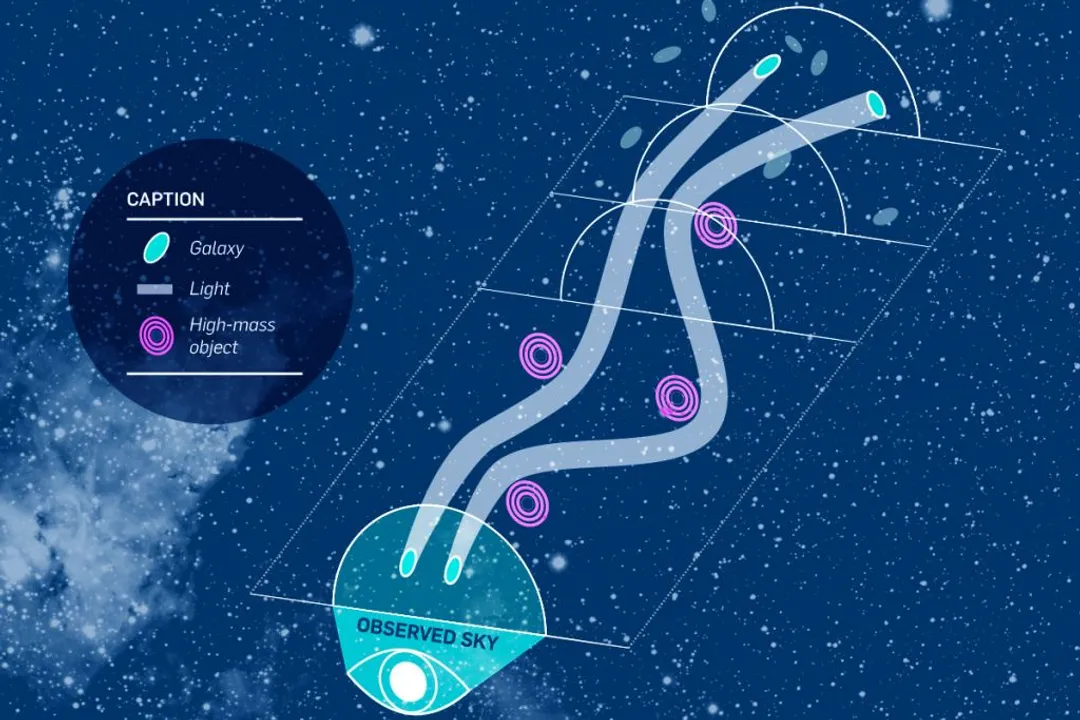
The concept of measuring the mass of the entire universe sounds like something out of science fiction, yet cosmologists have developed ingenious methods to arrive at an estimate for this staggering quantity. We cannot place the cosmos on a scale, of course. Instead, determining the "mass" of the universe really boils down to measuring its density—how much matter and energy are packed into a given volume of space—and relating that density to the geometry and expansion history of the cosmos itself. [7][8] This estimation process is complex because the majority of what constitutes the universe is currently invisible to us.
# Observable Scope

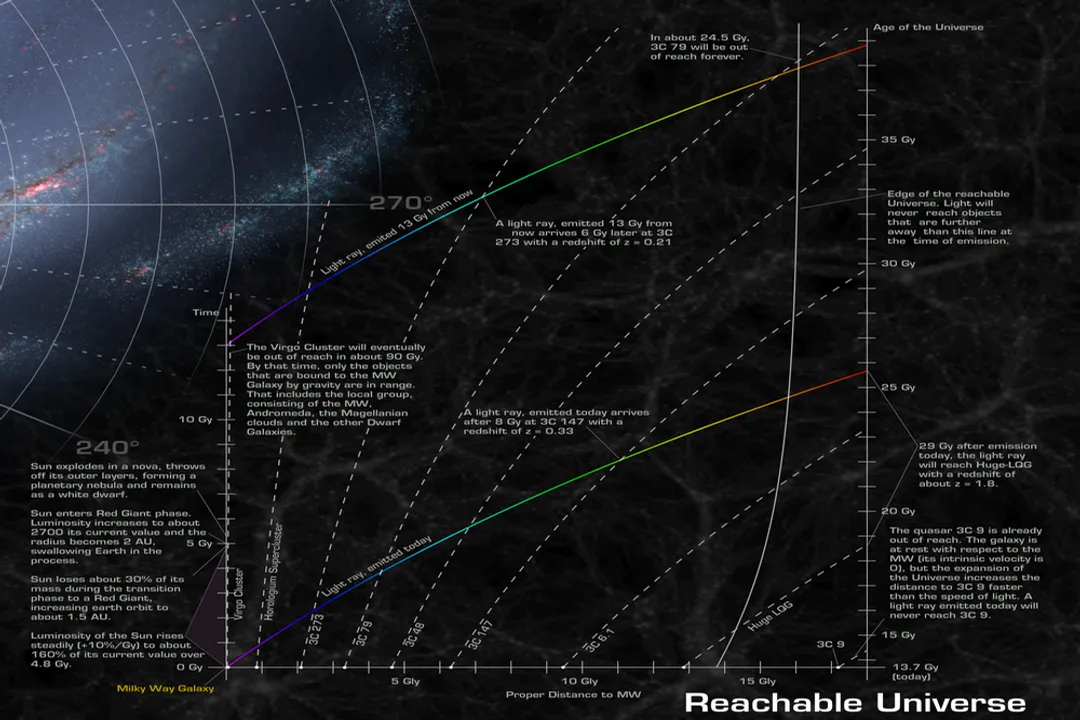
Before weighing anything, we must define the container. The universe is effectively infinite, but we can only discuss the mass we can observe. [7] This limit is set by the speed of light and the age of the universe, defining the observable universe. [4][7] Light from objects farther away than about 13.8 billion light-years has not had time to reach us since the Big Bang. [4] This observable sphere has a radius of approximately 93 billion light-years in co-moving distance, encompassing a finite, albeit colossal, volume. [4] Any mass calculation must, by necessity, be confined to this accessible volume. [7]
# Critical Density
The key to translating observation into total mass lies in understanding the critical density. [8] Cosmologists look at the overall geometry of space. Based on Einstein's theory of General Relativity, the total mass-energy density determines this geometry. [8] If the actual density is higher than the critical density, the universe would be "closed," meaning it curves back on itself like a sphere, and gravity would eventually halt expansion. [8] If the density is lower, the universe is "open," negatively curved like a saddle, and expansion continues forever. [8] If the density exactly matches the critical value, the universe is "flat," which is what current observations strongly suggest. [8]
To find the total mass, we calculate the mass-energy equivalent within the observable volume based on this critical density estimate. [8] This calculation yields an enormous figure, often expressed in terms of mass density, such as about grams per cubic centimeter, which represents the total critical density needed for a flat universe. [8]
# Expansion Rate
A major clue in determining this density comes from observing how the universe is expanding—the Hubble constant. [3] By measuring how fast galaxies are receding from us, we can infer the gravitational effects of the mass contained within them and the space between them. [3] Early estimates often focused solely on visible matter—the stars, galaxies, and gas clouds—using techniques like tracking the movement of galaxies or observing gravitational lensing, where massive objects bend the light from objects behind them. [3][1] However, these methods quickly revealed a problem: there simply wasn't enough visible matter to explain the observed gravitational effects or the required critical density for a flat geometry. [1]
# The Missing Components
This discrepancy leads us directly to the two dominant, invisible components of the universe: dark matter and dark energy. The mass of the universe is not dominated by the atoms that make up everything we see and touch. [6][10]
Dark matter, which interacts gravitationally but does not emit or absorb light, accounts for roughly 27% of the total mass-energy content. [5][10] Its existence is inferred by observing its gravitational influence on visible matter, such as the rotational speeds of galaxies—they spin too fast to hold together based on visible mass alone. [5]
Dark energy, conversely, is not "mass" in the traditional sense but is an unknown form of energy inherent in space itself that drives the accelerated expansion of the universe. [5][10] It makes up the vast majority of the universe's total energy budget, comprising about 68%. [5][10]
To put this into perspective, ordinary baryonic matter—the stuff that forms stars, planets, and people—accounts for only about 5% of the total mass-energy budget of the observable universe. [5][10] It is a humbling realization that our familiar world is just a tiny fraction of the cosmos's total composition. [6]
| Component | Approximate Percentage (%) | Primary Observational Constraint |
|---|---|---|
| Dark Energy | Cosmic Acceleration/Expansion Rate | |
| Dark Matter | Galaxy Rotation Curves / Gravitational Lensing | |
| Baryonic Matter (Normal) | Light Emission / Direct Counting |
This table highlights a critical point: our knowledge of the mass budget relies heavily on measuring effects rather than direct detection. While we can calculate the expected mass from the required critical density of a flat universe, the composition—the ratio of those components—is derived from observations like the cosmic microwave background (CMB) radiation. [3]
# Probing the Early Universe
The most precise way we constrain the total mass-energy density and its distribution comes from studying the Cosmic Microwave Background (CMB). [3] The CMB is the faint afterglow of the Big Bang, light released when the universe became transparent about 380,000 years after its birth. [3] Tiny temperature fluctuations in this background radiation act like a snapshot of the early universe's structure. [1]
By analyzing the precise patterns (the angular power spectrum) of these fluctuations, cosmologists can mathematically model the physical conditions present at that time, including the total density of matter and the influence of dark energy. [3] The patterns observed perfectly match models that predict a spatially flat universe (zero curvature), which requires the total mass-energy density to equal the critical density. [8] In essence, the ripples in the ancient light tell us exactly how much "stuff" (both visible and dark) was needed to create those ripple heights and separations. [1]
If we were to find that the universe was not flat—if the CMB data suggested significant curvature—the required critical density would change, leading to a revision of the total estimated mass for the observable volume. [8] Currently, the high-precision data from satellites like Planck strongly constrain the universe to be flat within a very small margin of error, cementing the necessity of a total mass-energy density equal to the critical density. [3]
# Philosophical Implications of Mass Measurement
Considering the vast majority of the universe's "mass" is actually dark energy—a repulsive force causing expansion to speed up—it changes how we interpret the weight of the cosmos. If we equate mass-energy () with total content, then the universe is overwhelmingly dominated by something pushing itself apart, rather than the gravitational glue provided by matter (dark and visible) that works to pull it together. [5][10]
This leads to a peculiar thought experiment when discussing the net gravitational effect. While the total energy density is set by the critical density required for flatness, the gravitational mass equivalent is primarily determined by matter and dark matter, as dark energy functions differently, essentially having negative pressure rather than positive mass density in some contexts of gravitational analysis. [5] However, in terms of the total mass-energy budget that defines spacetime geometry, dark energy is the chief contributor, meaning the "weight" of the universe is predominantly anti-gravitational in its large-scale effect.
It’s a fascinating inversion: what we can see (the 5% baryonic matter) has the least impact on the universe's fate, while the dominant component (dark energy) determines that the universe will likely expand forever, preventing any eventual "collapse" that would have been determined by a mass-dominated, closed geometry. The measurement of mass, therefore, is less about finding a total "weight" and more about solving a cosmic accounting puzzle that dictates destiny. [8] The precise quantification of these ratios, enabled by mapping the CMB, offers tangible, testable predictions about the universe’s ultimate geometry and fate, moving these concepts far from mere speculation into the realm of measurable science. [3]
# Synthesizing Measurements
The current estimate for the mass-energy equivalent of the observable universe is derived by multiplying the volume by the critical density inferred from the CMB observations. [8] Since the critical density is around grams per cubic centimeter, and the observable universe's co-moving radius is about meters (the 93-billion-light-year diameter), the numbers become astronomical quite quickly. This exercise highlights that the mass we calculate is a cosmic average, not a sum of individual galactic masses, though the latter contributes to the dark and visible matter components of that average. [1][2] We confirm the total mass scale by ensuring the calculated density matches the flatness requirement derived from early-universe fluctuations. [3]
The tools required—precision telescopes mapping microwave radiation, instruments looking for gravitational lensing distortions, and surveys tracking redshift to measure expansion—are extremely sensitive. If any of these observational pillars were off by a significant margin, the calculated mass composition would shift dramatically, potentially yielding a universe dominated by matter (closed geometry) or one accelerating even faster due to an even greater dark energy fraction. The consistency across these independent lines of evidence—expansion, structure, and background radiation—is what gives confidence to the current mass-energy budget breakdown. [3]
Related Questions
#Citations
How do we know the mass of the universe? : r/Physics - Reddit
How is the total mass of the universe calculated?
How did we measure the mass of the universe?
Observable universe - Wikipedia
Mass, Size, and Density of the Universe
The mass of the universe - Phys.org
How Do You Weigh The Universe?
Calculation of the Mass of the Universe, the Radius of ... - Scirp.org.
Dark Energy and Dark Matter | Center for Astrophysics | Harvard ...
The mass of our Universe - Dark Cosmos