What process drives the Sun's energy production, fusing 600 million tons of hydrogen per second?
Answer
The proton-proton chain reaction
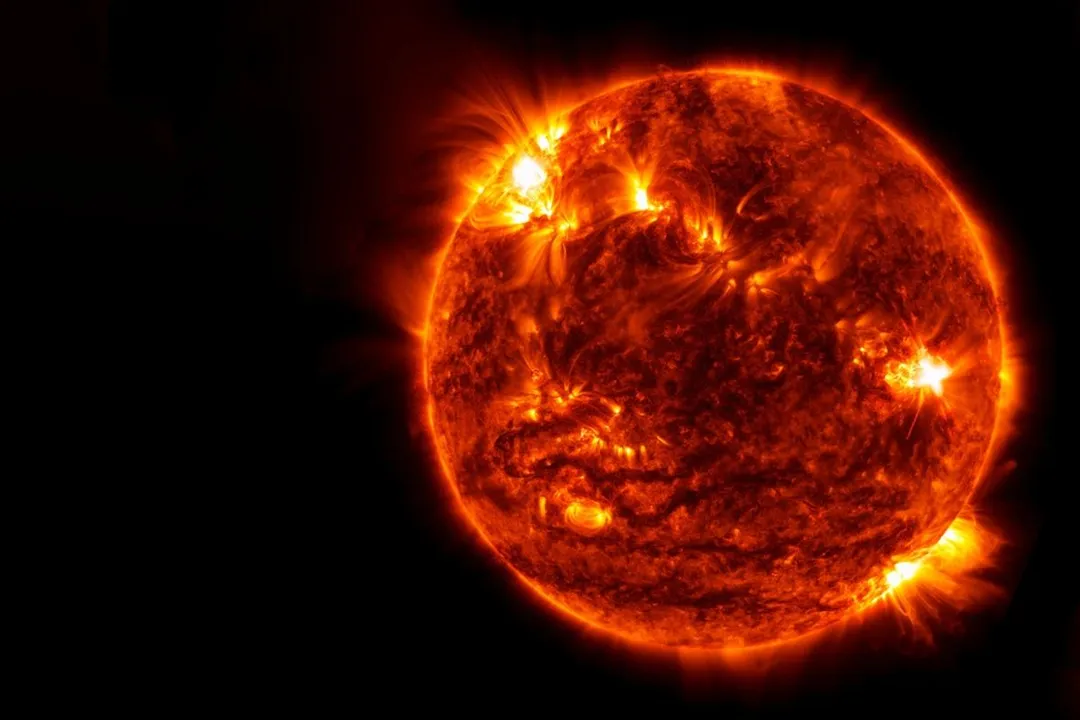
The immense energy output of the Sun, specifically the consumption of about 600 million tons of hydrogen every second to create helium, is powered by the proton-proton chain reaction. This specific sequence of nuclear reactions is the dominant energy generation mechanism in stars the size of or smaller than the Sun. It is this highly efficient, sustained conversion of mass into energy at the core that validates the Sun's status as a self-luminous celestial body defined by thermonuclear processes, setting it apart fundamentally from non-fusing objects.
Related Questions
What specific classification defines the Sun as a G-type main-sequence star?What physical process distinguishes the Sun as a star from large planets like Jupiter?In terms of luminosity compared to its stellar peers, how does our Sun generally rank?What is the calculated mass of the Sun in kilograms, according to astronomical measurements?How far is the Earth from the Sun when measured in Astronomical Units (AU)?What classification describes the stage in the H-R diagram where the Sun spends most of its existence?What is the approximate core temperature of the Sun in degrees Celsius?What specific stellar type is far less massive than the Sun and burns fuel for trillions of years?What process drives the Sun's energy production, fusing 600 million tons of hydrogen per second?What future evolutionary state awaits the Sun after it exhausts its core hydrogen fuel?