Is the Sun considered a star?
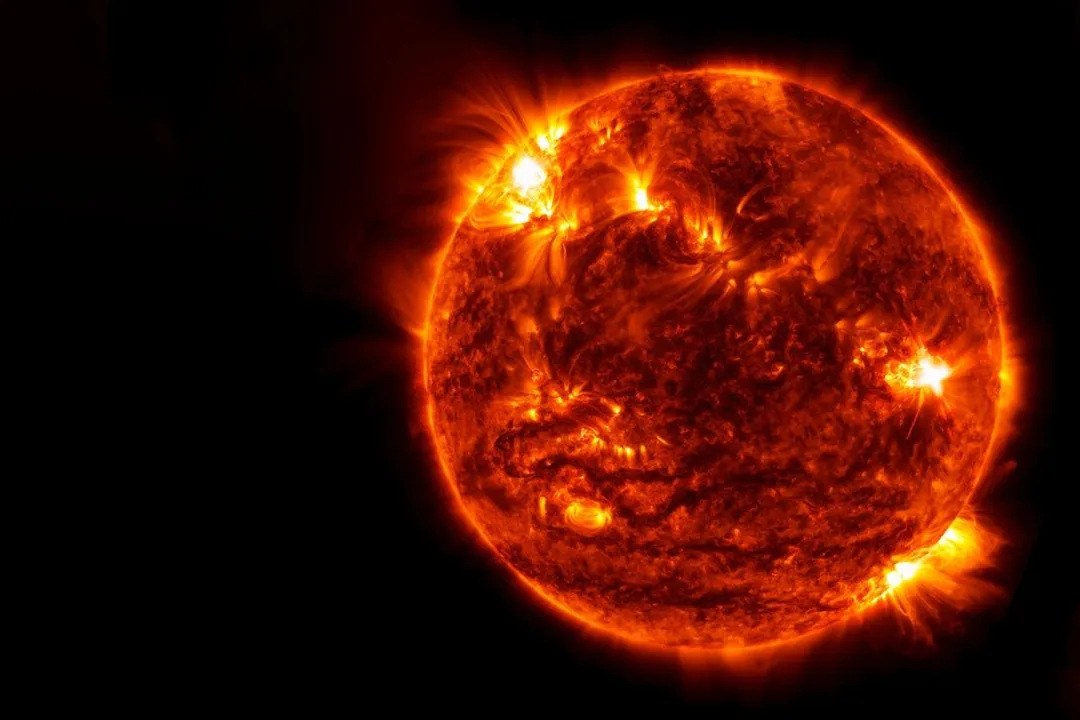
The celestial body anchoring our solar system, the one that warms our skin and dictates our seasons, is indeed classified as a star. [1][4][10] It is not a planet, nor is it a unique cosmic phenomenon separate from the billions of points of light we observe in the night sky; it is simply our star, the one whose proximity allows us to study it up close. [5] Its classification is based on its fundamental nature: it is a massive, luminous ball of plasma held together by its own gravity, deriving its energy from thermonuclear fusion occurring deep within its core. [2][4]
# Solar Identity

At its most basic, the Sun is a star, a category of astronomical object defined by its ability to generate light and heat through sustained nuclear reactions. [3][4] This process involves fusing lighter elements into heavier ones in the intensely hot and dense core. [1] Specifically, the Sun is primarily composed of hydrogen—about $73%$—and helium, which makes up roughly $27%$ of its mass. [1] This ongoing fusion is what defines it as a star, distinguishing it from planets, which, like Earth, shine only by reflecting the light of their parent star. [3][4]
The Sun is the gravitational anchor of our solar system, around which everything else orbits, including the eight major planets, asteroids, and comets. [2][10] It contains over $99.8%$ of the total mass of the entire solar system. [1] This immense gravitational dominance ensures that the planets, including Earth, remain in their predictable paths around it. [2]
# Planetary Contrast

The simplest way to understand why the Sun is a star and not a planet lies in the definition of the two terms and the process that powers them. [3] Planets, by definition within our solar system, orbit a star and have cleared their orbital paths of other debris. [3] Crucially, planets do not generate significant energy via nuclear fusion in their cores—they are fundamentally cold relative to a star. [3] While planets like Jupiter generate some internal heat from gravitational contraction, this is negligible compared to the solar furnace. [3]
The Sun, being a star, is an emitter of light and heat. [4] If we were to observe the Sun from a great distance, it would appear much like any other star in the night sky—a brilliant point of light. The reason it appears so large and bright to us is purely due to its relative nearness. Consider that the Sun is only about $8$ light-minutes away, whereas the next closest star, Proxima Centauri, is over $4.2$ light-years away, an incomprehensibly vast distance. [1][2] The difference between seeing a huge, bright disk and a tiny, faint pinprick highlights the effect of distance on our perception of stellar size and brightness. [5]
If we tried to gauge the Sun's energy output purely by how much it illuminates Earth, we might mistakenly assume it's uniquely powerful. However, many stars we see in the night sky are intrinsically far more luminous, yet they appear dim because they are so distant. Our Sun, by contrast, is the only star whose surface features, like sunspots, we can observe directly. [5] Thinking about the sheer scale, if you were to line up the Sun's diameter of approximately $864,000$ miles next to Earth's diameter, the Sun could fit about $109$ Earths across its face. [1] Yet, some stars dwarf the Sun considerably; a star like Betelgeuse is so large that if it replaced our Sun, its surface would extend past the orbit of Jupiter. [7]
# Stellar Neighbors
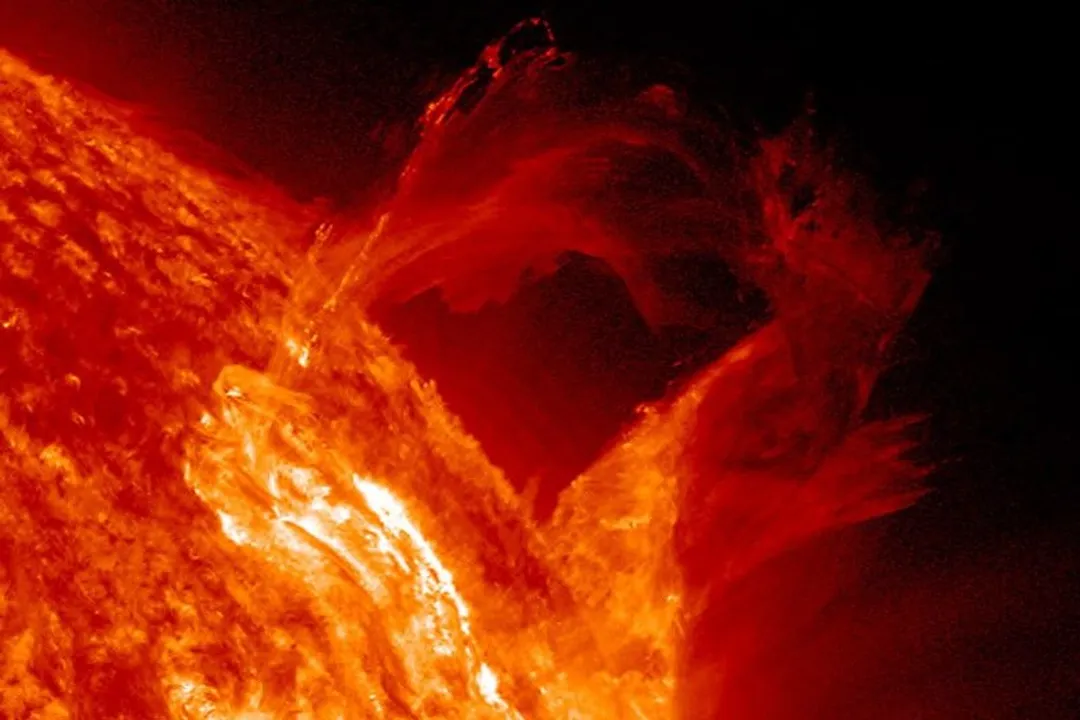
The question often arises: If the Sun is a star, are all stars like the Sun? The answer is a definitive no. [5] The term "star" is a broad classification encompassing an enormous diversity of sizes, temperatures, ages, and evolutionary stages. [5] Our Sun holds a specific place within this cosmic zoo. [5]
The Sun is classified as a G-type main-sequence star, often informally called a yellow dwarf. [2] It is currently about $4.6$ billion years old and is fusing hydrogen into helium in its core, placing it squarely on the main sequence stage of stellar life. [1]
There are far more stars in the universe that are not like our Sun. The most common type of star, by a large margin, is the red dwarf, which are smaller, cooler, and much dimmer than the Sun. [5] Conversely, there are massive stars, such as blue giants or super-giants, which burn through their fuel hundreds or thousands of times faster than the Sun and live much shorter lives. [7] When we refer to stars, we are talking about this vast population, only one member of which is our local, familiar G-type star. [5]
This brings up an interesting semantic point regarding naming conventions. "Sun" with a capital 'S' is the proper noun, the specific name for our star. [5][6] Other star systems that host planets will have their own star, which is, in essence, their sun. [5][6] If an exoplanet orbits Alpha Centauri A, then Alpha Centauri A is that planet's sun, even though we call it by its proper catalogue name. [6] The Sun is unique to us in name, but generic in classification. [5]
# Solar Statistics
Understanding the Sun's place requires knowing a few key numbers that define its "averageness". [7]
| Characteristic | Value | Notes |
|---|---|---|
| Age | Billion Years | Currently in its middle age [1] |
| Diameter | Miles | Large enough to fit Earths across it [1] |
| Surface Temperature | degrees Fahrenheit | The visible surface, or photosphere [1] |
| Core Temperature | Million degrees Fahrenheit | Where nuclear fusion occurs [1] |
| Spectral Type | G2V (Yellow Dwarf) | A common classification on the main sequence [2][7] |
While it may seem like the most important object in existence—and it certainly is for us—the Sun's physical parameters place it squarely in the middle ground of stellar populations. [7] If we were to create a census of all stars in the Milky Way, the Sun would be closer to the median than to the extreme ends of the size or temperature spectrum. [7] It is neither the smallest, coolest, nor the largest, hottest star known. [5]
To put the Sun’s status as an "average" star into perspective, one could imagine a theoretical stellar population chart. If you plotted the mass of every star, the distribution would likely show a massive spike toward the low-mass red dwarfs, far below the Sun's mass. The Sun would sit on the higher shoulder of that main, crowded peak. On the other end, the incredibly rare, massive blue giants would trail off in a long, thin tail. [7] Our G-type star is a solid, reliable mid-range performer in this cosmic context. [7]
# Lifespan Dynamics
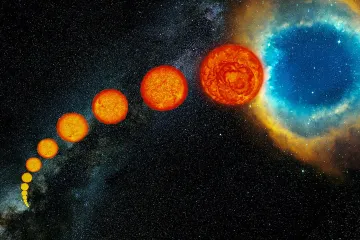
A star’s life is defined by its fuel and its mass. The Sun’s relatively moderate mass means it has a respectable lifespan, estimated to be around $10$ billion years on the main sequence. [1] It is currently halfway through this stable period. [1]
When a star runs out of hydrogen fuel in its core, it evolves off the main sequence. For the Sun, this will mean expanding dramatically into a red giant, engulfing the inner planets, before eventually shedding its outer layers to become a white dwarf. [1] Larger stars meet much more dramatic ends, often exploding as supernovae, while smaller stars simply fade away over trillions of years. [7] The Sun’s fate is relatively placid compared to the most massive stars, yet it is far more dynamic than the quiet fade of the smallest red dwarfs. [5]
If you ever find yourself trying to grasp the difference between star types, try this mental exercise: Imagine the Sun is a typical gasoline-powered family sedan—reliable, common, and capable of carrying you reliably for a long distance. A massive blue giant is like a top-fuel dragster—incredibly fast and powerful, but it burns through its fuel in seconds and then explodes spectacularly. The dim red dwarf is more like a highly efficient electric scooter—it will run for an incredibly long time, but you wouldn't get very far, very fast. [7] The Sun is built for the long, steady commute. [1]
In essence, the Sun is the archetype of a star because it perfectly matches the physical definition: a self-luminous sphere of plasma undergoing sustained nuclear fusion. [4] Its capital 'S' name confirms its identity as our local powerhouse, but its characteristics place it firmly within the large, stable middle class of stellar objects that populate the universe. [5][7]
Related Questions
#Citations
Our Sun: Facts - NASA Science
Sun - Wikipedia
ELi5 what makes the sun a star and not a planet? And why ... - Reddit
Our Sun is a Star - Facts About the Sun | Exploratorium
Why is the sun considered a star? Are there different types ... - Quora
The Sun Is A Star. But Is Every Star A Sun? - IFLScience
Why is the Sun called an "average star"? - Physics Stack Exchange
How Do We Know The Sun Is a Star? ☀️ #astronomy ... - YouTube
Is a Sun a Star or a Planet? How We Know - Discover Magazine