Are K stars hotter than the Sun?

The Sun, our nearest star, serves as the benchmark for almost every celestial body we study, often prompting a simple, yet profound, question about its fiery neighbors: are K-type stars hotter? When we look up at the stellar catalogue, we find that the answer is consistently no. K-type main-sequence stars occupy a specific niche in the stellar hierarchy, generally residing just a step cooler than our familiar G-type star. [1][7] They are categorized as "Orange Dwarfs" in some descriptions, a name that hints at their slightly cooler, reddish-orange hue compared to the Sun's brighter yellow-white appearance. [3]
# Stellar Classification
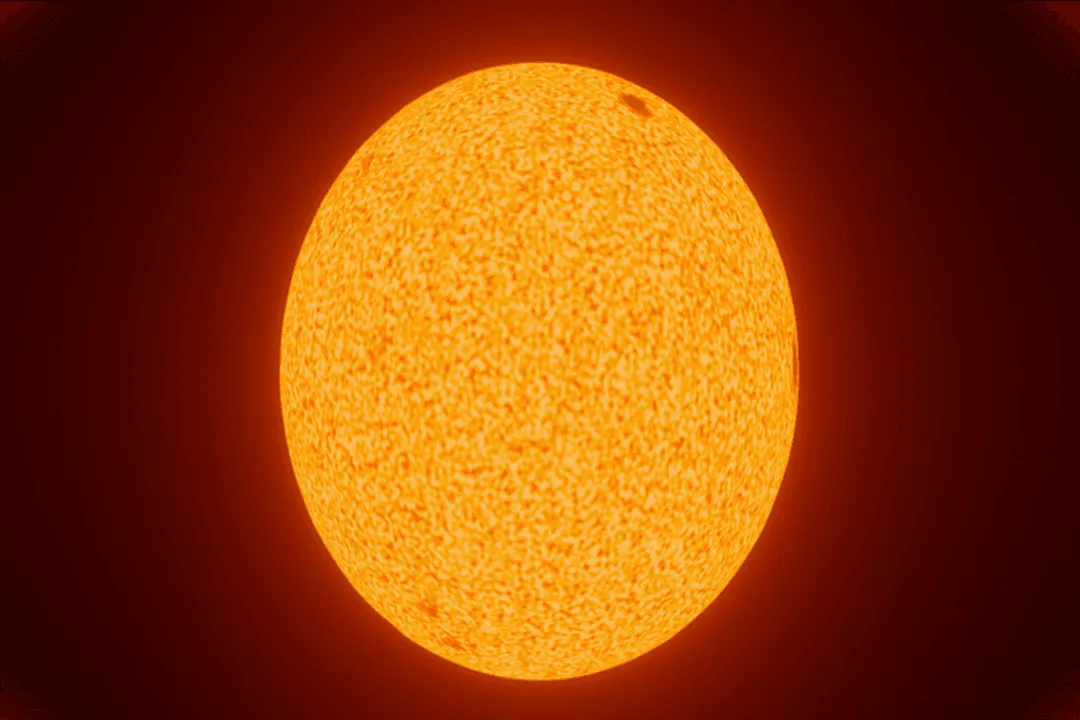
Understanding the temperature relationship requires a brief look at the system astronomers use to sort the stars visible across the galaxy. This system, known as the spectral classification sequence, orders stars primarily by their surface temperature, running from the hottest stars, designated 'O', down through 'B', 'A', 'F', 'G', 'K', and finally to the coolest, 'M' stars. [2][7][8]
Our own Sun sits squarely in the 'G' category, specifically classified as a G2V star. [7][8] The 'G' designation places it in the middle-to-upper range of stellar temperatures, giving us a solid reference point. [2] Following the Sun on this sequence are the 'K' stars, which represent the next step cooler on the thermal ladder. [1][7] This orderly arrangement means that by definition within the Morgan–Keenan (MK) system, the K-class stars possess surface temperatures lower than the F and G classes that precede them. [8]
# Temperature Comparison
The specific temperature range for K-type main-sequence stars is generally cited as being between approximately $3,700$ and $5,200$ Kelvin. [1][7] In contrast, the Sun, classified as a G2V star, boasts a surface temperature of about $5,778$ Kelvin. [7] This difference is significant when discussing stellar activity and evolution.
If we set the Sun's temperature as our standard, K stars are definitively cooler. [1][7] An 'Orange Dwarf' will be measurably less energetic at its surface than the yellow star at the center of our solar system. [3] For example, the coolest K stars hover near $3,700$ K, putting them nearly $2,000$ degrees cooler than the Sun, while the hottest K-type stars approach the lower limit of the G-type class, topping out just shy of $5,200$ K. [1][7]
To better illustrate where the Sun fits into the broader context of stellar temperature, consider this relative breakdown based on the spectral classes:
| Spectral Class | Color Description | Surface Temperature Range (Approx. K) | Relative to Sun (G2V) |
|---|---|---|---|
| O & B | Blue/Blue-White | > $10,000$ to $30,000+$ | Much Hotter |
| A & F | White | $6,000$ to $10,000$ | Hotter |
| G | Yellow-White | $5,200$ to $6,000$ | Reference Point |
| K | Orange | $3,700$ to $5,200$ | Cooler |
| M | Red | $2,400$ to $3,700$ | Much Cooler |
This table shows that the K-type star population exists in a thermal 'valley' between the slightly warmer G-stars and the much cooler M-type red dwarfs. [1][7][8]
# K Star Properties
K stars are not just defined by being slightly cooler than the Sun; they possess a distinct set of physical attributes that make them scientifically compelling. Being cooler generally translates to lower mass and less luminosity when comparing main-sequence stars of similar ages. [1][8]
The mass of a K-type main-sequence star is typically between $0.5$ and $0.8$ times the mass of the Sun. [1] Luminosity, or the total energy output, is also scaled down, meaning a K star emits less total light than a G-type star like ours. [1] This lower energy output is a direct consequence of their lower core temperatures and fusion rates compared to the Sun. [8] A K star might only shine with $10$ to $50$ percent of the Sun's luminosity. [1]
This lower energy output also dictates their spectral signature. The absorption lines observed in a K star's light spectrum are characterized by strong lines of ionized calcium, neutral metals, and some molecular bands, distinguishing them from the spectral features dominated by neutral metals found in G-type stars like the Sun. [8]
# Longevity and Habitability
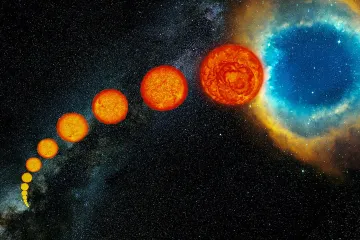
Perhaps the most fascinating aspect of K stars, which sets them apart from both hotter and cooler neighbors, is their remarkable longevity. Stellar lifespan on the main sequence is incredibly sensitive to mass; less massive stars burn their nuclear fuel far more slowly. [3][8]
Since K stars are less massive than the Sun, their fuel consumption is much more economical. While the Sun is expected to spend about $10$ billion years on the main sequence, K-type stars can last for $15$ to $30$ billion years, or even longer depending on their exact mass within the class. [3] This extended period of relatively stable energy output offers profound implications for the possibility of life developing around them.
When we consider searching for life, the Sun has about five billion years left before it begins its transition into a red giant phase. [4] A K star, however, offers its habitable zone planets a much longer tenure under stable, life-sustaining conditions. [3] If life requires billions of years to evolve complex structures, a star that offers double the main-sequence lifetime presents a significantly more patient cosmic incubator. While their habitable zones are closer to the star than ours is to the Sun (due to lower luminosity), their extended lifespan gives any potential biosphere a massive temporal advantage over Earth's residents.
# Observing Orange Dwarfs
While K stars are abundant—they represent about $13$ percent of the stars in the local solar neighborhood—finding the brighter examples can be challenging because they are intrinsically dimmer than many stars we commonly observe. [3] The brightest K-type stars observable from Earth are often giants or subgiants, which have swollen up as they age, masking their original main-sequence characteristics, or they might simply be stars that are exceptionally close to us. [5] For instance, Alpha Centauri B, part of our nearest star system, is a bright K-type star, but it requires a telescope to resolve it distinctly from the brighter A-type star, Alpha Centauri A. [5] The vast majority of K dwarfs, the main-sequence stars, are too faint to be easily spotted with the naked eye. [5]
# The Cooler Reality
Ultimately, the answer to whether K stars are hotter than the Sun is a straightforward comparison of their assigned spectral classes. The G-class Sun sets the standard for yellow-white stars around $5,778$ K. [7] The K-class, situated immediately after G in the sequence, represents stars that are undeniably cooler, existing in the orange-hued segment of the spectrum with surface temperatures dropping below $5,200$ K. [1][3][7] They are dimmer, less massive, and burn their hydrogen fuel at a slower, steadier pace than our own star, making them excellent candidates for long-term astronomical observation and the search for enduring extraterrestrial ecosystems. [3][4]
#Videos
Why are K-type stars considered cooler and orange? - YouTube
Related Questions
#Citations
K-type main-sequence star - Wikipedia
Stellar Classification | The Schools' Observatory
What Is A K-Type Star? And Why Do They Matter? | IFLScience
Stars in an Exoplanet World - NASA Science
Are there any bright *main-sequence* K-type stars in the night sky ...
Why are K-type stars considered cooler and orange? - YouTube
K-type Stars Definition - Intro to Astronomy Key Term | Fiveable
AST 101: Spectral Classifications
K Stars - Universe Today