Can James Webb see Proxima Centauri?
The question of whether the James Webb Space Telescope (JWST) can "see" Proxima Centauri often stems from a fundamental misunderstanding of what a telescope actually does. If you imagine a photograph showing the swirling clouds or surface topography of a distant exoplanet, you are picturing an achievement that remains far beyond our current capabilities. However, if you define "seeing" as the ability to detect light, analyze chemical signatures, and confirm the presence of celestial bodies through sophisticated measurement, then JWST is arguably the most capable instrument humanity has ever pointed at our closest stellar neighbor [1.3].
The confusion usually lies in the difference between resolution and sensitivity. To "resolve" an image means to distinguish individual features—like seeing the separation between two headlights of a car from a distance. To "detect" means simply realizing that a specific photon of light originated from a certain direction. JWST is designed for the latter on a monumental scale, but it is not a "planet photographer" in the way many enthusiasts hope [1.3].
# Imaging Limits
Physics imposes a strict limit on what any telescope can resolve, determined by its aperture size and the wavelength of light it observes. The angular resolution of a telescope is proportional to the wavelength of light divided by the diameter of the mirror. Even with its massive 6.5-meter primary mirror, JWST is not nearly large enough to resolve the disk of Proxima Centauri, let alone a planet orbiting it [1.3].
To put this in perspective, Proxima Centauri is a red dwarf, relatively small and dim. Its angular size in the sky is roughly 0.001 arcseconds [1.7]. For context, the diffraction-limited resolution of JWST is significantly coarser than that. If you were to attempt to take a direct image of Proxima Centauri with JWST, the star would appear not as a detailed sphere, but as a bright point source, likely surrounded by "diffraction spikes"—the characteristic six-pointed flare caused by the telescope's hexagonal mirrors and support struts [1.3].
Even the most powerful ground-based observatories, which can sometimes use interferometry to combine light from multiple telescopes and effectively create a larger "virtual" mirror, still struggle to resolve surface details on anything but the largest, closest, and brightest stars [1.3]. A planet orbiting Proxima Centauri is roughly 100 times smaller than the smallest detail JWST could theoretically resolve [1.3]. Consequently, any attempt to image such a planet as a visible "disk" is impossible with current technology.
# Detection Methods
If JWST cannot take a "photo," how does it contribute to our knowledge of nearby stars? It relies on indirect methods, specifically high-contrast imaging using coronagraphs and spectroscopy. This is where JWST’s design truly shines.
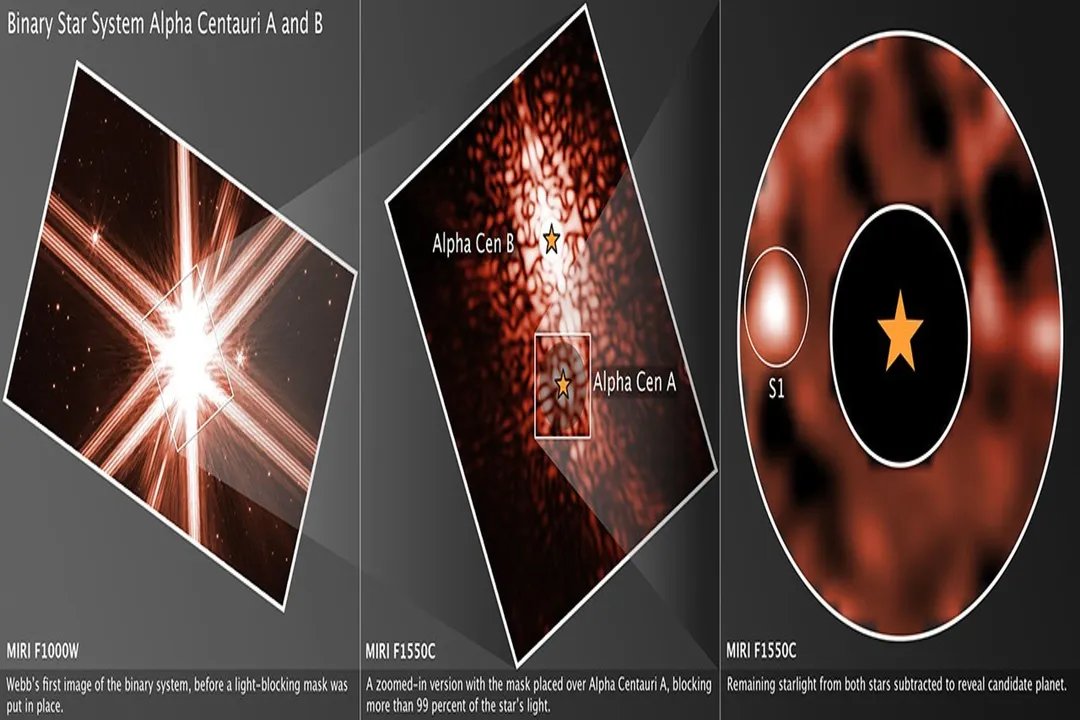
The Mid-Infrared Instrument (MIRI) on JWST includes a coronagraph—a specialized mask inside the telescope that blocks the overwhelming glare of a star, allowing the much fainter light from nearby objects to emerge from the darkness [1.4]. This is akin to holding your hand up to block the sun so you can see a bird flying near it. Without this suppression of starlight, any planet would be completely swamped by the star’s radiation [1.4].
However, this process is fraught with technical challenges. The star and the planet are often so close together that the coronagraph mask inevitably blocks part of the planet's light, or the light from the star "leaks" around the edges of the mask due to the telescope's own optical imperfections. Researchers must then use advanced computer modeling and "reference stars" to subtract the remaining starlight, leaving behind potential faint signatures of orbiting companions [1.4].

# Alpha Centauri Evidence
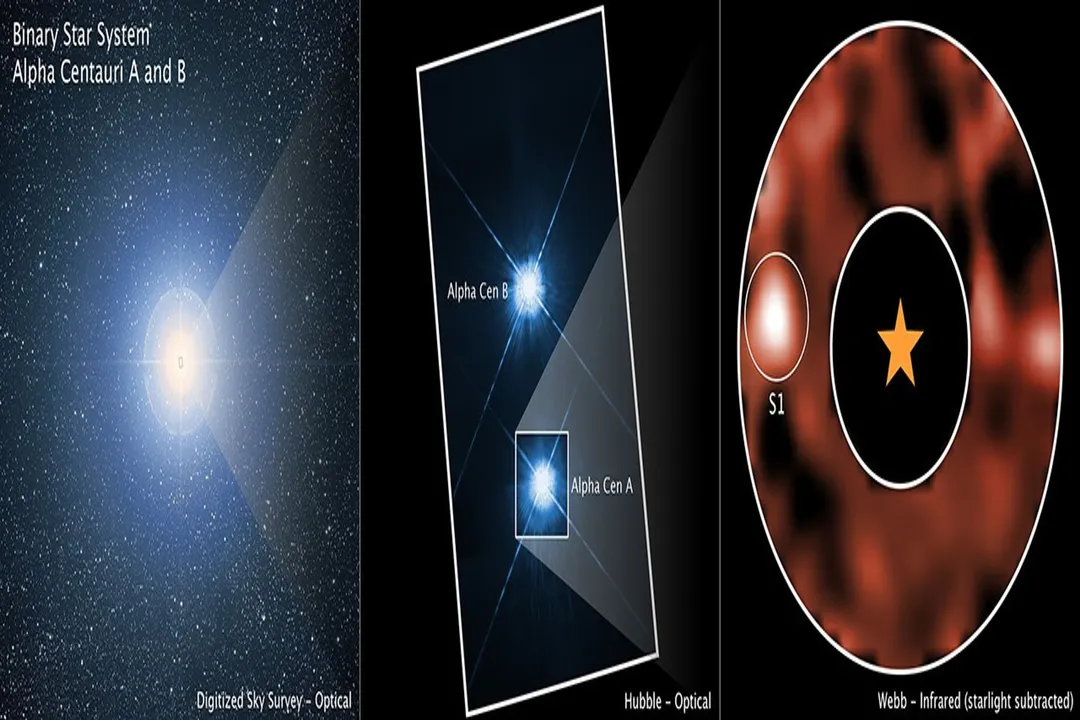
A significant development in this area involved the Alpha Centauri system, which includes the binary stars Alpha Centauri A and B, along with Proxima Centauri. In recent observations, astronomers used JWST’s MIRI instrument to conduct one of the most demanding coronagraphic studies to date [1.4][1.6].
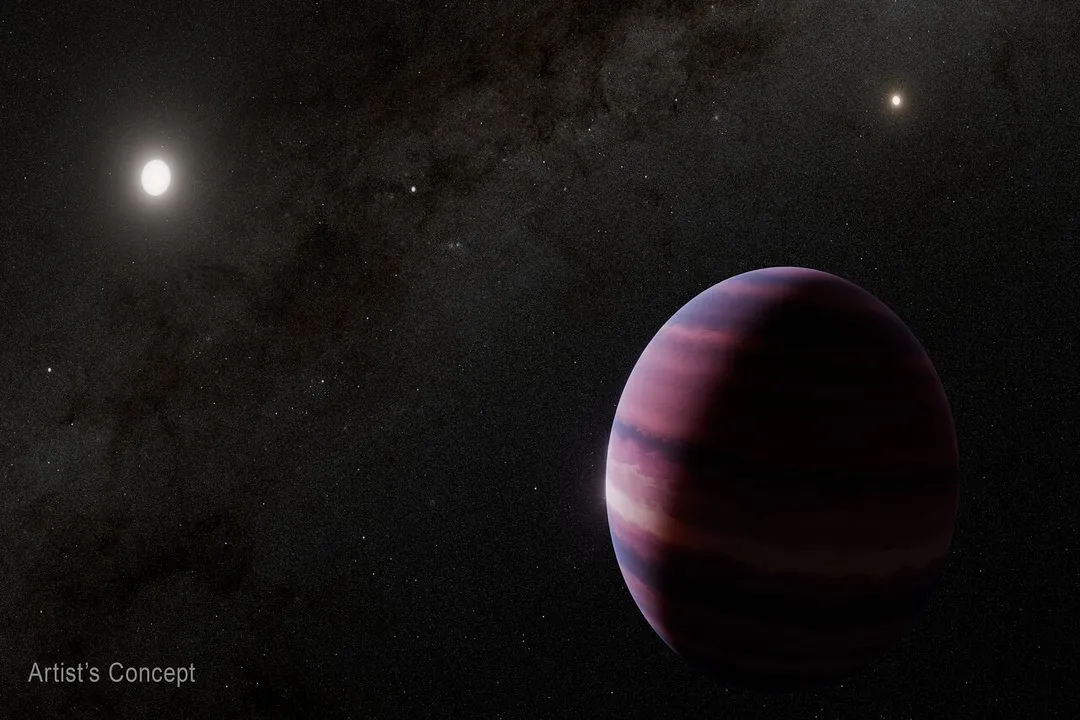
By carefully planning the observing sequence and using the coronagraph to obscure the light from Alpha Centauri A, researchers successfully identified a faint signal that could be a gas giant planet [1.4][1.6]. This was not a clear, high-resolution photo of a planetary surface. Instead, it was the detection of a persistent, faint light source that, after extensive modeling of orbits and data, appeared to be a planet roughly the mass of Saturn [1.4].
This case study highlights both the power and the frustration of modern astronomy. While the initial observations were promising, subsequent attempts to confirm the planet's position yielded no detection [1.4]. Scientists determined that the planet's orbit likely carried it into a position where it was too close to the star or obscured by the coronagraphic hardware, or perhaps the initial signal was a transient phenomenon [1.4][1.6]. This "disappearing planet" mystery demonstrates that "seeing" a planet is often an exercise in statistical probability and complex modeling rather than simply snapping an image [1.4].
| Feature | Direct Imaging | Spectroscopy |
|---|---|---|
| Primary Goal | Locate the object | Analyze composition |
| Requirement | High contrast (Coronagraph) | High precision (Spectrograph) |
| Outcome | Point source of light | Chemical "fingerprint" |
| Resolution | Unresolved (1 pixel) | Resolved by wavelength |
# Why Infrared
JWST is optimized for infrared light for a reason. Red dwarfs like Proxima Centauri are relatively cool and emit the bulk of their energy in the infrared spectrum [1.8]. Furthermore, planets, which are much cooler than their parent stars, also glow in the infrared. By observing at these wavelengths, astronomers maximize the contrast between the star and the planet [1.8].
This capability is essential for studying atmospheres. If a planet were to transit its star, or even if it were simply reflecting the star's infrared light, the MIRI instrument could potentially pick up a signature. This allows scientists to analyze the "color" or spectral content of the light, potentially detecting the presence of water, methane, or carbon dioxide in the planet's atmosphere—data that is arguably more valuable than a photograph [1.7].
# Future Outlook
While JWST continues to push the boundaries of what we can detect, we are still waiting for the next generation of telescopes to provide even clearer views. Future observatories, such as the Extremely Large Telescopes (ELTs) under construction, will have significantly larger light-collecting areas [1.3]. These ground-based giants, combined with advanced adaptive optics to cancel out atmospheric turbulence, will offer improved resolution.
Beyond that, the dream of "seeing" a surface feature—like a continent or an ocean—on an exoplanet will likely require space-based interferometry. This concept involves flying multiple small telescopes in formation, precisely spaced hundreds or thousands of meters apart, to act as a single, enormous mirror [1.3]. Such a mission would provide the angular resolution needed to turn a single, blurry pixel into a resolved image of a distant world.
For now, JWST remains the gold standard. It provides the data necessary to refine our models of planetary formation, test the stability of orbits, and search for the faint, elusive heat signatures of worlds that would otherwise remain invisible. While it cannot provide a portrait of Proxima Centauri, it provides the "vital signs" of the system, which is a significant step toward understanding our closest neighbors in the galaxy.
Related Questions
#Citations
NASA's Webb Finds New Evidence for Planet Around Closest Solar ...
Can the JWST actually image Proxima Centauri to the point ... - Reddit
JWST hunts for a hidden Earth near Proxima Centauri
How many pixels could an image of Proxima b taken by James ...
Webb finds new evidence for planet around closest solar twin