Why is there no fusion in white dwarfs?

The stellar remnants we call white dwarfs represent the final, dense stage for stars like our Sun. They are essentially cooling embers of thermonuclear burnout, shining brightly despite having ceased the power source that sustained their parent stars for billions of years. The fundamental reason we see no active nuclear fusion occurring within them comes down to a unique physical state of matter that provides support against gravity, fundamentally altering the conditions required for fusion to begin again. [2][5]
# Stellar Life Cycle

To understand the quiet state of a white dwarf, one must first appreciate its fiery past. A star spends the majority of its life fusing hydrogen into helium in its core, a process governed by hydrostatic equilibrium, where the outward pressure from fusion balances the inward crush of gravity. [6] Once the core hydrogen is depleted, the star begins fusing helium into carbon and oxygen. [6] For stars with masses similar to the Sun (up to about eight times the Sun's mass), this fusion process continues until the primary fuel is spent, and the star eventually sheds its outer layers, leaving behind the hot, compact core known as a white dwarf. [6]
# Pressure Support
The defining characteristic that prevents a white dwarf from igniting further fusion is the mechanism that stops its gravitational collapse: electron degeneracy pressure. [5][2][6] When the star sheds its outer layers, gravity tries to compress the remaining core immensely. However, the matter within the white dwarf is no longer governed by normal thermal gas laws. [2] Instead, it has reached a state where the electrons are packed so incredibly tightly that they resist further compression due to the Pauli exclusion principle. [5][6] This principle dictates that no two electrons can occupy the same quantum state simultaneously.
This degeneracy pressure is not dependent on temperature, which is a crucial difference from the pressure supporting a main-sequence star. [2] In a normal star, if the core cools, the thermal pressure drops, gravity wins, the core shrinks, heats up, and fusion reignites. In a white dwarf, even if the core temperature plummets, the electron degeneracy pressure remains, holding the star up against its own weight. [2] This means the star can remain physically stable even while steadily cooling down over eons. [6]
# Ignition Barrier
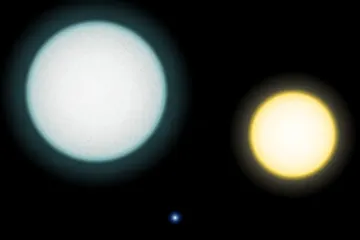
Nuclear fusion, particularly the kind that fuses heavier elements like carbon or neon, requires extreme temperatures—often exceeding $10^8$ Kelvin—to force the positively charged nuclei close enough to overcome their mutual electrostatic repulsion, known as the Coulomb barrier. [5] The core of a white dwarf, though initially scorching hot—sometimes reaching $100,000$ Kelvin or more immediately after formation [6]—is simply not hot enough, nor is the density and pressure structure conducive to starting this process on its own. [5] The electron degeneracy pressure has effectively locked the nuclei into a configuration where the kinetic energy (related to temperature) is insufficient to overcome the electrical repulsion necessary for fusion. [5]
Consider the sheer density involved. If you took a single teaspoon of white dwarf material, it would weigh several tons. [6] To put that into perspective, a typical stellar core relies on heat pushing outward. If we imagine a miniature version of this stellar collapse on Earth—say, taking a cubic meter of ordinary material and compressing it to the density of a white dwarf, which is around $10^9$ kilograms per cubic meter—the resulting gravitational potential energy release would be immense, but the stability of the final state is what matters here. [2] The material is already supported by quantum mechanical forces, not thermal energy, thus eliminating the temperature feedback loop required to restart the fusion engine. [5]
# Mass Limit
While fusion is suppressed by the lack of temperature and the presence of degeneracy pressure, there is a hard upper limit to how much mass this pressure can support: the Chandrasekhar Limit, which is approximately $1.4$ times the mass of the Sun (). [5]
If a white dwarf accretes mass from a binary companion star and pushes its mass above this threshold, electron degeneracy pressure fails to contain gravity. [5] This triggers a catastrophic gravitational collapse, which rapidly increases the core temperature and density to the point where carbon fusion ignites explosively throughout the star. [5] This runaway reaction destroys the star entirely in a brilliant Type Ia supernova explosion. [5] Therefore, the only way a white dwarf can undergo further fusion is if it violates the very physical conditions (remaining below ) that define it as a stable white dwarf in the first place. [5]
# Fading Light
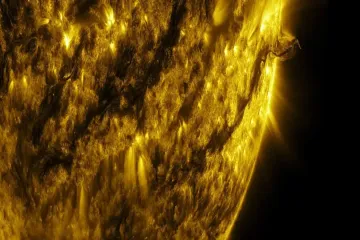
If fusion isn't powering the white dwarf, what makes it shine? The light emitted by a white dwarf is purely thermal; it is the residual heat left over from the star's life, which it radiates into space over vast timescales. [6][1] When first formed, they are very hot, often exhibiting a blue-white color, but they lack the internal energy generation of a main-sequence star. [6]
As they cool, their surface temperature drops, causing them to shift in color from blue/white to yellow, then red, and eventually fade from view. [6] This cooling process is incredibly slow, taking billions or even trillions of years. [1]
A fascinating consequence of this long cooling phase is the process of crystallization. [9] As the temperature drops sufficiently, the atomic nuclei within the degenerate plasma can transition from a disordered liquid state to an ordered crystalline lattice structure, much like water turning to ice, though on a vastly different scale. [9] This phase change releases latent heat, temporarily slowing the cooling rate, effectively meaning the star emits a final burst of energy as it "solidifies". [9] Eventually, after an unimaginably long period, the white dwarf will cease radiating detectable light and become a cold, dark black dwarf. [6]
If we consider the current age of the universe, estimated to be about $13.8$ billion years, it is generally accepted that no white dwarf has cooled down enough to become a true black dwarf yet. [1] The coolest observed white dwarfs are still very faint and cool, but they remain luminous because the timescales required for complete thermal exhaustion far exceed the current age of the cosmos. This presents a unique observational scenario: we are effectively looking back in time at the cooling history of stars that have already finished their main evolutionary chapters. [1]
# Density Scale
To better appreciate the extreme environment inside a white dwarf versus a normal star, we can compare their characteristic densities. A main-sequence star like the Sun has a mean density only slightly higher than water, around . [6] If we take a star just slightly more massive than the Sun, say , and calculate the density required for degeneracy pressure to perfectly balance gravity, we find it jumps dramatically.
| Stellar Object | Typical Mass () | Representative Density () | Supporting Pressure Type |
|---|---|---|---|
| Sun (Main Sequence) | $1.0$ | Thermal Gas Pressure | |
| Earth | Electron Degeneracy (Minor) | ||
| White Dwarf | $0.6$ to $1.4$ | Electron Degeneracy Pressure |
The density difference between the Sun's core and a white dwarf of similar mass is staggering, illustrating why the physics governing the white dwarf is so different—it is completely dominated by quantum effects rather than simple thermal dynamics. [2] This transition from a gas-dominated plasma to a Fermi gas is why the concept of the internal temperature being "too low" becomes meaningless; the state is maintained by density alone. [2]

# Gamma Ray Influence
While internal fusion is absent, one might wonder about energy escaping the star as it cools. Gamma rays are high-energy photons produced during fusion processes. In stars actively fusing elements, these photons interact with the dense plasma, undergoing many scatterings before emerging as lower-energy light. [4] When a star transitions into a white dwarf, it ejects its outer layers; however, the compact core itself does not typically produce a significant flux of new high-energy photons like gamma rays because the nuclear furnace has been extinguished. [4] The radiation observed from the white dwarf is predominantly the cooled, thermal radiation leaking from its surface over time, not high-energy particles generated internally like in a supernova explosion or an active fusion core. [4]
The primary physics governing the white dwarf's observable life is thus reduced to a very slow, sustained energy loss from an already established, incredibly hot configuration, locked into place by the limits of quantum mechanics preventing further gravitational contraction or thermal ignition. [5][6] The absence of fusion is not a temporary lull; it is the defining, stable endpoint for stars of moderate mass.
#Videos
Why Don't White Dwarfs Fuse Their Carbon and Oxygen? - YouTube
Related Questions
#Citations
What makes white dwarfs emit light? Is it continued fusion of ... - Reddit
Why doesn't nuclear fusion happen in a white dwarf? - Quora
Why Don't White Dwarfs Fuse Their Carbon and Oxygen? - YouTube
White Dwarf - ESA/Hubble
White dwarf - Wikipedia
Do gamma rays escape from stars when turning into white dwarfs
Education - Ask an Astronomer + Frequently Asked Questions
What is a white dwarf star and how does it form? - Facebook
Why do white dwarfs crystallize? - Wonderdome