What is the difference between a blue giant and a white dwarf?
The universe is populated by stars, each following a distinct evolutionary path dictated primarily by its initial mass, leading to dramatically different end products such as the colossal blue giant and the faint white dwarf. These two stellar remnants represent endpoints or brief, brilliant phases in the lives of stars, showing the extreme range in stellar evolution, from blazing youth to cooling old age. [2]
# Stellar Evolution
Stars spend the majority of their active lives fusing hydrogen into helium in their cores—this is the main sequence phase. [2] A star’s fate, however, is determined by how much material it began with. Stars of lower to intermediate mass, like our Sun, will eventually exhaust their core hydrogen fuel and expand into a red giant before shedding their outer layers to expose a dense core. [2] On the other hand, stars born with significantly higher masses follow a path that is both faster and far more dramatic. [2]
# Blue Giant Characteristics
A blue giant is a star characterized by immense heat, brightness, and mass. [2] These stars are exceptionally luminous, pouring out vast amounts of energy, which gives them their distinctive blue-white color in the visible spectrum. [2] In terms of size, they are considerably larger than a star like our Sun. [2] Because they burn through their nuclear fuel at such a ferocious rate to maintain their immense outward pressure against gravity, their lifespans are remarkably short in cosmic terms. [2] While a low-mass star might happily shine for billions of years, a blue giant lives fast and dies young, often lasting only a few million years on the main sequence. [2] Think of them as the cosmic equivalent of a high-performance sports car—incredibly impressive while running, but consuming fuel at an unsustainable pace.
# White Dwarf State
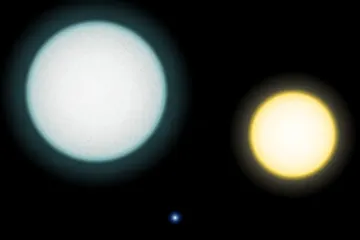
The white dwarf, in stark contrast, is what remains after a low-to-intermediate mass star—one up to about eight times the mass of the Sun—has ended its life as a red giant and expelled its outer atmosphere. [2] This resulting stellar core is incredibly compact; it is often described as being roughly the size of the Earth, yet possessing nearly the mass of the Sun. [2] This extreme compression makes them staggeringly dense. A teaspoon of white dwarf material would weigh several tons. [2] Crucially, once a star settles into the white dwarf phase, the central furnace of nuclear fusion has shut down; there is no more hydrogen or helium fusion occurring. [2] Instead, the white dwarf shines purely from residual, stored thermal energy. [2] Over unimaginably long stretches of time, perhaps trillions of years, this remnant will slowly radiate away its heat until it becomes a cold, dark stellar cinder known as a black dwarf. [2]
# Comparing Their Existence
The differences between these two classes are profound, spanning nearly every measurable stellar property. They occupy entirely different places on the Hertzsprung-Russell (H-R) diagram, representing opposite ends of an evolutionary spectrum for different mass groups. [2]
Consider the fundamental physics at play. A blue giant is supported by the tremendous outward pressure generated by active hydrogen fusion in its core, fighting against a gargantuan gravitational pull. [2] Its sheer size, being much larger than the Sun, is a direct consequence of this energetic battle. [2] Conversely, a white dwarf is supported not by fusion, but by a quantum mechanical effect called electron degeneracy pressure. [2] This pressure arises because electrons are packed so tightly that the Pauli exclusion principle prevents them from occupying the same quantum state, providing the necessary structural support against collapse, even without the heat of fusion. [2]
If you were observing a hypothetical sky where Earth orbited a white dwarf, the sky would appear very different than if it orbited a main-sequence star; while the white dwarf would be intensely hot near its surface, its tiny physical size means its overall brightness or luminosity would be quite low compared to the Sun, resulting in a dim stellar presence in the sky unless you were orbiting very closely. [6] A blue giant, however, would bathe any nearby planet in blistering light due to its enormous surface area radiating heat outward.
Here is a simplified look at their defining characteristics:
| Property | Blue Giant | White Dwarf |
|---|---|---|
| Mass Range | Very High (Many Solar Masses) [2] | Low to Intermediate (Up to ~1.4 Solar Masses) [2] |
| Size | Much Larger than the Sun [2] | Roughly the size of Earth [2] |
| Energy Source | Active Hydrogen Fusion [2] | Residual Heat (No Fusion) [2] |
| Luminosity | Extremely High [2] | Very Low (Faint) [2] |
| Lifespan Phase | Short-lived main sequence phase [2] | Final, cooling remnant stage |
# Evolutionary Timelines
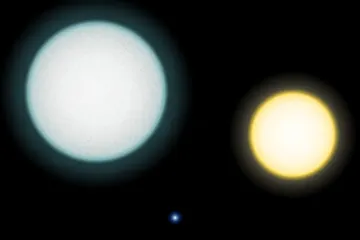
The concept of "dwarf" versus "giant" can sometimes be confusing because a star is classified as a giant during a phase when it is huge, but a dwarf when it is small and dense. [3] A blue giant represents a short phase in a massive star's life, while a white dwarf represents the final state for a low-to-intermediate mass star. [2]
For a star like the Sun, the path is: Main Sequence Red Giant Planetary Nebula White Dwarf. [2] The "giant" phase is the expansion before the collapse.
For a massive star that becomes a blue giant, its future is much shorter and more violent. After exhausting its fuel, it does not gently form a white dwarf; instead, it collapses catastrophically, leading to a Type II supernova explosion, leaving behind either a neutron star or a black hole, depending on the star's initial mass. [2] This highlights a key distinction: the blue giant is the precursor to the most energetic explosions in the universe, whereas the white dwarf is the quiescent cinder of a quieter stellar demise. [2]
It is an interesting synthesis that the term "dwarf star" is used both for the smallest, longest-lived stars (like red dwarfs) and for the dense remnants of dead, Sun-like stars (white dwarfs). [3] While a red dwarf fuses hydrogen very slowly, a white dwarf does not fuse anything; the difference between the slow-burning, long-lived red dwarf and the cooling white dwarf successor to the Sun is a difference between stellar longevity and stellar mortality. [3] A white dwarf is essentially the burnt-out husk, whereas even a red dwarf is still very much alive and burning fuel, albeit at a glacial pace. [3]
The evolutionary difference is also reflected in their thermal characteristics, though one must be careful with comparisons. While a blue giant is incredibly hot on its surface due to active fusion, a newly formed white dwarf can actually be hotter than the surface of a red giant because it is the exposed, compressed core of a previously large star. [8] However, the blue giant’s massive fusion process keeps its overall energy output vastly superior to the cooling white dwarf.
# Observer's Perspective
If we consider the sheer rarity of observation, the two objects offer different insights into cosmic time. Because blue giants are so rare and short-lived, every blue giant we currently observe is essentially a snapshot of a star in its glorious, but fleeting, adolescence. [2] The stars that become white dwarfs, conversely, spend billions of years on the main sequence, meaning that the vast majority of stars in the galaxy are currently in that long, stable phase or are already cooling as white dwarfs. [2] Seeing a blue giant is seeing a brief, powerful moment; seeing a white dwarf is looking at the near-final chapter of an average star's billions-year history. This means that statistically, for every blue giant illuminating a nebula, there are countless white dwarfs spread out across the galaxy, gradually fading into obscurity, waiting for the universe to grow old enough for them to cool completely. [2]
#Videos
The Ultimate Guide to Star Types: Dwarfs, Giants & Supergiants
Related Questions
#Citations
Stars
Star Types - NASA Science
Dwarf star - Wikipedia
What is the difference between a dwarf star and a giant star? - Quora
[PDF] Star Classification - University of Louisville
The Ultimate Guide to Star Types: Dwarfs, Giants & Supergiants
How would the sky look if earth orbited a white dwarf or a blue giant?
Is a white dwarf hotter than a Red Giant? - Astronomy Stack Exchange
White Dwarfs, Red Dwarfs, and Blue Giants, Oh My! - Star Trek