Which is hotter, a blue giant or a white dwarf?

When examining the vastness of the cosmos, the surface temperature of a star is not always intuitively related to its apparent size. A common query arises when comparing the fiery brilliance of a blue giant star against the dim, dense cinder of a white dwarf: which of these stellar extremes actually burns hotter? The answer isn't a simple declaration; it hinges entirely on the stage of life the white dwarf is currently experiencing. [1][7]
# Star Color Heat
The color we observe when looking at a star is a direct indicator of its surface temperature, a fundamental concept in astrophysics. [6] For general stellar classification, the hottest stars appear blue or blue-white, while the coolest stars glow red. [5] This relationship means that, across the main sequence of stars where hydrogen fusion is the dominant power source, larger and more massive stars tend to be hotter and therefore bluer. [4]
Blue giants certainly fit this description. They are massive, luminous stars that burn through their fuel supply rapidly, resulting in extremely high surface temperatures that push them into the blue end of the spectrum. [4][5] They represent a stage of stellar evolution characterized by immense energy output and corresponding heat.
# White Dwarf Nature

White dwarfs, on the other hand, represent the final stage for stars roughly the mass of our Sun. [7] They are the dense, incredibly compressed remnants left behind after a star has exhausted its core nuclear fuel and shed its outer layers. [7] Despite their diminutive size compared to giants, these stellar cores are extraordinarily hot when they first form. [1]
When a star dies and becomes a white dwarf, it no longer generates energy through fusion; it simply radiates away its residual thermal energy, meaning it must cool down over billions of years. [7] A very young, freshly formed white dwarf can retain a surface temperature that rivals or even surpasses many active stars. [1] Conversely, an ancient white dwarf that has been cooling for eons will be significantly cooler, potentially cooler than a relatively average main-sequence star. [7]
# Direct Temperature Conflict
The crucial point of comparison rests on this cooling timeline. If you compare a young white dwarf to an old star like a red giant, the white dwarf will almost certainly be hotter. [1] For instance, a newly formed white dwarf can possess surface temperatures exceeding 100,000 Kelvin. [7] In contrast, a red giant, while large, is relatively cool on its surface, often having temperatures under 5,000 Kelvin. [1]
However, the comparison against a blue giant requires more nuance. Blue giants are intrinsically very hot, often reaching tens of thousands of degrees Kelvin, placing them high on the temperature scale. [5] A young white dwarf can certainly match or exceed the temperature of a blue giant, but it is an unstable state that rapidly decays. [1] As an insightful way to visualize this, imagine a temperature spectrum: at the very high end, you find the most massive, hottest blue stars, but immediately following them, before the vast majority of other stars, you encounter the peak temperature range of newly born white dwarfs. The blue giant maintains its peak temperature for millions of years; the white dwarf achieves that peak for a comparatively brief period before beginning its long, slow descent into darkness. [7]
# Stellar Evolution Contrast
Stellar astronomy classifies stars based on their size and energy production, showing clear evolutionary paths. [3] Blue giants and red giants represent different phases, usually linked to high-mass stars reaching the end of core fusion, causing their outer layers to expand dramatically. [3] Red giants are cool and huge; blue giants are hot and large. [5]
The white dwarf is a completely different endpoint, representing the collapsed core of a lower-to-intermediate mass star (like the Sun) after it has passed through the red giant phase and shed its atmosphere. [3][7] This means a blue giant is an active, fusing star near the zenith of its life, whereas the white dwarf is a stellar corpse. The fact that a dead star remnant can momentarily reach the heat of a very active, massive star highlights just how much thermal energy is packed into that dense remnant. [1][7]
Here is a simplified conceptual view contrasting the two stellar extremes based on what we know about their temperature ranges in different phases:
| Star Type | Phase of Life | Typical Temperature Range (K) | Relative Luminosity |
|---|---|---|---|
| Blue Giant | Active Fusion | High (e.g., 10,000 K to 50,000 K+) | Very High [4] |
| Young White Dwarf | Post-Fusion Remnant | Extremely High (Can exceed 100,000 K) | Low (due to small size) [7] |
| Old White Dwarf | Cooling Remnant | Low to Moderate | Very Low [7] |
| Red Giant | Late Fusion | Low (e.g., 3,000 K to 5,000 K) | High (due to large size) [1] |
Looking at this comparison, it becomes clear that the youngest white dwarfs are the hottest objects in the stellar graveyard, potentially hotter than the hottest main sequence blue stars, though perhaps not the absolute hottest supergiants that exist for short spans. [1] The term "blue giant" itself implies a high temperature bracket, but the white dwarf's initial thermal shockwave upon formation can create transient temperatures that exceed the steady-state temperatures of many blue stars. [7]

# Observational Context
Understanding why we might not see a mix of all these types simultaneously scattered about helps solidify their distinct evolutionary paths. [10] Stars spend a vastly different amount of time in each phase. A blue giant phase, while incredibly luminous, is relatively brief because the star consumes its fuel so quickly. [4] A white dwarf, however, can spend trillions of years slowly radiating heat away. [7] This time difference means that at any given moment in the galaxy, you are statistically more likely to see stars that spend longer periods in a given state, such as a main-sequence star, rather than the brief, spectacular outbursts or the long, slow fade of the extremes. [10]
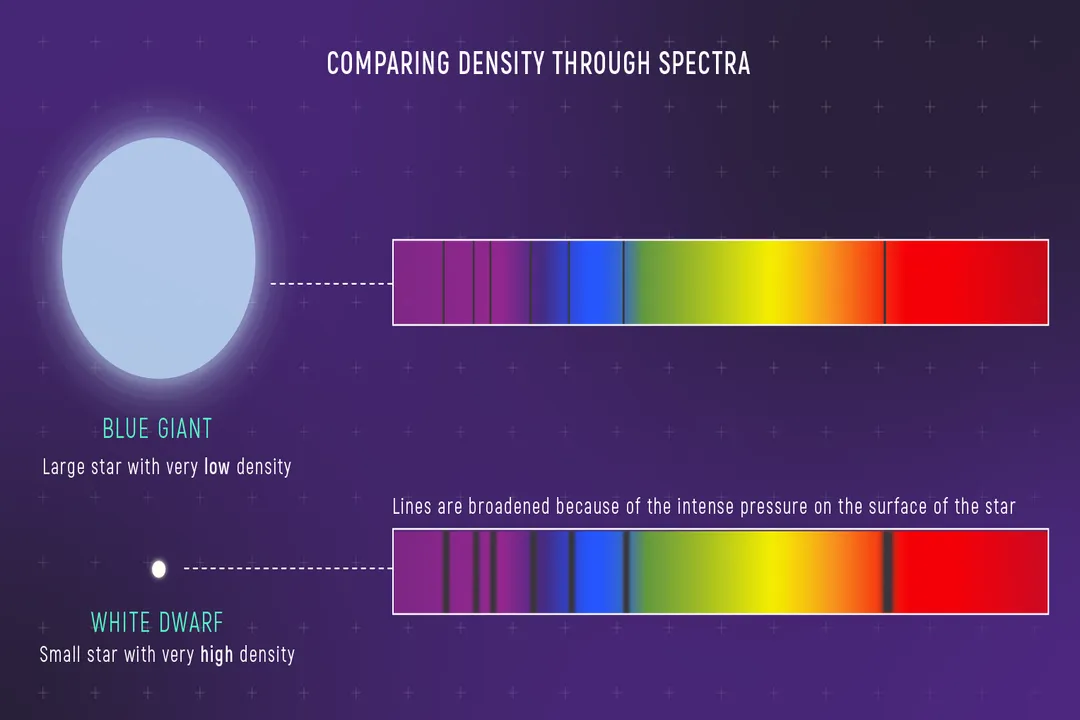
Furthermore, the extreme density of the white dwarf plays an unappreciated role in its initial heat retention. A white dwarf packs the mass of a star into the size of the Earth. [7] This packing results in incredibly high surface gravity and density, which dictates how efficiently that internal heat leaks outward. While a blue giant is hot because it's massive and actively fusing, the white dwarf is hot because it represents compressed, trapped energy from a once-massive core. Thinking about it this way—the sheer energy density—it’s almost counter-intuitive that something so small and dead could outshine the surface heat of a star many times the Sun's mass that is still actively burning. [1]
# Conclusion on Stellar Heat
To settle the matter: A blue giant is reliably and continuously very hot throughout its active phase because it is fusing elements at an enormous rate. [4][5] A white dwarf is only hotter than a blue giant during the very early stages of its existence, immediately after it has expelled its outer layers. [1][7] Over time, the blue giant maintains a stable, high temperature until it dies, while the white dwarf's temperature declines monotonically toward absolute zero. Therefore, while the record-holder for hottest possible surface temperature at a given moment might belong to a transient, newly formed white dwarf, the consistently hotter object among the two, over the duration of its observable life, is generally the blue giant. [1]
Related Questions
#Citations
Is a white dwarf hotter than a Red Giant? - Astronomy Stack Exchange
Stars
Stellar Astronomy: Part 4 – Of Dwarfs and Supergiants
Are blue stars the hottest and largest stars? - Quora
Why Are Blue Stars Hotter Than Red Stars? When you look up at the ...
The color of a star is a function of its surface temperature : r/spaceporn
White dwarf - Wikipedia
Spectrum of a Blue Giant vs. Spectrum of a White Dwarf
Which of these stars would be the hottest? A. Red dwarf B ... - Brainly