Why is Hubble's Law still important today?
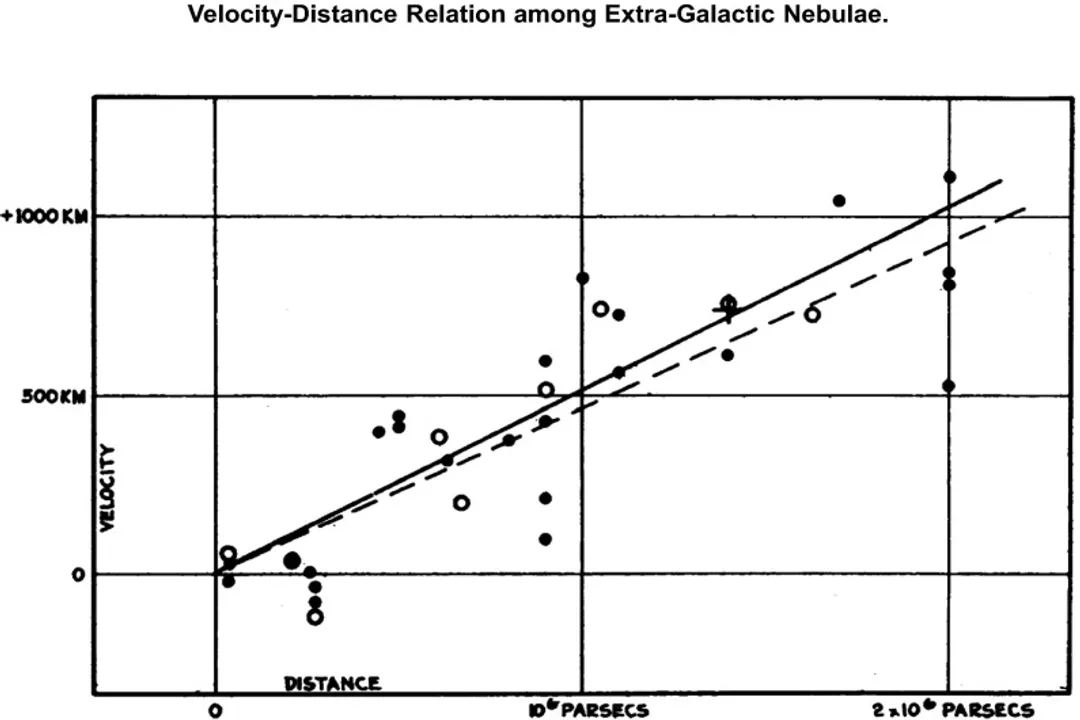
The discovery that galaxies are rushing away from us, and that the farther away they are, the faster they recede, stands as one of the bedrock observations of modern astronomy. This relationship, formalized by Edwin Hubble, is not just a historical footnote but an active, critical area of research that defines our understanding of the cosmos's size, age, and evolution. [3][5] At its heart lies a simple yet profound mathematical statement: the velocity of a galaxy is proportional to its distance from us.
# Expansion Rate
Hubble's Law establishes a direct proportionality between a galaxy's recessional velocity () and its distance (), expressed by the equation . [5][3] The constant that bridges velocity and distance is the Hubble Constant, symbolized as . [1][5] This constant effectively quantifies the rate at which the universe is expanding right now. [1] Astronomers typically express in units of kilometers per second per megaparsec (). [1] A megaparsec is a measure of distance equivalent to about $3.26$ million light-years. [5] Therefore, a value of means that for every additional megaparsec a galaxy is from Earth, its speed of recession increases by $70$ kilometers per second. [1]
The initial realization of this expansion was revolutionary because it provided observational backing for the expanding universe model, which itself is central to the Big Bang theory. [5] Hubble's work, built upon earlier observations by others, demonstrated that the universe is not static but dynamically evolving. [5] Understanding the precise value of is critical because it dictates the scale of the observable universe—how far away the most distant objects are—and provides a fundamental parameter for cosmological modeling. [1][5]
# Cosmic Yardstick
One of the primary functions of Hubble's Law in practice is to serve as a cosmic distance ladder rung, allowing astronomers to gauge the vastness of space. [5] While we can directly measure the redshift (and thus the velocity) of a distant galaxy using spectroscopy, accurately measuring its true distance () is much more challenging. [5] However, once the Hubble Constant () is established with high confidence, the law becomes a reliable tool: measure the velocity, use the known constant, and calculate the distance. [5]
For relatively nearby galaxies, astronomers rely on standard candles like Cepheid variable stars whose absolute luminosities are known. [2] For much more distant objects, Type Ia supernovae are employed as standard candles. [2] By calibrating these local distance indicators to determine their distances accurately, and then measuring their recession velocities via redshift, scientists can calculate the value of that fits the resulting plot of velocity versus distance. [2] This method is often termed the "local" or "late-time" measurement of the Hubble Constant. [2]
This direct application turns the redshift measurement, which is relatively straightforward, into a powerful distance indicator for almost anything beyond our immediate galactic neighborhood. [5] Without this linear relationship, mapping the three-dimensional structure of the universe beyond the Milky Way would be nearly impossible.

# Age Estimate
The Hubble Constant offers a direct, though simplified, path toward estimating the age of the universe. [1] If one were to imagine a universe that expanded at a perfectly constant rate throughout its entire history—a scenario known as the coasting model—the age of the universe would simply be the inverse of the Hubble Constant (). [5] This time, sometimes called the Hubble time, provides a fundamental benchmark. [5]
For example, if were exactly , the inverse would yield a time scale. Given that , the calculation gives a time in seconds, which converts to approximately $14$ billion years. [1] The age derived this way is remarkably close to the accepted age of the universe, which points to the fact that while the expansion rate has changed, it hasn't changed that drastically over cosmic history. [5] The actual age determination requires integrating the Hubble Parameter over time, accounting for the varying influence of matter, radiation, and dark energy. [6][9] However, the initial estimate derived from provides immediate context for the magnitude of cosmic age we are discussing.
To illustrate the sensitivity of this calculation, consider the different values derived from modern cosmology. If we use the lower value often derived from early universe data, say , the corresponding Hubble time is slightly longer, pointing toward an older universe. Conversely, the higher value, often around derived from local measurements, suggests a slightly younger universe if we were to assume that expansion history was perfectly steady. [2] This slight difference in the derived age, which amounts to a few hundred million years, is a key factor driving the current cosmological tensions. [2] The implication is clear: a small shift in the measured constant results in a noticeable, though cosmologically minor, change in the estimated timeline of cosmic evolution.
# Shifting Value
A critical nuance in discussing the Hubble Constant is recognizing that the "constant" is constant only in space at any given moment in time, not constant throughout cosmic history. [6][9] What astronomers measure today, , is the expansion rate now. [6] The rate of expansion changes over time because the components that make up the universe—matter, radiation, and dark energy—affect gravity differently. [9][6]
The term that accurately describes the expansion rate at any time in the universe's history is the Hubble Parameter, . [6][9] When cosmologists model the universe's evolution, they use the CDM model (Lambda Cold Dark Matter), which specifies how evolves based on the densities of its constituents. [6] The present-day value, , is simply the specific instance of at . [9]
When using early-universe data, such as observations of the Cosmic Microwave Background (CMB) radiation—the afterglow of the Big Bang—scientists fit the CDM model to predict what should be today based on the physics known from the early universe. [2] This prediction is around . [2]
Conversely, the local measurements, which rely on measuring distances to objects relatively close to us using standard candles, directly measure the current expansion rate independent of the early universe's physics. [2] These local measurements consistently yield a higher value, often clustering around . [2] This divergence between the predicted value and the directly measured present-day value is the heart of the modern cosmological crisis, known as the Hubble Tension. [2]

# Tension Discrepancy
The disagreement between the early-universe estimate of (from CMB data) and the late-universe estimate (from supernova/Cepheid data) is the Hubble Tension. [2] This is more than just a slight disagreement in measurement error; the discrepancy between the two primary values is statistically significant, exceeding $5$ sigma in some recent analyses. [2] This high confidence level means that if both measurement techniques are sound and the underlying cosmological model is correct, the probability of this difference arising by chance is extremely low. [2]
To visualize the difference, consider the two main camps using their characteristic numbers:
| Measurement Source | Method Type | Representative Value () | Cosmological Implication |
|---|---|---|---|
| Planck Satellite Data | Early Universe/CMB | Requires a specific expansion history governed by known physics. | |
| SHOES/Supernovae | Late Universe/Standard Candles | Measures the expansion rate directly in the modern epoch. | |
| [2] |
The fact that these two independent methods, relying on physics separated by billions of years of cosmic evolution, do not converge on the same number forces a serious re-evaluation of our fundamental assumptions. [2] The tension is not about the existence of the expansion—Hubble's Law remains firmly established [3]—but about the precise rate of that expansion today and how that rate relates to the universe's initial conditions.
# New Physics
The continued importance of Hubble's Law today stems precisely from this tension. If the discrepancy cannot be resolved by finding subtle, systematic errors in one or both measurement techniques—which is a major area of ongoing research [2]—it implies that the standard cosmological model (CDM) is incomplete. [2]
The CDM model successfully describes the universe's evolution if we assume the expansion rate evolved smoothly from the early universe's state to today's state, as dictated by general relativity and the observed contents of the universe (dark matter and dark energy). [6] A persistent Hubble Tension suggests that something caused the expansion to speed up or slow down differently than predicted between the time the CMB formed and the time local measurements were taken. [9]
This situation provides an exciting avenue for discovering physics beyond the Standard Model of particle physics and cosmology. Potential solutions involve modifying our understanding of dark energy, perhaps suggesting it was stronger or had different properties in the early universe than assumed, or perhaps even changing the physics governing the very early universe, such as the nature of neutrinos or the existence of an unknown form of early dark energy. [2][9] Researchers are actively investigating whether there were unknown interactions or phase transitions in the universe's first few hundred thousand years that would alter the initial conditions used to project the value of forward to today. [6]
The pursuit of a definitive value is therefore synonymous with the search for the universe's missing components or unknown physical laws. Cosmologists are now treating the local measurement () not just as a number to plug into equations, but as a probe capable of detecting deviations from the expected CDM script. [2][6] The precision achieved in measuring this law, which began with mapping distant galaxies, has now become so fine that it is effectively telling us that our current, best-fit model of the cosmos may require revision. Hubble's Law, born from simple observation, now demands a deeper, more complex explanation of reality.
Related Questions
#Citations
The Hubble constant, explained - UChicago News
Hubble Constant and Tension - NASA Science
Hubble's law: Why are most galaxies moving away from us? - Space
The Expansion of the Universe - WorldWide Telescope Ambassadors
Hubble's Law | ASTRO 801: Planets, Stars, Galaxies, and the Universe
Surprise! The Hubble Constant Changes Over Time | by Ethan Siegel
Hubble's Law - impulso.space - Science Capsule
Hubble's Law and the expanding universe - PMC - NIH
Surprise! The Hubble Constant Changes Over Time - Big Think