Why do meteors burn blue?
The brilliant streaks we witness blazing across the night sky, commonly called shooting stars, are technically meteors—small pieces of interplanetary debris encountering Earth’s atmosphere. While many observers note a general white or yellowish flash, the appearance of a distinct blue or green tint often captures special attention. This coloration is not random; it’s a direct spectral fingerprint left behind as the space rock ablates, revealing the chemical ingredients locked within its structure. [1][2] Understanding why a meteor burns blue requires looking closely at the physics of its fiery descent and the specific elements interacting with the superheated air around it. [4]
# Entry Physics
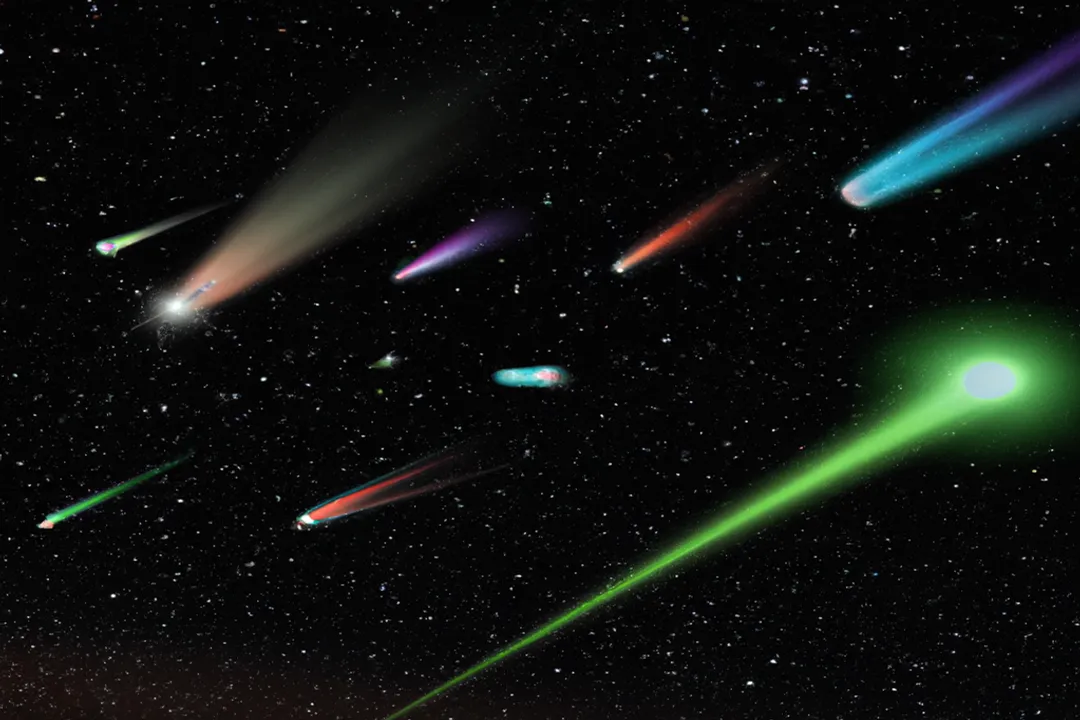
A meteoroid begins to glow not primarily due to friction, as is often assumed, but because of the intense compression of air directly in front of it as it slams into the atmosphere at hypersonic speeds. [3] This rapid compression heats the air and the surface of the object to thousands of degrees Celsius, a process called ram pressure heating. [3] As the material—both the vaporized rock and the surrounding atmospheric gases—reaches these extreme temperatures, its atoms become energized. When these energized atoms relax back to a lower energy state, they release that excess energy in the form of photons, which we see as light. [2][4] This entire process of material loss due to heating and vaporization is known as ablation. [3]
# Elemental Signatures
The specific color observed is a direct consequence of the atomic structure of the material being vaporized. [4][6] Every chemical element possesses a unique set of wavelengths it emits when excited, much like a barcode for light. [1] When a meteoroid enters, the high-energy environment excites the atoms of its constituent minerals, causing them to emit light at those characteristic frequencies. [4] The resulting color is a composite of all these emissions occurring along the meteor’s path. [8]
For instance, the presence of common elements like Sodium typically imparts a distinct yellow hue to the trail. [1] Iron, a frequent component of meteorites, often contributes to reddish or orange light when vaporized. [1] However, the striking blues and greens are usually attributed to lighter, more volatile elements or specific transition metals present in the rock, which ionize readily under the intense conditions. [6]
# The Blue Spectrum
When a meteor appears distinctly blue, it often signifies the presence of certain trace metals that emit light in the shorter wavelength end of the visible spectrum. [1] The most commonly cited element responsible for bright blue-green flashes is Magnesium (Mg). [1][6] Magnesium vaporizes and emits strongly in the blue-green region when superheated. [1] Some astronomical observations also link specific blue signals to the presence of Copper (Cu) or the excitation of atmospheric Nitrogen under very specific, high-energy conditions, though the material composition is the primary driver for the meteoroid itself. [4][6]
It is important to note the close relationship between blue and green. In many descriptions of meteor colors, blue and green are grouped together because the spectral lines for elements like Magnesium often fall into this overlapping region. [1][6] A very fast, high-energy entry might produce an intense blue-white flash due to highly ionized species, while a slightly slower entry might favor the characteristic green glow from neutral Magnesium or Nickel. [4] Therefore, a blue meteor is usually an indication that the impacting body contained a relatively high concentration of these lighter, easily excited metallic atoms compared to the bulk materials that produce yellow or red light. [6]
# Contributing Factors
While elemental composition sets the stage for the color, two other critical variables heavily influence what we actually see from the ground: the velocity of the meteoroid and the atmospheric gases surrounding it. [2]
# Speed and Energy
The speed at which a meteoroid hits the atmosphere directly relates to the energy available for heating and excitation. [2] A very fast-moving meteoroid, perhaps traveling at extreme entry velocities (over ), generates much higher temperatures than a slower one. [2] These higher temperatures lead to greater ionization—the removal of electrons from the atoms—which changes the available emission lines. This greater energy can shift the spectral output toward the blue and ultraviolet end, making the resulting light appear bluer or intensely white-blue, as opposed to the warmer yellows and reds produced by less energetic ablation. [4]
# Atmospheric Interaction
The color we perceive is a mixture of the light emitted by the vaporized meteoroid material and the light emitted by the atmospheric gases being excited by the shockwave. [6] Earth's atmosphere is predominantly Nitrogen and Oxygen. When these gases are heated to high temperatures, they too emit light. Nitrogen often glows with a reddish or purplish hue, while Oxygen can contribute to greenish light, especially at lower altitudes. [6] A particularly slow or small meteoroid might have its own faint elemental signature completely overwhelmed by the background glow of the atmospheric gases, potentially washing out a subtle blue signal into a general white or greenish streak. [6][8]
We can sometimes distinguish the material color from the atmospheric contribution by observing the duration of the color. If the blue persists throughout the streak, it suggests the meteoroid material is rich in the necessary element. If the color is only noticeable in the very brightest part of the flash, it might be more indicative of peak atmospheric excitation. [4]
# Element Color Reference Table
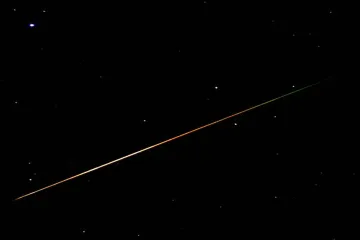
To help illustrate the direct link between composition and perceived color, it is useful to compare the common spectral emitters. This synthesizes the data on how different elements contribute to the overall light show observed during ablation:
| Element | Common Symbol | Typical Color Contribution | Notes |
|---|---|---|---|
| Magnesium | Mg | Blue to Green | Often the source of distinct blue-green tints. [1][6] |
| Sodium | Na | Yellow | One of the most easily excited and common colors seen. [1] |
| Calcium | Ca | Violet or Lilac | Contributes to the fainter, shorter-wavelength ends of the spectrum. [1] |
| Iron | Fe | Orange to Red | Common in stony and iron meteorites, often visible in warmer tones. [1] |
| Nickel | Ni | Green | Can contribute strongly to green coloration, often seen alongside Mg. [1] |
| Atmospheric Gas | N/O | Red/Green/Blue | Background light from air itself; intensity depends on entry speed. [6] |
This table highlights that the blue seen in a meteor is rarely from the bulk material like silicates (which tend to be less colorful) but from specific metallic additives present in the parent asteroid or comet. [6] The presence of a strong blue suggests the object might originate from a parent body compositionally different from one that typically yields only yellow or red fireballs.
# Analyzing Blue Fireballs
When amateur astronomers or fireball observers record a meteor that is predominantly blue, they are often looking at an object that has met very specific criteria. One interesting analysis point is that a deep, stable blue often requires a significant amount of energy transfer occurring near the peak intensity point of the ablation process. [4] Unlike a slow, faint meteor where the light is mostly thermal radiation from surface ablation, a blue flash suggests that the material has been sufficiently energized to excite those specific high-energy atomic transitions. This implies the object was likely traveling quite fast upon entry, generating the necessary kinetic energy to drive the blue spectral lines to prominence over the background emissions from air or iron. [2][4]
Furthermore, the clarity of the blue signal is also a function of altitude. If the meteoroid burns up high in the mesosphere, the atmospheric path length is shorter, meaning there is less intervening atmosphere to scatter or absorb the emitted blue light before it reaches the observer. Conversely, if the object is dense and survives to lower altitudes, the light signature is muddied by denser air, and the color might shift toward the warmer, more visible yellow-red range, or simply appear as a very bright, featureless white fireball. [8] Therefore, a vivid blue meteor is often a double gift: a chemically interesting object traveling fast enough to excite its metals, surviving long enough for the blue light to reach you relatively unscattered. [2] Observing these specific colors gives experts clues not just about the chemistry, but about the entry dynamics of the space rock itself.
Related Questions
#Citations
What Do Meteors' Colors Tell Us? - IFLScience
Why do meteors glow in vibrant colors? - AccuWeather
Leonid MAC - Facts on meteors and meteor showers
What determines the color of an incoming metorite? : r/askscience
Meteors glow in different colors due to chemistry - Facebook
Why is it that when we see a meteor burning up in the atmosphere, it ...
Fireball FAQs - American Meteor Society
Why Meteors Appear In Different Colors To Those Of Us On Earth ...