What is the name of China's new space station?
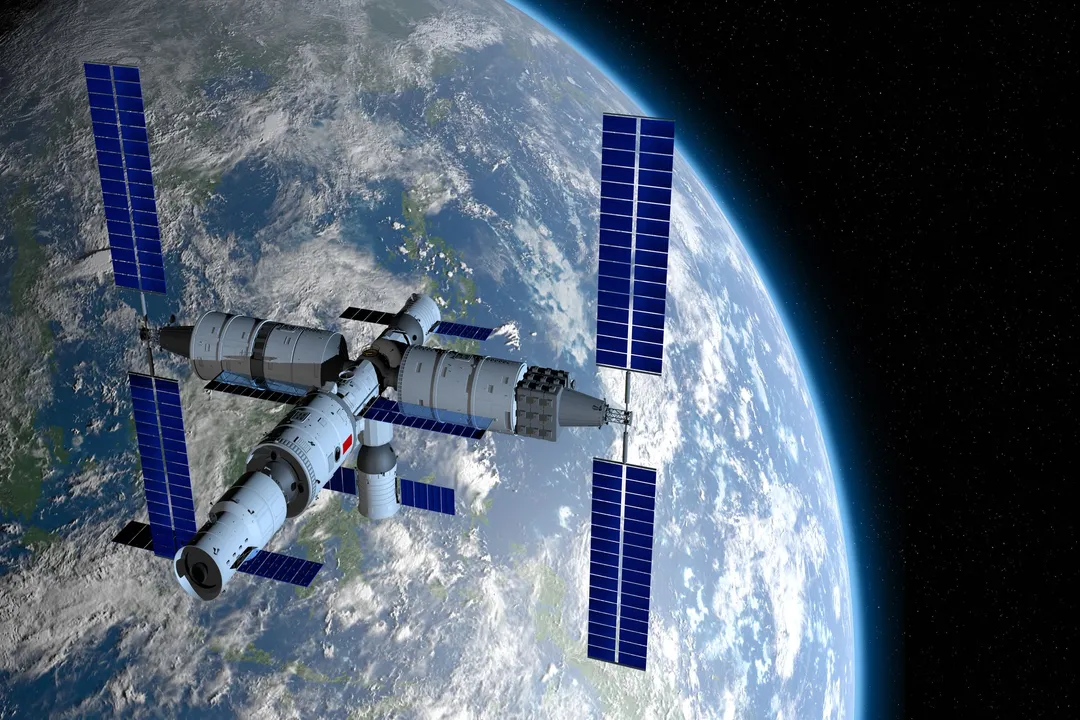
The question of what China’s new orbiting outpost is called is answered quite clearly: it is the Tiangong space station. [1][2][3] The name Tiangong (天宫空间站) literally translates from Mandarin to mean "Heavenly Palace space station". [2] This name is not new to China’s space efforts, as it was also used for two earlier, smaller experimental space labs, Tiangong-1 and Tiangong-2, which served as crucial pathfinders before the current permanent structure was assembled. [2][3] The China Manned Space Agency (CMSA) ultimately decided to use Tiangong as the standardized, overarching name for the modular station without a serial number attached, signifying a step up in capability from its predecessors. [2]
# Core Modules
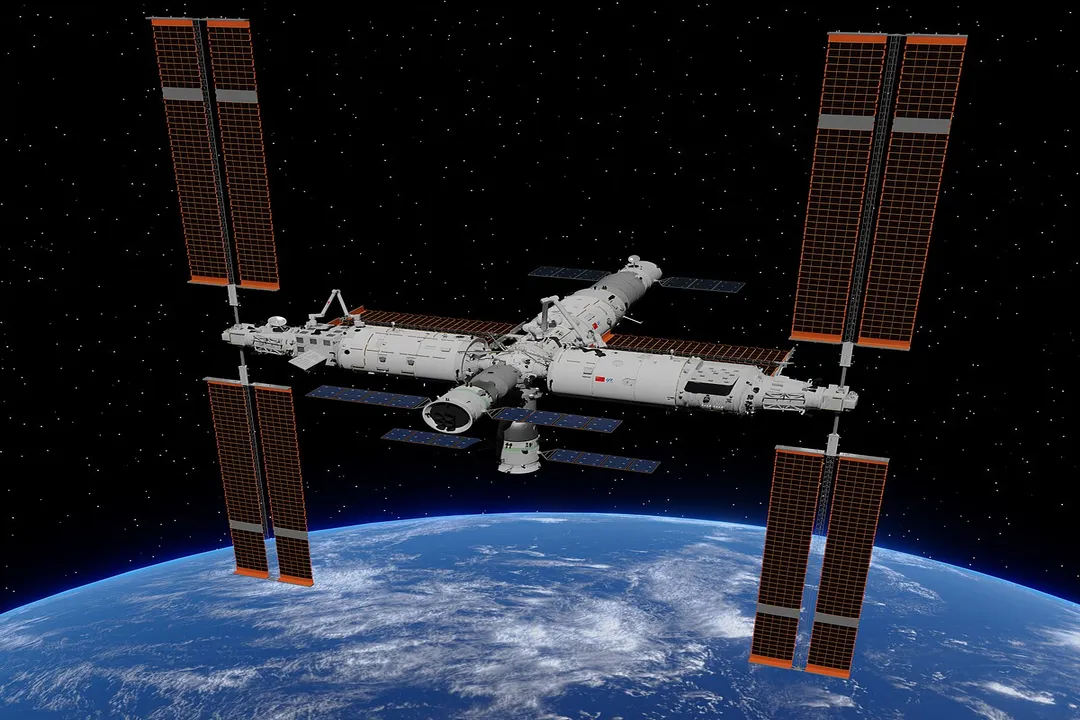
Tiangong is China’s first long-term, permanently crewed space station, built in low Earth orbit at an altitude similar to the International Space Station (ISS), roughly between 217 and 280 miles up. [1] It is a third-generation, modular facility, meaning it was assembled in orbit from separate components launched over a relatively short period. [2] Construction of the core operational station was completed in late 2022. [1][2]
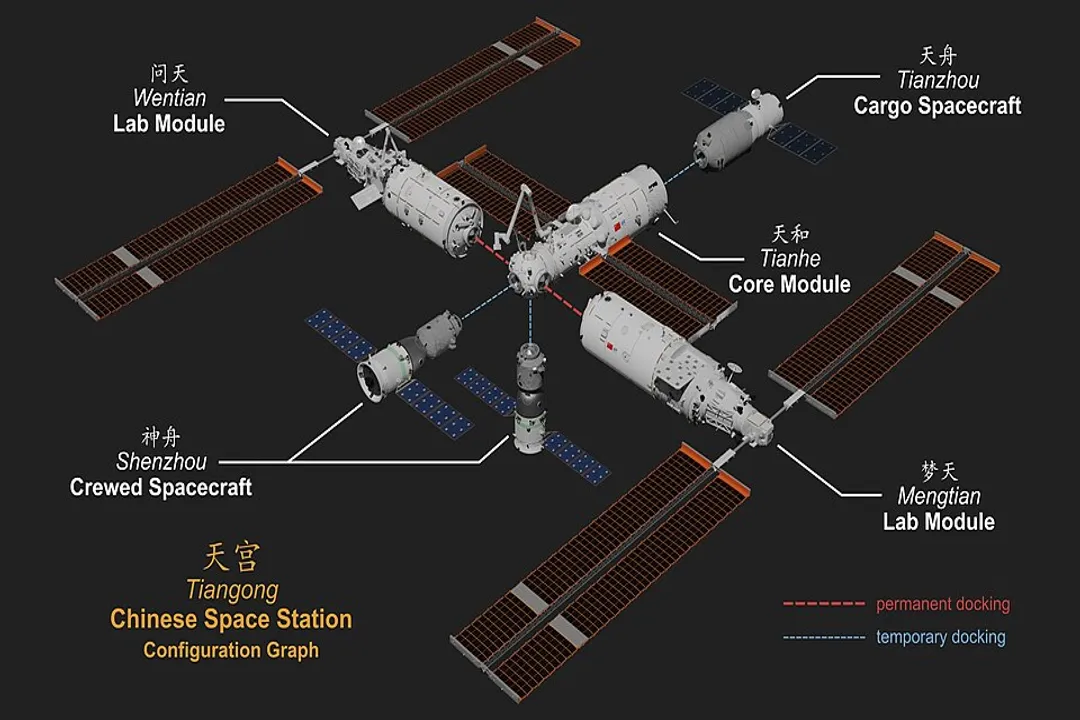
The station is currently composed of three primary modules connected in a basic T-shape: [2][3]
- Tianhe (天和): This is the core module and serves as the central hub for life support, living quarters, and the station's guidance, navigation, and attitude control systems. [2][3] It includes the main living area with a kitchen setup, toilet, and facilities to help manage the crew’s health, such as equipment for combating muscle atrophy. [1] Tianhe, meaning "Harmony of the Heavens," was the first piece launched in April 2021, setting the stage for the entire complex. [2][3] It also houses the primary long-reach robotic arm, nicknamed Chinarm. [2]
- Wentian (问天): Launched in July 2022, this is the first laboratory module. [2][3] It provides additional life support and propulsion capacity, acting as a vital backup to the core Tianhe module. [2] A key feature of Wentian is the dedicated airlock for Extravehicular Activities (EVAs), which allows astronauts to exit the station without needing to utilize the Tianhe module’s primary docking hub, improving operational flexibility. [1]
- Mengtian (梦天): The second laboratory module, Mengtian ("Dreaming of the Heavens"), arrived in October 2022. [2] This module focuses on expanding the station's in-orbit research capability, particularly for microgravity science. [1] Notably, Mengtian features a dedicated cargo airlock designed specifically for moving scientific payloads from the interior out to external mounting platforms, a feature distinct from the crew airlock on Wentian. [2]
These modules rely on automated rendezvous and docking procedures, a capability refined through the earlier Tiangong test labs. [2] This method of in-orbit assembly, where pre-built modules are robotically maneuvered into position, bears similarity to the construction of the Russian Mir space station. [2]
# Comparing Scale
While it represents a massive achievement for China’s independent space program, a direct comparison between Tiangong and the ISS highlights significant differences in size and capability. [1]
| Feature | Tiangong Space Station | International Space Station (ISS) |
|---|---|---|
| Number of Core Modules | 3 | 16 (as of early data) [1] |
| Approximate Mass | ~450 tons [1] | |
| Pressurized Volume | [2] | Significantly larger [1] |
| Crew Capacity (Typical/Max) | 3 / 6 [2] | Typically 6-7 |
The differences in scale are intentional, reflecting different development paths and political realities. Because China was barred from participating in the ISS program—largely due to the U.S. Wolf Amendment which restricts cooperation between NASA and entities tied to the Chinese military [1]—building its own station became the only viable path for long-duration crewed orbital research. [1] Consequently, Tiangong’s current configuration is about one-third the size of the ISS. [2] However, the station is designed to feel spacious for its crew; as one deputy chief designer noted, the occupants would feel like they were living in a "villa" compared to the cramped quarters of China's earlier, much smaller space labs. [1]
# Operational Life
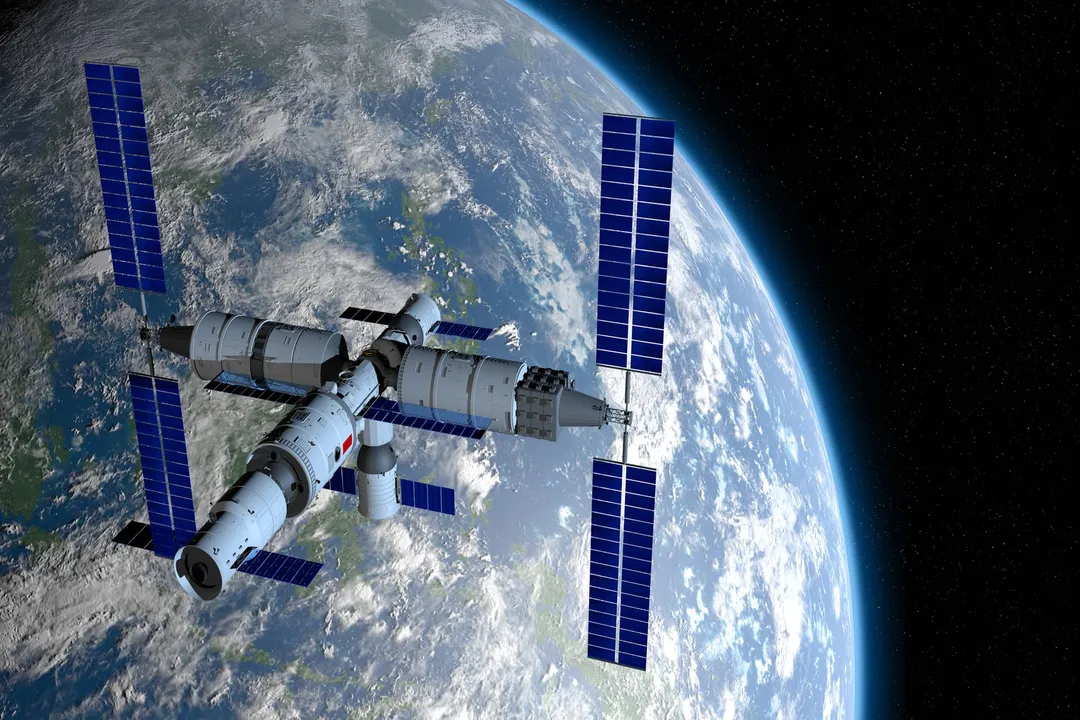
Tiangong is designed for a minimum operational lifespan of ten years, with the possibility of extension up to fifteen years. [2] This implies a commitment to sustained research and technological development over the next decade and a half. To achieve this extended service life efficiently, the station incorporates advanced systems. For example, the Tianhe core module is equipped with Hall-effect thrusters, a highly efficient form of electric propulsion that uses significantly less fuel than traditional chemical engines—cutting fuel use by up to 90% in some estimates. [2] This efficiency directly supports station-keeping maneuvers over many years without constant reliance on costly resupply missions for propellant. [2]
The station is designed for continuous habitation, typically hosting three taikonauts (Chinese astronauts) for six-month missions. [2][3] Crew rotations, such as the handover between Shenzhou 14 and Shenzhou 15 crews, allow for a temporary increase to six astronauts aboard, demonstrating the station's capability for expanded activities and crew exchange procedures. [1] Crew life is managed on China Standard Time (CST), and the station even features special lighting functions to simulate Earth's daylight cycle, an essential feature when experiencing 16 sunrises and sunsets every day in low Earth orbit, helping to regulate the crew’s circadian rhythms. [1]
# Future Outlook
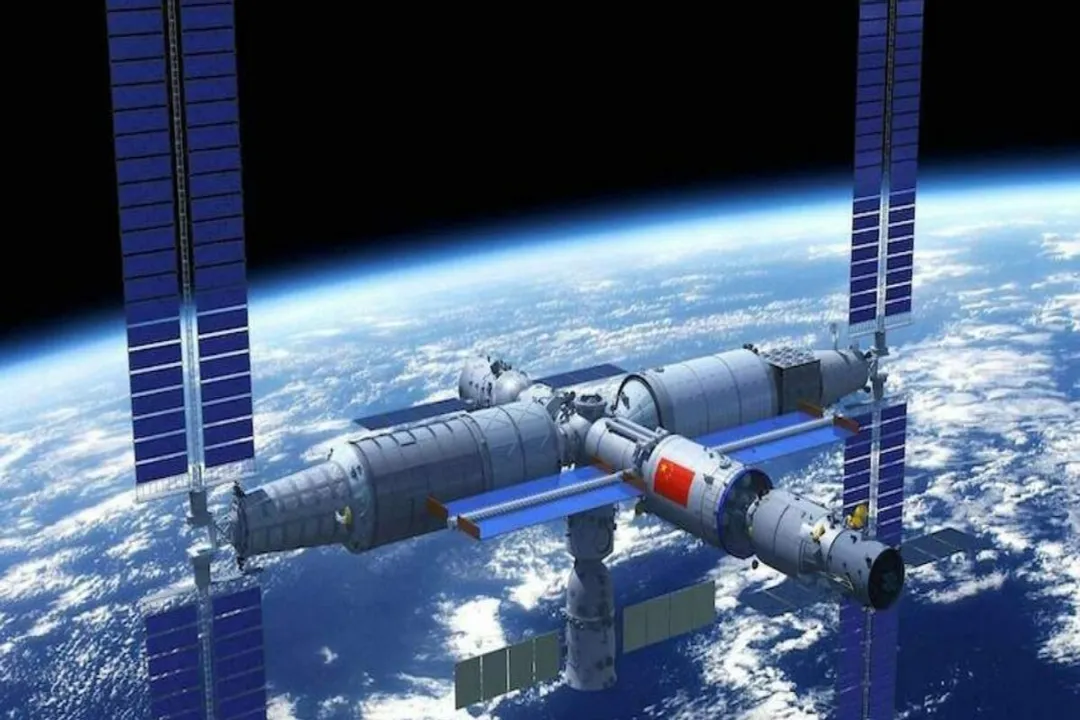
The current three-module configuration is considered the station's core, but plans are already in place for expansion. [2] China has proposed expanding Tiangong to a total of six modules, a process that could begin as early as 2027, potentially increasing its mass to around 180 tons. [2] This future expansion would likely involve adding a new core module featuring multiple docking ports to accommodate further growth and new vehicle interfaces. [2]
Beyond physical expansion, a major component of the future station complex will be the Xuntian space telescope. [2] This telescope is planned to orbit near, but independently from, Tiangong, capable of periodically docking with the station for maintenance, servicing, or upgrades. [2][3] Xuntian will feature a large mirror, slightly smaller than the Hubble Space Telescope’s, but with a field of view 300 to 350 times greater, allowing it to survey a vast portion of the sky. [2]
While the station is primarily a Chinese asset, it is intended to support international collaboration, hosting scientific experiments from various countries selected in part through cooperation with the United Nations Office for Outer Space Affairs. [2] Despite earlier astronaut training exchanges with the European Space Agency (ESA), current political and financial climates mean that most of the collaboration involves hardware and research proposals rather than foreign crew members living aboard, though agreements for short-duration visits by astronauts from partner nations, such as Pakistan, have been confirmed. [2] The launch of cargo via Tianzhou spacecraft and crew transport via Shenzhou vehicles ensures the station remains supplied and operational for its long service ahead. [2]
Related Questions
#Citations
Tiangong space station - Wikipedia
China's space station, Tiangong: A complete guide
Tiangong, China's space station | The Planetary Society