Will New Glenn have a payload?
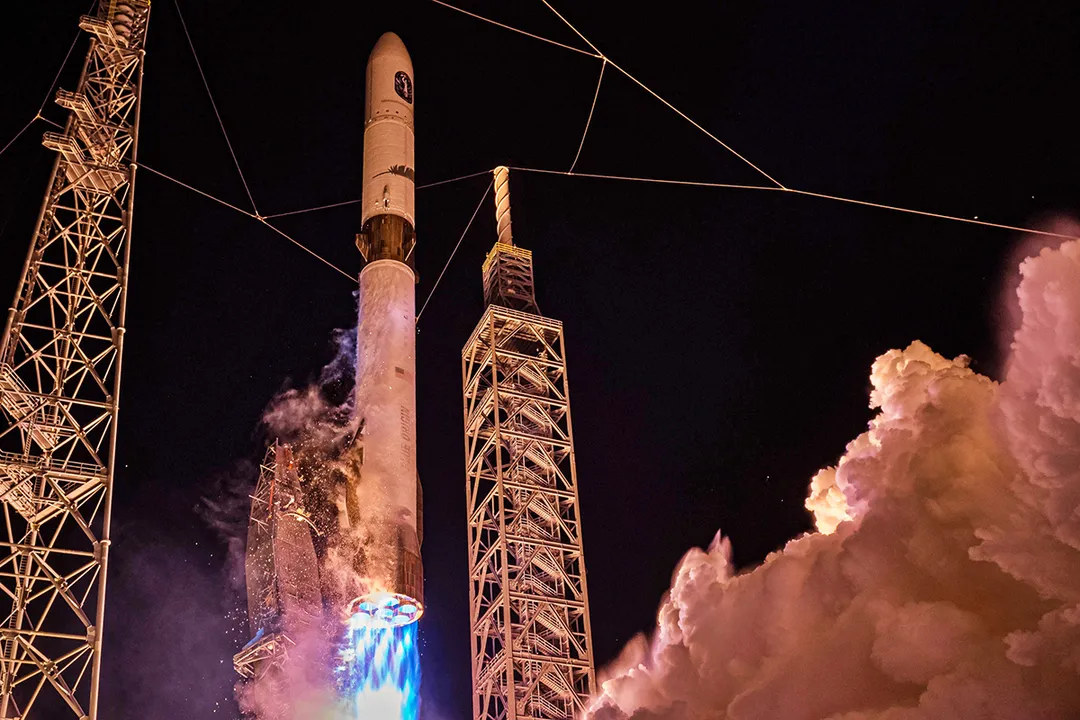
The arrival of Blue Origin’s New Glenn is not a matter of if it will carry a payload, but what kind and how often it will launch them. This heavy-lift orbital vehicle, developed by Jeff Bezos’s company, represents a significant addition to the American launch capabilities, aiming for high cadence and significant lift capacity across various orbits. [1][8] The question for the industry is less about the presence of a payload bay and more about whether its performance profile—particularly its massive payload fairing—will carve out a unique and sustainable market niche, or if it will simply join the roster of heavy lifters with capabilities that sometimes overlap with existing options. [3]
# Vehicle Design
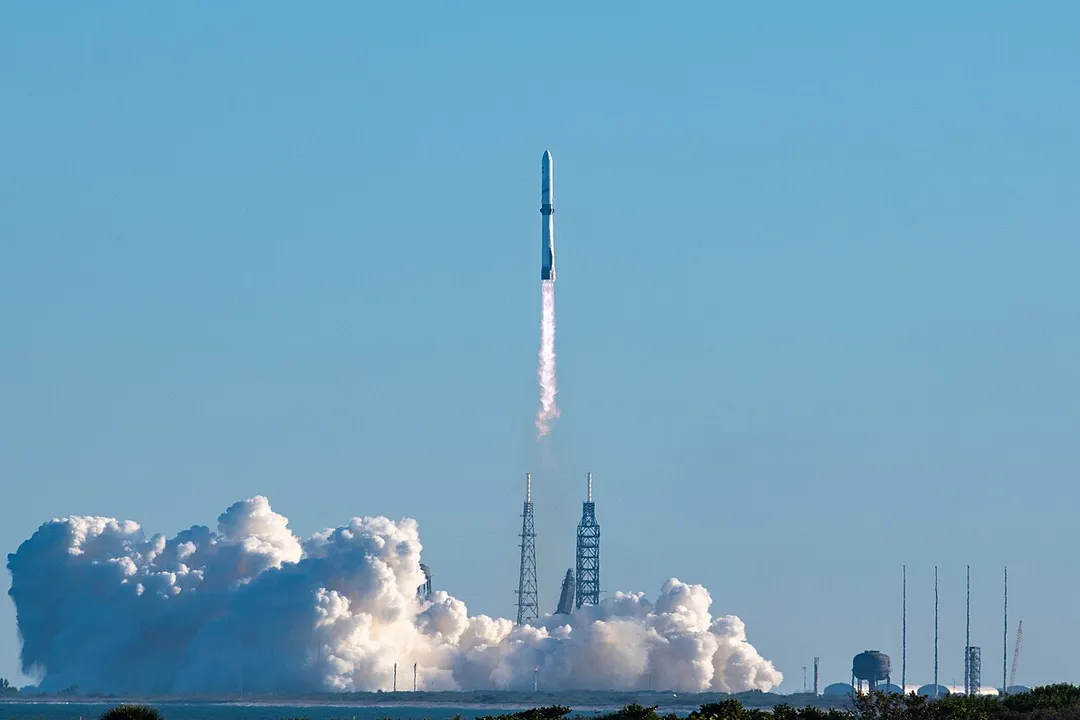
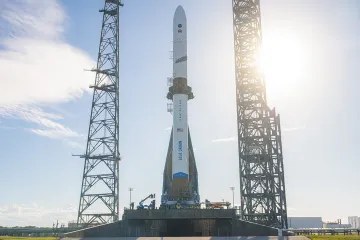
New Glenn is designed as a partially reusable, two-stage rocket, distinguished immediately by its sheer size and its first stage powered by the powerful BE-4 engines. [1][4] The overall architecture features a reusable first stage capable of returning to land on a designated pad at Launch Site One or an autonomous drone ship at sea, a critical factor for controlling operational costs over time. [1] The upper stage, which is expendable, is designed for high-performance delivery to difficult-to-reach orbits. [1]
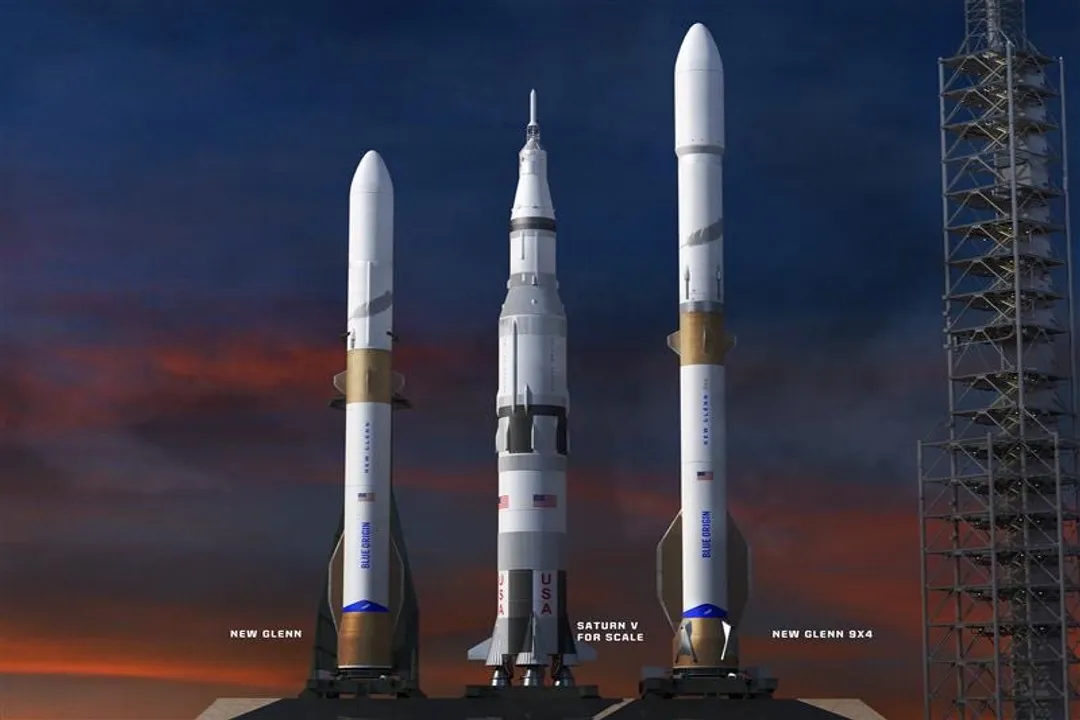
The sheer volume available for payloads is one of the rocket’s most defining features. The vehicle boasts a massive payload fairing, measuring nearly 7 meters in diameter and 21 meters long. [1] To put this size into perspective, Blue Origin has shared analogies indicating that this volume is equivalent to holding the entire volume of a common U.S. school bus within the fairing. [6] This substantial volume is intended to appeal to customers launching large constellations or singular, exceptionally bulky satellites that might struggle to fit into smaller fairings, even if those smaller rockets offer slightly better mass-to-orbit performance in certain scenarios. [6]
# Engine Power
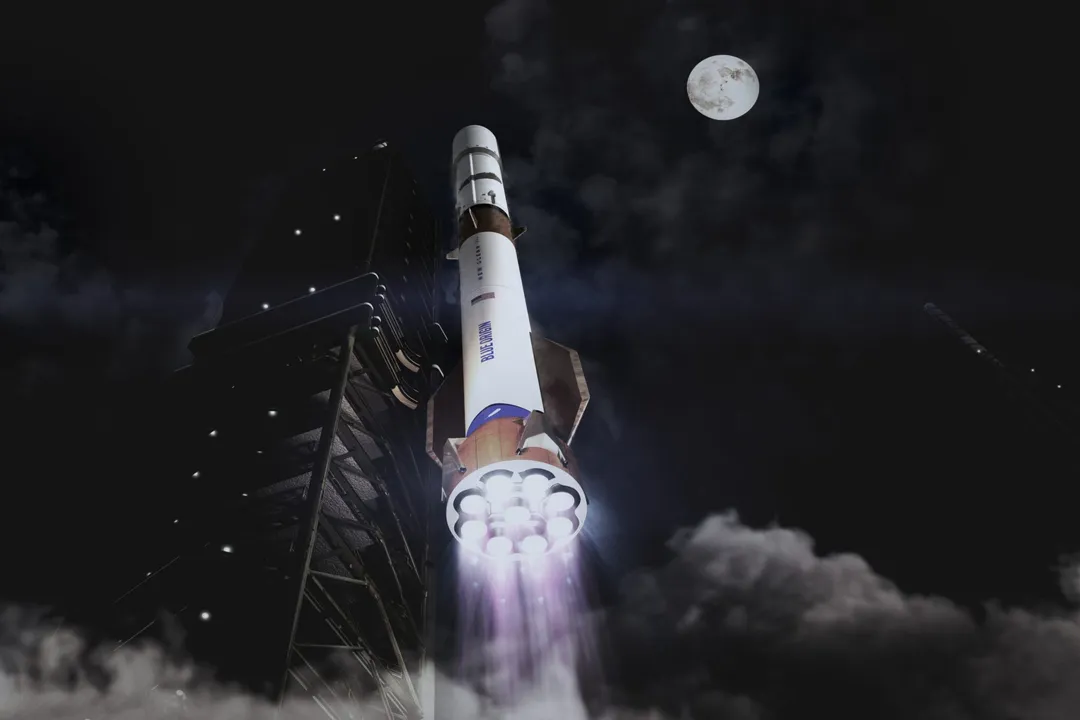
The propulsion system is key to understanding the vehicle's potential payload delivery. The first stage is driven by seven BE-4 engines fueled by liquid natural gas (LNG) and liquid oxygen (LOX). [1][4] These engines generate the thrust necessary to lift the massive structure skyward. [1] The upper stage, conversely, utilizes two reusable BE-3U engines running on liquid hydrogen and liquid oxygen. [1]
Blue Origin has also highlighted enhancements aimed at boosting performance that directly translate into greater payload capacity or orbital flexibility. [9] These upgrades include the incorporation of upgraded engines and the use of subcooled components within the vehicle’s systems. [9] Subcooling the propellants—cooling them to temperatures below their standard boiling points—allows for denser fuel loading within the tanks. This means that for a given tank size, more propellant mass can be carried, leading to a higher delta-v budget, which can be traded for heavier payloads or higher-energy orbits. [9] This engineering focus on density and efficiency suggests a commitment to maximizing the lift capability well after the initial design parameters were set. [3]

# Capacity Metrics
The expected performance of New Glenn is substantial, though direct comparisons across different destinations often reveal trade-offs. The rocket is projected to deliver up to 13,000 kilograms (about 28,660 pounds) to Geostationary Transfer Orbit (GTO). [4] For Low Earth Orbit (LEO), the capacity is often quoted to be around 30,000 kilograms (66,000 pounds). [4]
However, when comparing New Glenn’s potential to other heavy-lift vehicles, especially those already operational, the mass figures can generate nuanced discussions among industry watchers. [2] For instance, in direct comparison for specific deep-space targets like Mars, some analysis suggests that New Glenn's payload capacity might be less than that of the Falcon 9 rocket for that specific mission profile. [2] This highlights a crucial point: payload success is destination-dependent. A rocket optimized for high-volume LEO missions or high-energy GTO insertion might carry less to a specific planetary transfer orbit than a vehicle designed with different engine staging or propellant choices optimized for that deep-space trajectory. [2]
This leads to an observation about market positioning: New Glenn seems strongly oriented toward large commercial satellite deployments requiring GTO insertion, which benefits directly from its powerful upper stage and the sheer size of the fairing, rather than solely winning the 'mass-to-LEO' race against competitors. [1]
# Future Manifest
Will it have payloads? Absolutely, as contracts and mission preparations are already underway, confirming future business for the vehicle. [5] The presence of government work provides a baseline manifest that helps amortize the development and operational costs, which is vital for any new, large rocket system. [1]
One high-profile potential mission involves NASA. Blue Origin has been selected by NASA for the Mars Sample Return (MSR) mission’s Earth Return Orbiter (ERO) component, though this is a complex program with several moving parts and potential launch date shifts. [5] A planned launch attempt for a precursor mission, which involved a different vehicle, was tentatively set for November 2025, illustrating the active government pipeline these systems feed into. [5] While the final launch vehicle for every component of a massive program like MSR is subject to change based on testing and readiness, securing a role on such a flagship NASA project provides significant validation and guaranteed flight time. [5]
Beyond institutional science missions, the primary economic driver for any heavy-lift vehicle is the commercial satellite market. The sheer size of the fairing suggests an eagerness to capture missions involving large Earth observation satellites, communications platforms, or even nascent space infrastructure components that demand significant mass and volume margins. [1][3] Securing contracts for these large, high-value assets is how Blue Origin will demonstrate the commercial viability of the New Glenn system. [8]
# Analyzing the Volume Advantage
When discussing payload, people often default to weight, but for many satellite operators, volume is the limiting factor. [6] This is where New Glenn’s enormous fairing becomes a key selling proposition.
Consider a situation where a constellation operator is trying to launch several moderately sized satellites simultaneously. If an existing rocket can carry most of them by mass, but the physical dimensions force them to fly with one fewer satellite per launch, the operational costs increase due to fewer flights needed to deploy the constellation. New Glenn’s nearly 7-meter diameter fairing is designed to accommodate these larger structures, potentially allowing customers to stack more units or launch a single, very large satellite that simply cannot be disassembled small enough to fit into a smaller vehicle's shroud. [6]
Here is a hypothetical comparative scenario illustrating this trade-off:
| Metric | New Glenn (Est. Max) | Competitor X (Est. Max) | Implication |
|---|---|---|---|
| LEO Mass Capacity | 30,000 kg [4] | 22,800 kg [2] (Falcon 9, hypothetical comparison) | New Glenn has higher mass ceiling. |
| Fairing Diameter | ~7 meters [1] | ~5.2 meters [4] (General industry reference) | New Glenn accommodates larger structures. |
| GTO Mass Capacity | 13,000 kg [4] | 5,500 kg [4] (General industry reference) | New Glenn offers superior GTO performance. |
This comparison, though using generalized competitor data where available, emphasizes that a few extra tons of LEO mass do not always tell the whole story; the ability to inject a heavy payload directly into GTO or fit a very large structure is what separates launchers in this market segment. [4]
# Operational Context
The successful deployment of any payload hinges not just on the rocket’s capability on paper, but on the reliability and frequency of its operations. [8] Blue Origin's stated goal is high flight cadence, which is necessary to service the burgeoning commercial space economy. [1] The decision to make the first stage reusable is a direct attempt to control the variable cost per launch, making the price competitive enough to attract regular payload traffic. [1]
The path to high cadence involves mastering recovery and refurbishment. If the turnaround time for inspecting, refurbishing, and re-certifying the massive first stage between flights proves too long or expensive, the economic advantage diminishes, regardless of the theoretical payload capacity. [8] The actual realized payload capacity that customers can book month-to-month is tethered to the operational tempo achieved in the first few years of service. [3]
The investment in advanced engine technology, such as the BE-4's use of methane, is another factor that influences operational logistics. While methane is known to simplify ground operations compared to hydrogen (which requires extreme cryogenic cooling for the upper stage, as seen in the BE-3U), the infrastructure required to store and load LNG at scale for frequent launches presents its own unique set of engineering and logistical challenges at the launch site. [9] Successfully managing this ground segment is an unstated but necessary prerequisite for regularly flying payloads to orbit. [9]

# Beyond LEO and GTO
One area where New Glenn’s payload profile becomes particularly interesting is in missions requiring significant velocity changes () beyond what standard GTO provides, often for deep space or specialized orbits. The performance upgrades mentioned earlier, specifically the use of subcooled propellants, directly enhance the vehicle's ability to push payloads to higher energy orbits or on interplanetary trajectories. [9]
For instance, a specific trajectory that requires a very high apogee near geosynchronous altitude might benefit more from the increased density-range provided by subcooling than a standard GTO mission where the upper stage is throttled back to preserve fuel for orbital insertion. [9] This flexibility in performance tuning allows the provider to tailor the launch service precisely to the mission's budget, rather than just offering fixed LEO/GTO slots.
In effect, New Glenn is being positioned to handle the next generation of large scientific probes and expansive commercial communication arrays that are pushing the boundaries of current launcher capabilities—not just in raw weight, but in the complexity of the final orbit they must attain. [5] The combination of a large fairing for physical size and enhanced upper-stage performance for energy delivery creates a compelling package for customers whose mission requirements exceed the standard benchmarks of today's rockets. [1] The question of having a payload is settled by its design intent: it is engineered to carry the future's largest and most demanding hardware.
#Videos
Blue Origin Is Ready To Launch New Glenn - YouTube
Related Questions
#Citations
New Glenn | Blue Origin
New Glenn has less payload to Mars than falcon 9. Are they ... - Reddit
Blue Origin supersizes New Glenn rocket to carry heavier payloads
New Glenn - Wikipedia
Blue Origin launches NASA's Mars mission - Spectrum News 13
It may be hard to visualize just how much New Glenn can carry to ...
Blue Origin Is Ready To Launch New Glenn - YouTube
Blue Origin goes orbital