Is the New Glenn Super Heavy Lift?
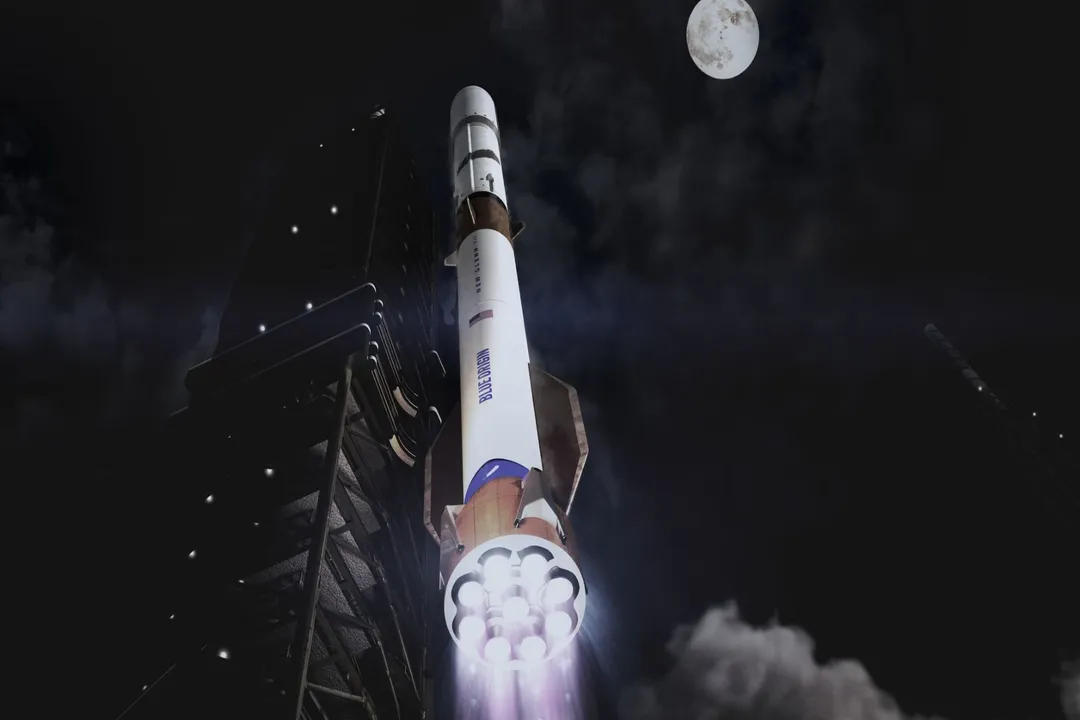
The New Glenn rocket, named in honor of the first American to orbit Earth, John Glenn, has rapidly moved from concept to operational status, successfully achieving orbit and landing its first stage in 2025. [1] However, the question of whether it truly belongs in the Super Heavy Lift category requires looking beyond the vehicle that took its maiden flight. Blue Origin has officially announced two configurations for this rocket family: the two-stage, partially reusable vehicle currently flying, designated , and a significantly upscaled version in development, the . [1][3] It is the latter configuration that decisively answers the prompt, placing the New Glenn family squarely in contention for the Super Heavy designation. [1]
# Baseline Specs
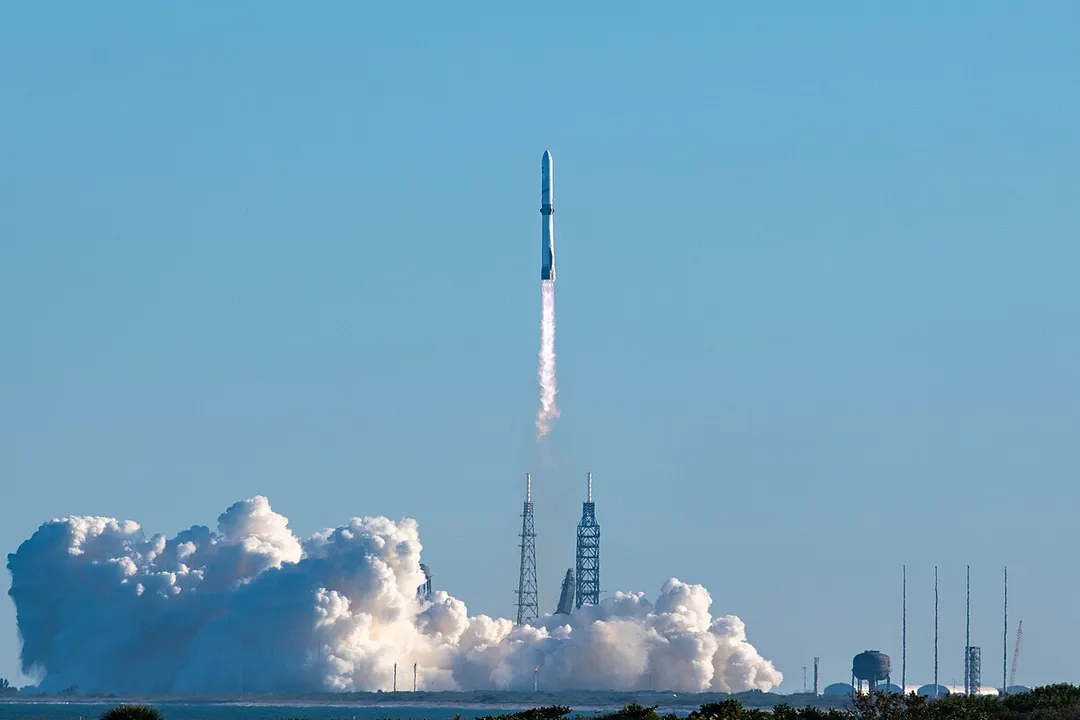
The vehicle that debuted in January 2025 and successfully landed its booster in November 2025 is the configuration, which the company classifies as a heavy-lift launch vehicle. [1] This initial operational version stands tall and utilizes a diameter airframe. [1]
The propulsion architecture for the standard New Glenn is defined by its engines, which are all designed and built by Blue Origin. [1] The first stage, designated GS1, is powered by seven BE-4 engines, which use liquid oxygen () and liquid methane () as propellants. [1] The second stage, GS2, is powered by two vacuum-optimized BE-3U engines running on and liquid hydrogen (). [1]
The performance envelope for this initial vehicle targets significant capacity while retaining a reusable first stage, which is designed to land vertically on the Landing Platform Vessel Jacklyn. [1]
# Capacity Table For The Variant
The stated payload goals for the standard version are substantial for a partially reusable vehicle. [1]
| Destination | Payload Mass (Approximate) | Notes |
|---|---|---|
| Low Earth Orbit () | Achieved with reusable first stage [1] | |
| Geosynchronous Transfer Orbit () | Targeted for dual-manifested missions [1] | |
| Trans-Lunar Injection () | For deep space missions [1] |
The cost per launch for this configuration is projected to be in the range of \text{US}\68\text{US}\. [1] The commitment to reusability is underscored by the design goal for the booster to support a minimum of $25$ flights. [1]
# Super Heavy
The designation "Super Heavy Lift" is earned by the variant, which Blue Origin announced in late 2025. [3] This version represents a substantial scaling up of the original design, primarily through increased engine count and a larger diameter fairing. [1]
The name directly references the engine configuration: nine BE-4 engines on the first stage and four BE-3U engines on the second stage. [3] This expansion translates directly into a major increase in performance metrics, pushing the rocket into a class defined by launch capabilities well over to .
The vehicle is also physically imposing. An illustration released by Blue Origin CEO Dave Limp depicted this variant as being taller than the historic Saturn V rocket. [1] Furthermore, it features an enlarged payload fairing measuring () in diameter, significantly wider than the fairing on the standard version. [1] For context, the fairing on the model is already notably wider than the fairing used on the Falcon Heavy.
# Capacity Benchmarks
The performance jump between the two variants is substantial enough to challenge existing benchmarks in the American heavy-lift market. [1]
| Destination | Capacity (Approx.) | Capacity (Approx.) |
|---|---|---|
| Low Earth Orbit () | [1] | [1] |
| Geosynchronous Orbit () | [1] | (Direct) [3] |
| Trans-Lunar Injection () | [1] | [1] |
With a capacity exceeding , the configuration nears the lift capacity of NASA’s Space Launch System Block 1 rocket, yet it achieves this while maintaining a reusable first stage—a feature that the larger SLS Block 1 does not incorporate. [1] This specific juxtaposition of high payload performance with first-stage recovery is a compelling differentiator in the high-capacity launch market. [1]
# Evolving Propulsion
The New Glenn family’s performance evolution is not solely reliant on adding more engines in the variant; performance enhancements are also being phased into the existing architecture, scheduled to begin with mission . [3] These upgrades focus on increasing thrust by using subcooled propellants and optimizing engine performance. [3]
The seven BE-4 booster engines are slated to see their total liftoff thrust increase from approximately to ( to ). [3] The BE-4 engine itself has demonstrated capability exceeding on the test stand, with subcooling pushing the operating capacity further. [3] Similarly, the two BE-3U engines on the upper stage will see their combined thrust increase from to ( to ). [3]
Beyond propulsion, the planned upgrades for the entire family include a reusable payload fairing to support faster flight rates and a new, reusable thermal protection system designed to cut down on turnaround time between missions. [3] These structural and operational improvements suggest a commitment to making the vehicle both faster to turn around and capable of supporting heavier lifting concurrently. [3]
# Concurrent Strategy
Blue Origin has made clear that the development of the is not intended to replace the ; instead, both variants are intended to operate concurrently. [1][3] This presents an interesting segmentation strategy that differs from other major players who often focus on a single, optimized rocket architecture.
The concurrent operation suggests a tiered service offering. The variant, with its lower operational mass and thrust, is likely intended to offer a more agile, perhaps lower-cost-per-launch option for frequent missions, such as deploying mega-constellations for clients like Amazon's Kuiper program. [1][3] Conversely, the configuration would be reserved for missions requiring that premium capacity—such as national security imperatives like "Golden Dome," deep space exploration, or large lunar lander deployment missions. [3] This dual-track approach allows Blue Origin to address a wider spectrum of customer needs without forcing every payload into the largest available rocket, which can sometimes lead to inefficiencies or higher overall mission costs for smaller customers. [1]

# Economic Framework
The key enduring feature across the entire New Glenn family, from the initial to the future , is the reusable first stage. [1] While early concepts for reusability dated back to the initial design phase, the successful sea landing in November 2025 proved the operational viability of the recovery system for the heavy-lift version. [1]
When considering the Super Heavy in relation to the performance of non-reusable super-heavy rockets, the reusability factor offers a potential economic pathway to significantly lower access-to-space costs for the highest-capacity missions. [1] While the initial development cost for New Glenn was at least \text{US}\2.5 \text{ billion}9\times 4$ can approach the lift capacity of systems like the SLS Block 1 but achieve a launch cost less than one-tenth as much—a potential goal suggested by media reports—its entrance into the market will profoundly affect the economics of large-scale space infrastructure, whether that is for military payloads, large satellite constellations, or crewed/robotic lunar missions using the Blue Moon lander. [1]
The evolution of New Glenn from an announced heavy-lift concept to a family that includes a confirmed Super Heavy Lift variant () confirms that Blue Origin is aiming for the very upper limits of current launch capability while retaining a cost-saving focus on reusability across its entire orbital product line. [1][3] The answer, therefore, is not a simple yes or no for New Glenn, but rather that the New Glenn family encompasses both heavy-lift and super-heavy-lift offerings, prepared to compete in different, yet essential, sectors of the space economy. [1][3]
Related Questions
#Citations
New Glenn Update | Blue Origin
New Glenn - Wikipedia
Jeff Bezos' Blue Origin will build a 'super heavy' version of ... - Space