Is Blue Origin New Shepard reusable?

The New Shepard rocket system from Blue Origin is indeed designed for and achieves reusability. It functions as a fully reusable, suborbital rocket designed specifically for carrying humans to space and back. This design philosophy—reusability from the start—is central to the company's mission objective of "radically reduc[ing] the cost of access to Space".
# System Design
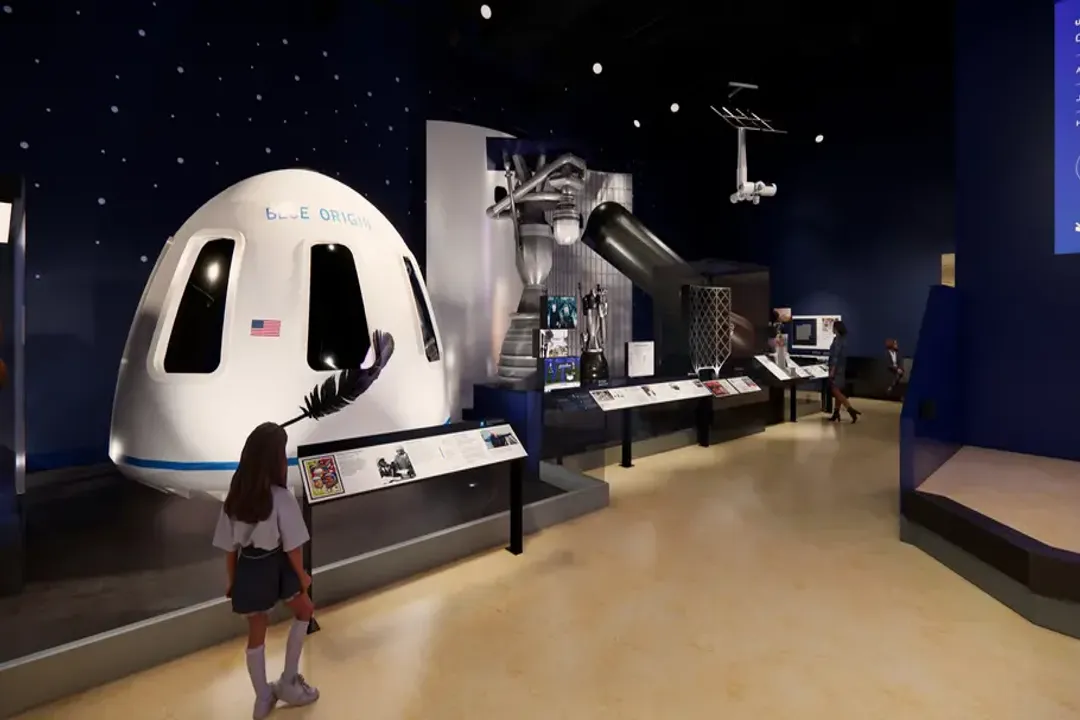
The New Shepard vehicle is a two-stage system, composed of a pressurized crew capsule perched atop a launch rocket, which the company often refers to as a booster or propulsion module. It operates on a vertical takeoff and vertical landing (VTVL) architecture. A key feature is that the entire system is fully autonomous; there are no human pilots controlling the vehicle during flight, relying instead on on-board computers.
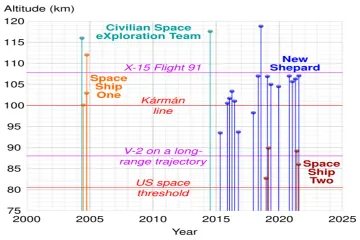
The mission profile involves a powered flight for about 110 seconds, taking the vehicle up to an altitude near (). After engine cutoff, the capsule separates from the booster to continue coasting upward to its apogee, which is planned to exceed the Kármán line—the internationally recognized boundary of space at (). This allows the occupants to experience several minutes of weightlessness and observe Earth's curvature. The entire suborbital journey, from launch to landing, takes approximately 11 minutes for the astronauts.
The vehicle relies on several unique aerodynamic and propulsive components to manage its descent and return to Earth. Aft fins stabilize the rocket during ascent and then steer it back toward the landing pad, remaining effective even at speeds exceeding Mach 3. Near the top of the booster, ring and wedge fins are employed to provide aerodynamic stability and, crucially, to help reduce fuel consumption during the descent phase. Furthermore, drag brakes deploy to help slow the booster down significantly before the engine restart phase. The system is fueled by liquid oxygen and liquid hydrogen.
# Booster Recovery
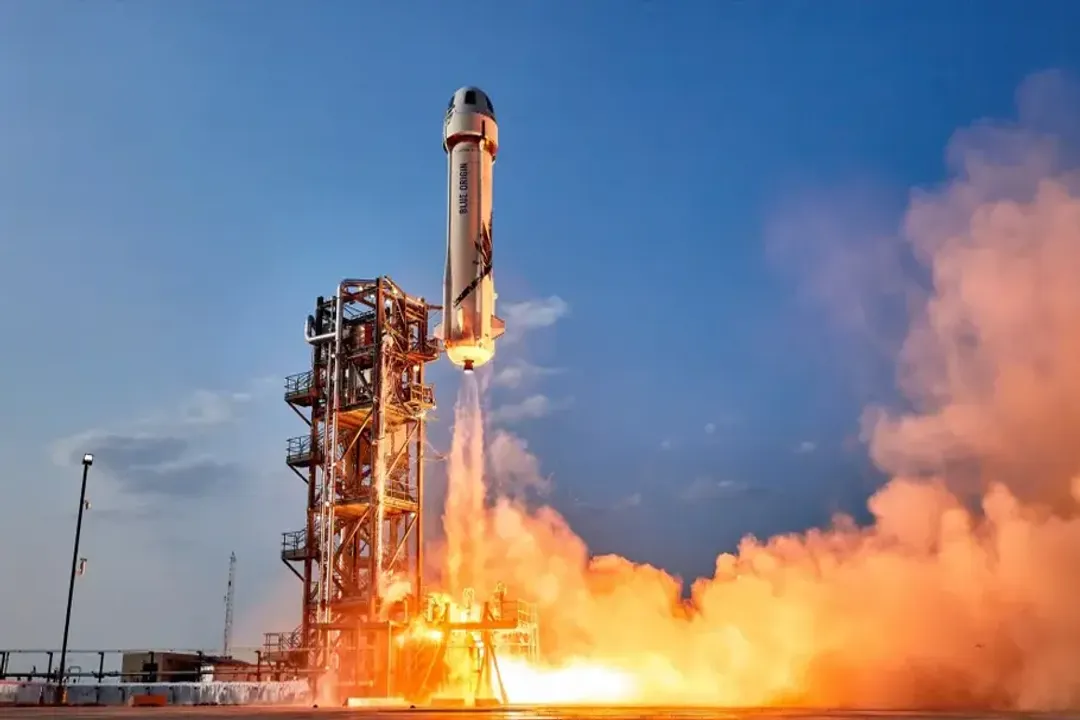
The successful recovery of the booster is the most visible aspect of New Shepard's reusability. Once the capsule separates, the booster autonomously navigates back toward the launch site in West Texas. This controlled return involves the engine restarting to slow the descent dramatically. The aim is a controlled pinpoint landing on the pad, with the landing gear deploying to cushion the touchdown and slow the vehicle to just about . The reusable nature of the booster drastically reduces the need for manufacturing new rocket bodies, which in turn lessens reliance on raw materials and the environmental impacts associated with their mining.
Historically, the first full-scale test flight in April 2015 (NS-1) saw the capsule successfully recover via parachute, but the booster itself crash-landed and was not recovered due to a failure in the hydraulic control system during descent. However, this early setback was quickly overcome. The second propulsion module, NS2, went on to fly five successful missions between 2015 and 2016, demonstrating successful booster recovery repeatedly. This success was recognized when Blue Origin was awarded the Collier Trophy in 2016 for demonstrating rocket reusability with the New Shepard vehicle.
Looking across the flight history, one can observe a significant variance in the time between uses for individual boosters. For instance, the NS2 module saw turnarounds as short as 60 days between its second and third flights. Contrast this with the booster for mission NS-24, which flew in May 2024, after its previous use was hundreds of days prior, following the in-flight anomaly of NS-23 in September 2022. The flight history indicates that while the design targets minimal refurbishment, operational pauses for investigation, as seen after the NS-23 incident, can result in a turnaround time extending well over a year for a specific booster, affecting the operational tempo despite the inherent reusability of the hardware.
# Capsule Descent
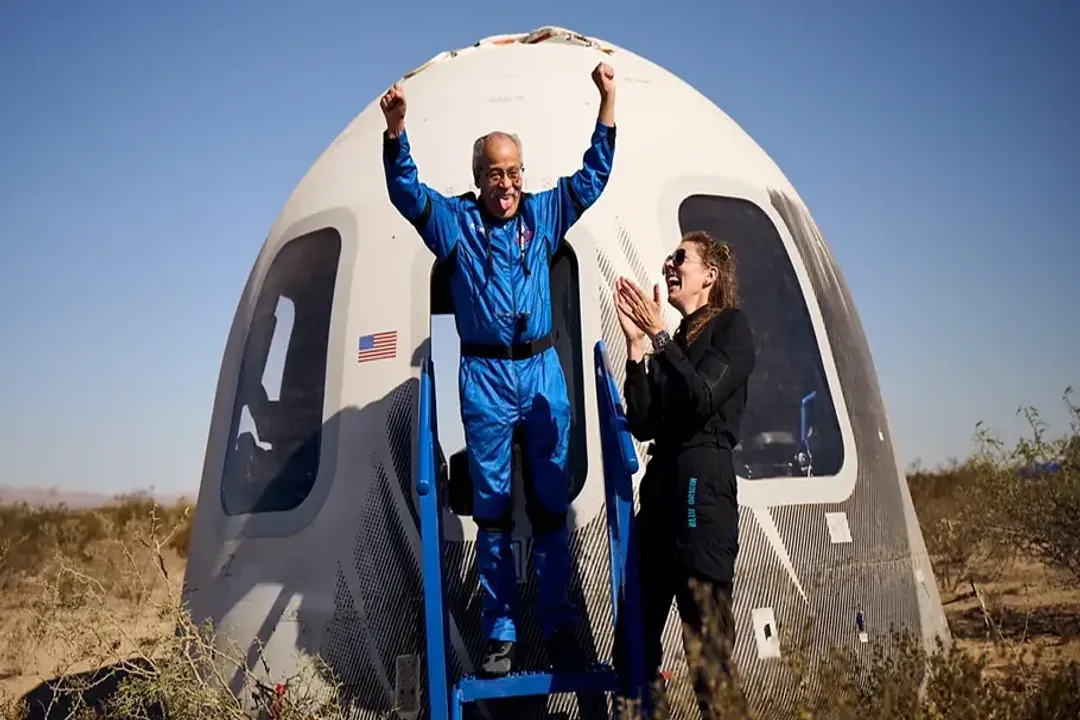
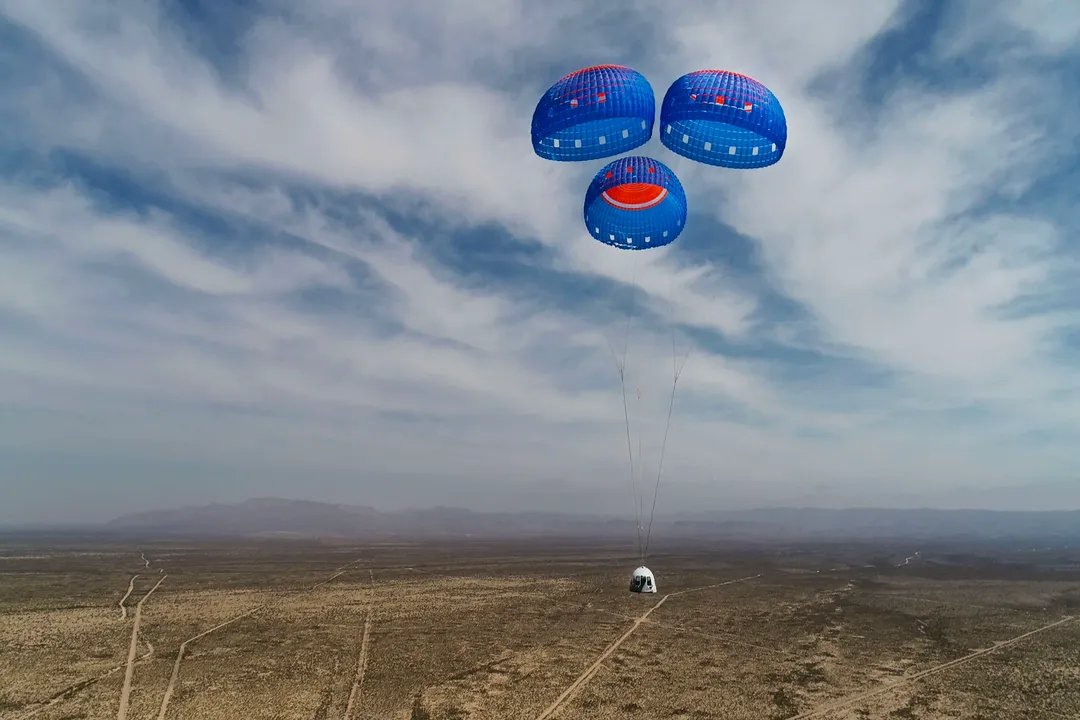
The crew capsule has its own complex, redundant recovery system designed to ensure a soft landing for its human occupants. After separating from the booster, the capsule descends using three independent parachutes for redundancy—it can land safely even if one fails.
Prior to touchdown, the capsule uses a retro-thrust system that expels nitrogen gas to further cushion the impact, slowing the descent to roughly . As a final layer of protection, a crushable ring about () high compresses upon impact with the ground, acting as a final decelerator to absorb the last of the g-forces. The capsule is named an RSS, which stands for Reusable Space Ship. For instance, the capsule that flew Jeff Bezos (NS-16) was named RSS First Step.
# Component Longevity
Blue Origin’s design principle emphasizes reusing nearly 99% of the system’s dry mass. This includes the engine, landing gear, capsule, booster, ring fin, and even the parachutes. The booster engine, the BE-3PM, is throttleable and reusable. The company explicitly states that the booster is designed for reusability up to 25 times with minimal refurbishment.
The system utilizes several propulsion modules over time. For example, Propulsion Module NS3, which carried the capsule RSS H. G. Wells, ultimately flew nine times before it was destroyed on the NS-23 mission in September 2022 due to an in-flight anomaly. Conversely, Propulsion Module NS4, flying with RSS First Step, has completed sixteen launches as of a recent flight record. The capsules themselves have a service life; RSS H. G. Wells was retired from service after its twelfth flight. When its service life concludes, RSS First Step is slated for display at the Smithsonian's National Air and Space Museum, signifying the historical achievement of this reusable spacecraft.
# Flight History
The New Shepard program has an extensive flight log demonstrating the progression of its reusable design. Following initial development, the first crewed flight (NS-16) occurred in July 2021 with Jeff Bezos aboard. The system has supported a mix of private astronauts, sponsored crewmembers, and extensive research payloads, including technology demonstrations for NASA's Artemis program.
The in-flight anomaly on mission NS-23 in September 2022 serves as a crucial data point for reusability testing. During that uncrewed flight, the BE-3PM main engine experienced a failure, which caused the launch escape system to trigger, separating the capsule successfully. The capsule landed safely under parachutes, but the booster was lost as it impacted the ground. Following an investigation, Blue Origin identified a thermal-structure failure in the engine nozzle. The system returned to crewed flight in December 2023 (NS-24).
The manifest of missions shows a growing operational cadence. For instance, by early 2025, Propulsion Module NS5 had debuted, flying its first mission in October 2024. The flight on April 14, 2025 (NS-31), notably carried the first all-women crew since 1963. This constant cycle of flying, recovering, and re-flying underscores the practical application of the reusable architecture.
# Environmental Footprint
Blue Origin frames its design choices, particularly reusability, under the banner of being "For The Benefit of Earth". The reusability aspect inherently reduces the environmental impact compared to single-use rockets by cutting down on the manufacturing of new components like boosters. Furthermore, the choice of propellant—liquid oxygen and hydrogen—means that the only byproduct of the BE-3PM engine combustion is water vapor; there are no carbon emissions from the engine itself during flight.
It is important to maintain a precise view of these environmental claims. While the exhaust of the engine is carbon-free, the overall environmental cost of spaceflight must account for the entire system lifecycle. The energy and materials required to manufacture the reusable engine, construct the capsule, and perform the rigorous refurbishment necessary to prepare the booster for its next flight are all factors in its true ecological accounting. The comparison is often drawn against older designs where large portions of the vehicle, like the Apollo command module, were simply discarded. Blue Origin’s approach attempts to shift the majority of the environmental burden toward the manufacturing and refurbishment of long-life components rather than the one-time jettisoning of major hardware like a booster after a single flight.
#Videos
Blue Origin NS-33 New Shepard launch and landing - YouTube
Related Questions
#Citations
New Shepard | Blue Origin
New Shepard - Wikipedia
Blue Origin NS-33 New Shepard launch and landing - YouTube
How Sustainable is Blue Origin's New Shepard Space Flight?
Introducing RSS First Step | National Air and Space Museum