What is the elliptical path of the planets called?
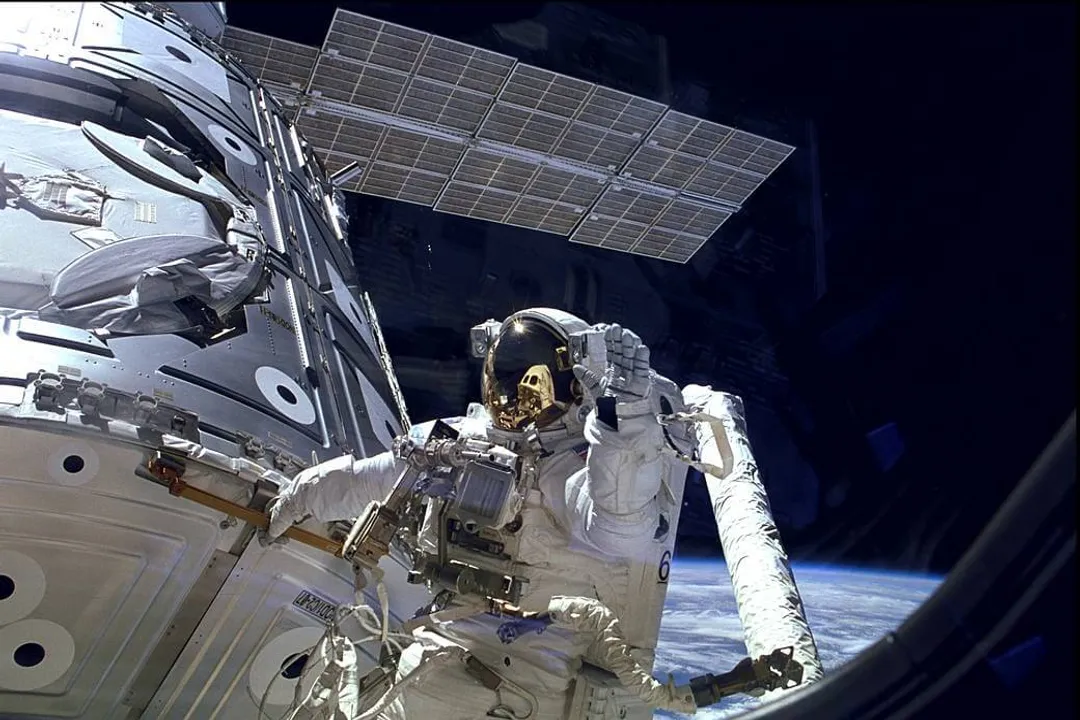
The path traced by a planet as it revolves around the Sun is formally known as an elliptical orbit. [1][4][5][6][9] While everyday visualizations often depict this movement as a perfect circle, the actual trajectory followed by celestial bodies within our solar system is slightly elongated, giving it an oval shape. [5] This elliptical path is the fundamental geometric description of how planets move in response to the Sun's gravitational pull. [4][5]
# Kepler's Foundation
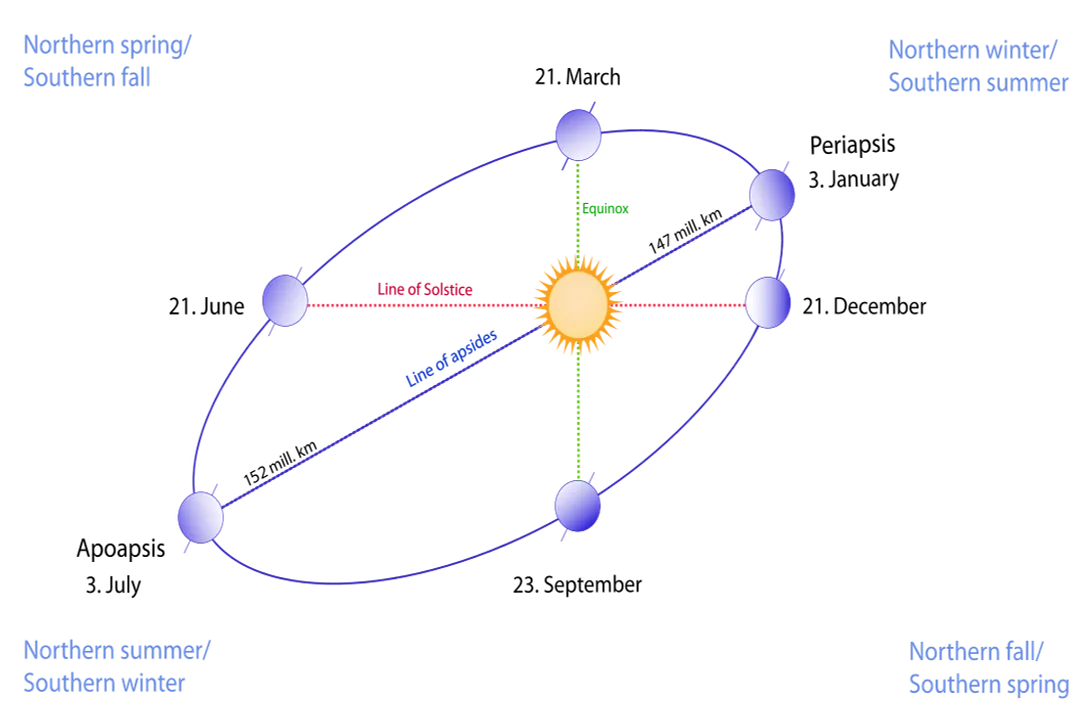
The definitive understanding of this orbital shape is codified in the laws established by Johannes Kepler in the early seventeenth century. [1] Kepler's First Law of Planetary Motion, often called the law of orbits, specifically dictates that the orbit of every planet is an ellipse, with the star at the center of the orbit—the Sun, in our case—located at one of the two foci of that ellipse. [1][5] This immediately clarifies why the path is not centered; if the Sun were exactly in the middle, the orbit would necessarily be a circle, which is mathematically considered a special case of an ellipse where the two foci coincide. [1][9]
# Anatomy of the Path
To understand the geometry of an ellipse, one must first grasp the concept of its foci. [1] An ellipse is defined as the set of all points where the sum of the distances to the two fixed points (the foci) is constant. [1] When modeling a planetary orbit, one focus is occupied by the central star, and the other focus is simply empty space. [9]
The dimensions of this oval path are described using specific parameters. The semi-major axis () is the longest radius of the ellipse, representing half the longest diameter. [1] This value is crucial as it essentially defines the average distance between the planet and the Sun over the course of its entire revolution. [1]
# Orbit Shape
The degree to which an orbit deviates from being a perfect circle is quantified by a measurement called eccentricity (). [1] The eccentricity value dictates the 'squashedness' of the path. [1]
- If , the orbit is a perfect circle. [1]
- If , the orbit is an ellipse. [1]
- If or greater, the path is an unbound parabola or hyperbola, meaning the object will not return. [1]
All planets in our solar system have eccentricities between zero and one, meaning they are gravitationally bound to the Sun. [1] Earth's orbit is remarkably close to circular, with an eccentricity of approximately $0.0167$. [1][9] In contrast, Mercury, the closest planet to the Sun, possesses the highest eccentricity among the major planets, registering around $0.205$. [1]
| Planet | Approximate Eccentricity () | Description |
|---|---|---|
| Mercury | $0.205$ | Most eccentric major planet |
| Earth | $0.0167$ | Nearly circular |
| Neptune | $0.0086$ | Closest to a perfect circle |
| Pluto (Dwarf Planet) | $0.2488$ | Highly eccentric compared to major planets |
| [1] |
# Speed Variation
The elliptical nature of the orbit is directly responsible for the varying speeds planets exhibit throughout their revolution, a concept covered by Kepler's Second Law, often called the law of areas. [2][5] Because the distance from the Sun changes, the planet's speed must also change to maintain a constant rate of area swept out per unit time. [5]
When a planet is closest to the Sun, it is moving at its maximum orbital velocity. [2] This closest approach is termed perihelion. [2] When the planet reaches its farthest point from the Sun, it slows down to its minimum speed. [2] This farthest point is known as aphelion. [2] This variation in speed is not arbitrary; it is a requirement dictated by the conservation of angular momentum. [5]
If you imagine the Earth completing one full loop, the distance difference between its perihelion (which occurs around January 3rd) and its aphelion (around July 4th) amounts to several million kilometers. [9] For an amateur astronomer tracking Jupiter, this variation in radial distance means that the apparent angular size of the planet observed from Earth changes noticeably over the course of Jupiter's year—sometimes appearing nearly 10% larger or smaller in the telescope depending on where Earth is in its own elliptical track. [1]

# Gravitational Context
While Kepler described how the planets move based on meticulous observation, it was Isaac Newton who provided the underlying why through the law of universal gravitation. [5] Newton demonstrated that any attractive force that varies with the inverse square of the distance between two bodies will produce orbits that are conic sections—circles, ellipses, parabolas, or hyperbolas. [1][5] Since the planets are bound by the Sun's gravity, they must trace the closed curve, which is the ellipse. [1]
It is worth noting that while the major planets exhibit very low eccentricity, other bodies follow much more dramatic paths. A typical comet, for example, can have an eccentricity approaching $0.99$, meaning its orbital path is extremely stretched out. [1] For such an object, the difference between perihelion and aphelion can span billions of kilometers, causing tremendous swings in temperature and activity as it moves from the inner to the far reaches of the solar system. [1] This contrast helps illustrate just how close to a perfect circle the orbits of planets like Earth and Neptune actually are. [1]
#Videos
Why Are Planetary Orbits Elliptical? - YouTube
Related Questions
#Citations
Elliptic orbit - Wikipedia
Elliptical Orbits Definition, Equations & Example - Lesson | Study.com
What Is an Orbit? | NASA Space Place – NASA Science for Kids
Why Are Planetary Orbits Elliptical? - YouTube
What is the pathway through which the planets revolve around the ...
Solar System orbits - HOU Spain
ELI5: Why do planets move in an elliptical orbit instead of a circular ...
Elliptical Orbit - an overview | ScienceDirect Topics
Earth's orbit - Simple English Wikipedia, the free encyclopedia