What is a rock that falls from the sky?
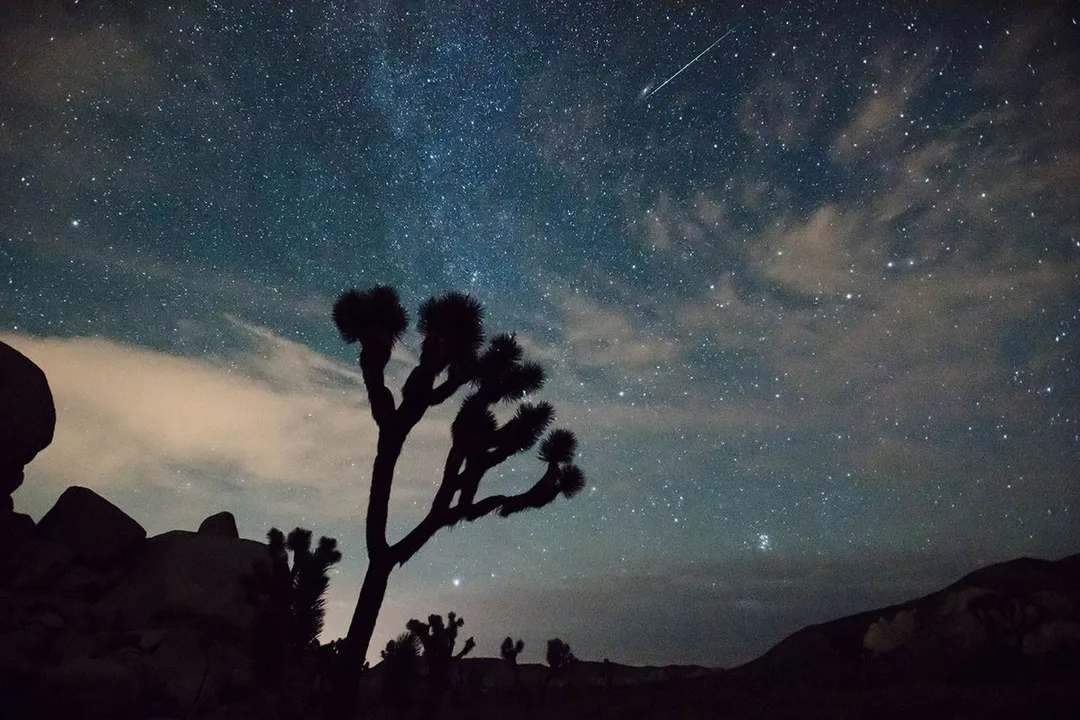
The objects that streak across our night sky, sometimes resulting in a tangible piece reaching the ground, carry names that are often used interchangeably in casual conversation, yet they describe distinct stages of a cosmic journey. The rock itself, while it is still traveling in space, is known as a meteoroid. [2] Only when that object enters Earth’s atmosphere and begins to burn up due to friction, creating a visible streak of light, is it properly termed a meteor. [2][5] If that object survives its fiery passage and actually lands on the Earth’s surface, then, and only then, is it referred to as a meteorite. [2][4] This differentiation is fundamental when discussing what exactly falls from the sky. [2]
# Terminology Breakdown
The progression from meteoroid to meteorite defines an object's identity relative to its location. [5] A meteoroid is generally defined as a small body in space, ranging in size from grains of dust up to about one meter across, though definitions can vary. [2][8] Objects larger than this are typically classified as asteroids. [2] When these celestial fragments encounter our planet, the intense compression of air ahead of them generates heat, causing them to glow brightly—this luminous phenomenon is the meteor. [2] The most spectacular fireballs seen are sometimes called bolides. [2] The final piece, the remnant that successfully impacts the surface, is the meteorite, a piece of another world retrieved right here on Earth. [3]
# Cosmic Composition
Meteorites are not homogenous; they represent the fundamental building blocks of the inner Solar System. [3] Scientists categorize them into three primary groups based on their makeup. [1][3]
The most common type encountered are stony meteorites. [1] These are primarily composed of silicate minerals, much like rocks found on Earth, though their structures and mineral compositions can be vastly different. [8] A significant subgroup of stony meteorites are the chondrites, which are primitive, undifferentiated materials that have remained largely unchanged since the Solar System formed about 4.56 billion years ago. [1]
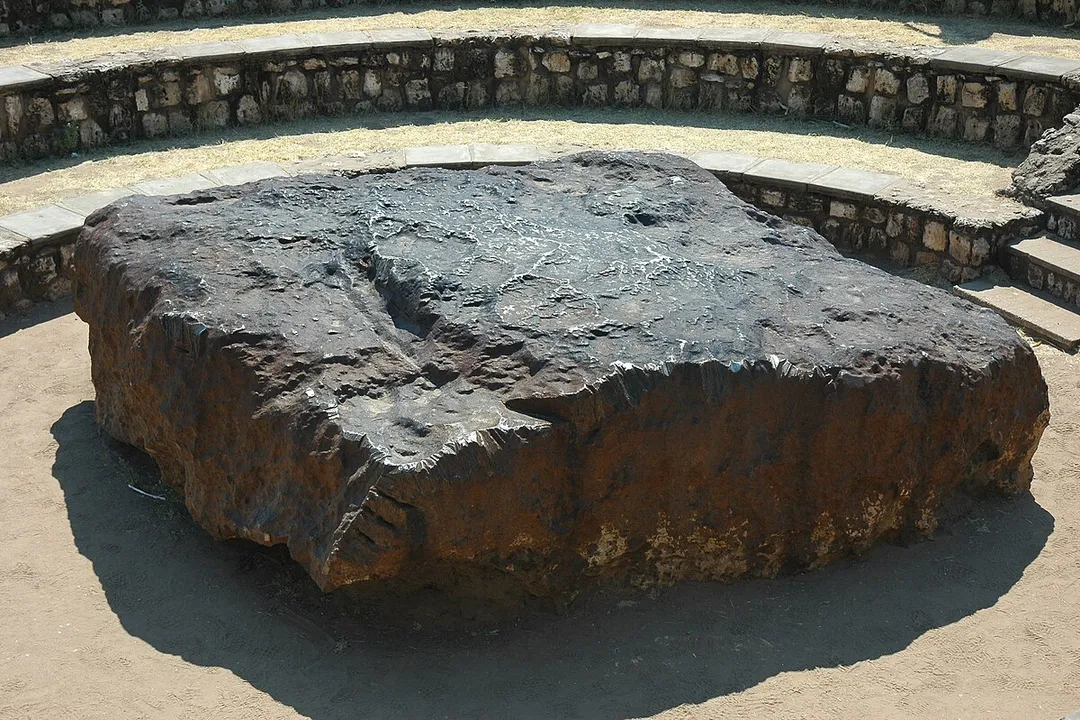
The second major group consists of iron meteorites. [1] As their name suggests, these space rocks are mostly made of iron and nickel alloy. [8] They are thought to be fragments of the cores of ancient, shattered planetesimals. [3] Because of their high metal content, these are often the easiest to identify initially due to their density and magnetic properties. [1]
Finally, there are the stony-iron meteorites. [1] These are the rarest category, containing roughly equal parts of silicate minerals and iron-nickel metal. [1][3] An example of this type is the pallasite, known for its striking appearance, featuring crystals of the olivine mineral embedded within a metallic matrix. [3]
| Classification | Primary Composition | Relative Rarity (Approx.) | Planetary Origin (Inferred) |
|---|---|---|---|
| Stony | Silicates (Olivine, Pyroxene) | Most common ( of falls) [1] | Asteroids |
| Iron | Iron-Nickel Alloy | Less common ( of falls) [1] | Asteroid Cores |
| Stony-Iron | Silicates and Iron-Nickel | Rarest ( of falls) [1] | Core-Mantle Boundaries |
# The Atmospheric Gauntlet
The journey through the atmosphere is violent and swift, which explains why the resulting object often looks very different from terrestrial rocks. [2] A meteoroid enters the atmosphere at tremendous speeds, sometimes exceeding 11 kilometers per second. [2] This hypervelocity impact with atmospheric gases causes intense ablation, or surface melting and vaporization. [2]
When a small object survives this process, the exterior cools rapidly once it slows down enough, forming a thin, glassy coating called a fusion crust. [2] This crust is a telltale sign of a recent meteorite fall. [2] While most meteoroids are small enough to burn up completely, the larger ones reach the ground as meteorites. [8] It is fascinating to consider that these arrivals are not solely derived from the asteroid belt; some confirmed meteorites have originated from impacts on the Moon or even Mars, blasted off their parent bodies by ancient, powerful collisions. [1]
For those interested in collecting, understanding the context of a find is key. While iron meteorites are chemically distinctive and often easy to spot with a simple magnet due to their high nickel-iron content, stony meteorites can look surprisingly similar to common Earth rocks like dark basalts. [1] This means that field identification based on appearance alone can be misleading; a dense, dark rock found in a remote field is far more likely to be terrestrial igneous rock than a fresh chondrite unless the fusion crust is clearly present and intact. [6] The magnetic test is a quick first step, but its positive result strongly favors an iron or stony-iron classification, giving collectors a hint about the rarity of their potential find. [1]
# Handling a New Find
If you are fortunate enough to witness a bright streak and subsequently locate a rock that might be a meteorite—a scenario that brings the excitement of space exploration right to your backyard—there are specific protocols to follow to preserve its scientific integrity. [7]
First and foremost, safety and preservation are paramount. [7] If you suspect you have found a meteorite, try to note the exact location and time of the event. [7] If the object is still hot, do not touch it with bare hands, though most will have cooled by the time they are found. [7]
There are several steps recommended to secure the specimen:
- Isolate the specimen: Move the rock away from sources of contamination, such as water, soil, or oils from your hands. [7]
- Handle minimally: If you must move it, try to wrap it in a clean, non-absorbent material, like aluminum foil or a clean plastic bag. [7] Avoid placing it directly into a regular trash bag or plastic container that could trap moisture, as this encourages terrestrial weathering and corrosion, which can rapidly destroy crucial features. [7]
- Seek expert identification: The next step involves contacting professional institutions. [7] Museums, university geology departments, or geological surveys are the best places to start. [7] Many organizations have specialists dedicated to meteorite identification. [3][7] Reddit groups focused on geology or meteorite collecting can also offer initial guidance on who to contact locally. [6][9]
It is important to understand that terrestrial weathering, even over a few months, can begin to alter the meteorite's surface texture and composition, particularly for the more common stony types. [7] Therefore, speed in contacting an expert without compromising the sample is vital for scientific analysis. [7] While many people who find dense, dark rocks hope they are meteorites, the vast majority turn out to be common terrestrial rocks, which is why expert verification is necessary. [6]
# Scientific Importance
Meteorites are irreplaceable assets for planetary science because they offer direct physical samples of bodies that formed at the same time as Earth. [3] Unlike lunar or Martian samples, which require expensive and complex missions to obtain, meteorites deliver extraterrestrial material directly to our doorstep. [3]
By studying these ancient space travelers, scientists can piece together the chemical makeup of the early Solar Nebula, understand planetary accretion processes, and investigate the conditions under which organic molecules—the precursors to life—might have formed. [3] Studying the impact record, preserved in the craters and ejecta associated with meteorite falls, also provides data on the frequency of major impact events throughout Earth’s history. [8]
When assessing the true "value" of a meteorite, one must weigh rarity against scientific content. A common chondrite fall, while scientifically valuable for tracing the solar system's initial chemical state, may hold less monetary value than a rare pallasite or a documented Lunar meteorite. [3] The context—the recovery circumstances, the witness testimony, and the short time between fall and recovery—can significantly influence the specimen's overall scientific pedigree and appeal to collectors. [7] For example, a witnessed fall means scientists know the precise geological context and environment it landed in, information that is impossible to get for a "find" that has lain on the ground for decades, collecting terrestrial dust and rust. [6] This context transforms a mere rock into a precise timestamp from the cosmos.
Related Questions
#Citations
Meteorite - Wikipedia
Meteors and Meteorites - NASA Science
Meteorites: Messengers From Outer Space
What is the term for rocks that fall from the sky? - Quora
Meteorites: Stones from Heaven | Astronomy - Lumen Learning
Rock fell from sky and would like more info : r/geology - Reddit
What to do if you think that you have found a meteorite
This fell from the sky. Does any one know what it is besides a ...