What happened to Venus's magnetic field?
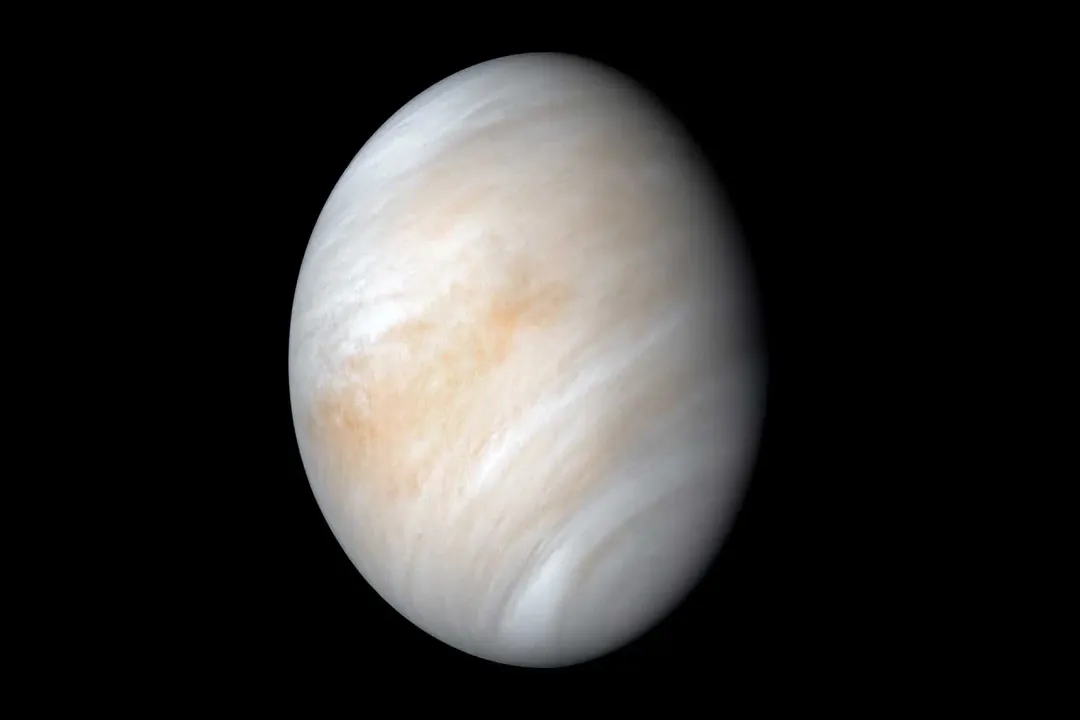
The question of why Venus, Earth’s twin in size, lacks the protective global magnetic field that our planet boasts is one of the great enduring mysteries of planetary science. While we observe a thick, oppressive atmosphere clinging to Venus, one might naturally expect such a massive atmosphere to have been stripped away over billions of years by the relentless solar wind in the absence of an intrinsic magnetic shield. Yet, Venus thrives beneath its blanket of clouds, possessing an atmosphere despite this deficit. To understand this situation, we must first look at what protection Venus does have and then examine the requirements for the magnetic field it should have generated.
# Induced Shield
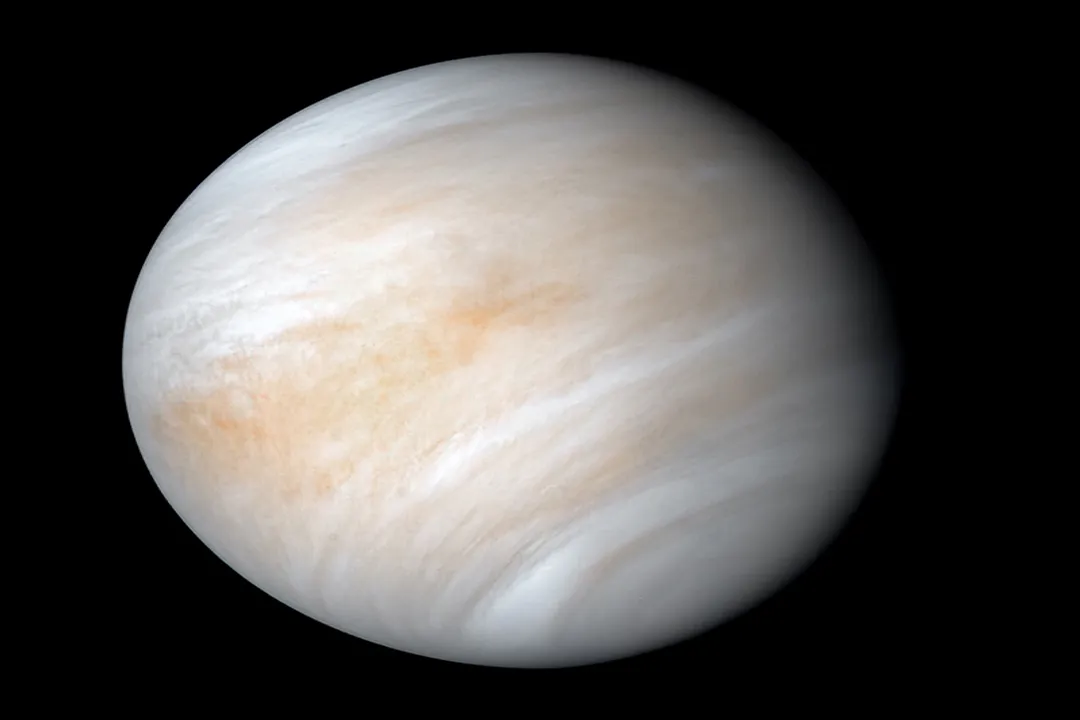
Venus does not possess a planetary magnetic field generated by an internal dynamo, like Earth's. Instead, it has what scientists call an induced magnetosphere. This structure is fundamentally different. An intrinsic field originates deep within the planet, radiating outward from the core. The induced field is created externally when the stream of charged particles flowing from the Sun—the solar wind—collides with the planet's upper atmosphere and ionosphere.
This collision effectively compresses the plasma surrounding Venus, creating a magnetic barrier. Observations from missions like Venus Express helped characterize this unique magnetic environment, showing how the solar wind bows around the planet due to the pressure it exerts on the atmosphere's conductive layers. The Solar Orbiter mission has continued to unveil new details about the structure of this magnetosphere. This external magnetic 'bubble' provides some deflection against the solar wind, which is vital for preventing the total erosion of the atmosphere.
However, an induced field provides less comprehensive protection than a globally generated one. While it manages to push the bulk of the solar wind away, the interaction is more direct and violent on the atmospheric boundary compared to Earth's well-defended magnetic shell. This interaction allows for continuous, albeit slow, atmospheric stripping via a process known as sputtering, where solar wind particles knock atmospheric ions free. The fact that the atmosphere remains so thick suggests that the rate of material loss must be very slow or that the planet's internal outgassing (perhaps from volcanism) keeps pace with the loss.
# Dynamo Needs
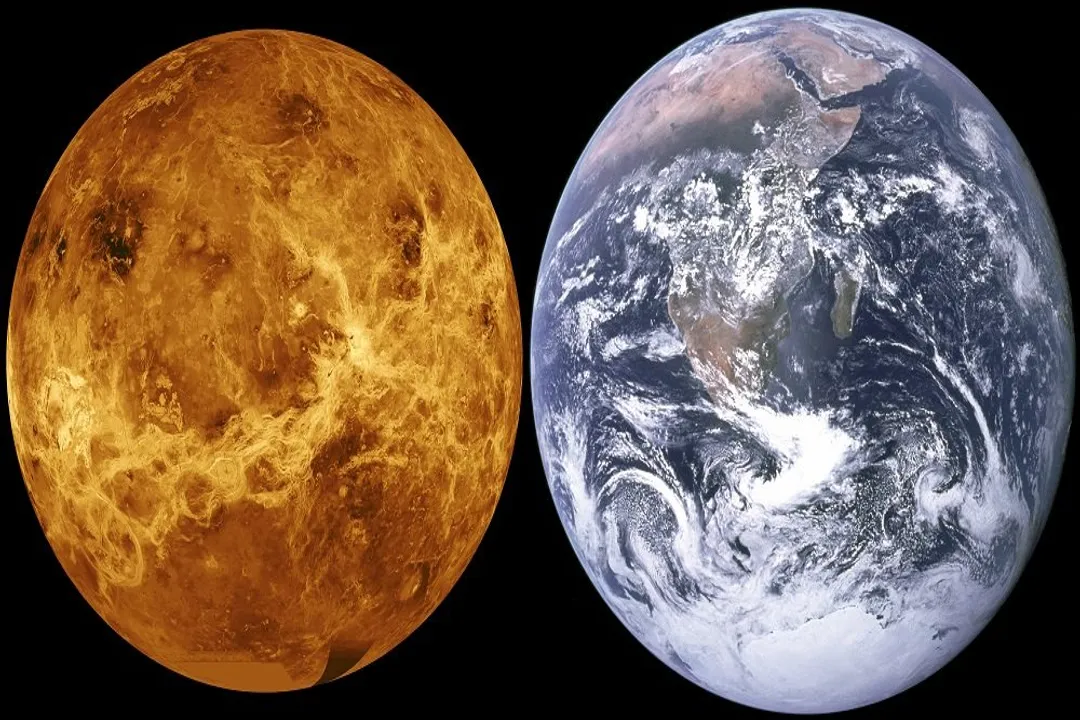
For a planet to generate a strong, internal magnetic field—a dynamo—astrophysicists generally agree that three main conditions must be met simultaneously.
- A Conductive Fluid: There must be a large volume of electrically conducting material, typically a molten, metallic outer core, like the iron-rich core of Earth.
- Convection: This fluid must be moving vigorously, driven by heat loss from the core into the mantle, creating circulation currents.
- Sufficient Rotation: The planet must spin fast enough to impose a Coriolis force on the moving fluid, organizing the chaotic convective motion into helical, stable magnetic field lines.
Venus appears to fail spectacularly on at least one of these points, which explains the lack of its own field. The contrast with Mercury is particularly telling. Mercury is much smaller than Venus, yet it maintains a weak intrinsic magnetic field, suggesting its core is still at least partially molten and convecting. Venus, being larger, would be expected to retain internal heat longer than Mercury, suggesting its core should still be liquid, posing a significant paradox.
# Rotation Rate
The most frequently cited culprit in the absence of a Venusian dynamo is its incredibly slow rotation. Venus spins once on its axis approximately every 243 Earth days. Furthermore, it rotates retrograde, meaning it spins in the opposite direction to most other planets. This rotation rate is so sluggish that the Coriolis forces generated are likely far too weak to organize the movement of its core material into the organized flow required to sustain a dynamo.
Consider the required energy scale. Earth rotates in 24 hours, providing immense rotational energy to shape its core convection. Venus takes over 400 times longer to complete one turn. If we were to look at Earth’s core dynamics, the lack of a magnetic field on Venus strongly implies that even if the core is hot and liquid, the rotation is the limiting factor, effectively imposing a speed limit on the planetary engine that prevents magnetic field generation. This provides a stark illustration of how rotation, often overlooked when discussing internal structure, is a necessary ingredient for magnetic self-sustainment.
# Core Status
While the slow rotation provides a very strong argument against the dynamo, the state of Venus’s core remains a key piece of the puzzle because a planet the size of Venus should, based on thermal models alone, still possess significant internal heat. The magnetic field is a direct indicator of the liquid, convecting outer core. Its absence implies one of two scenarios concerning the interior structure:
- The core has cooled significantly, leading to solidification of the metallic iron outer core, thus eliminating the conductive fluid necessary for the dynamo.
- The core is still liquid, but the lack of adequate convection—perhaps due to a lack of significant temperature contrast between the core and mantle, or the aforementioned slow rotation—prevents the dynamo from starting.
It is also worth noting the geological context. While Venus is known to be volcanically active—a process that requires significant internal heat—this activity does not necessarily translate to the specific type of vigorous, organized convection needed in the deep core to generate a magnetic field. The lack of plate tectonics, a process thought to help Earth cool its mantle and drive core convection, might also play a role in slowing down or stopping Venus's internal engine over geologic timescales.
# Atmosphere Puzzle
The retention of the thick atmosphere without a shield brings us back to the primary observation. The fact that Venus has any mechanism capable of repelling the solar wind, even an induced one, is crucial for its current state. If Venus had lost its field early in its history and possessed a thin atmosphere, that atmosphere would have been rapidly stripped away by the Sun's bombardment.
The thick atmosphere itself might be a consequence of the historical lack of a strong field, rather than an independent phenomenon. For instance, if Venus lost its water early on due to runaway greenhouse effects, the remaining dense atmosphere would create an incredibly high surface pressure and density. This density might then interact more effectively with the solar wind at the upper layers, immediately creating a strong induced magnetic boundary layer.
To place this in perspective, consider a hypothetical scenario where Earth's dynamo abruptly switched off today. While the initial effects would be noticeable via increased radiation flux at low altitudes, our atmosphere would not vanish overnight. However, over millions of years, the cumulative loss would be significant. Venus, having potentially existed in this 'dynamo-off' state for billions of years, has survived because its existing atmosphere is so massive that the solar wind interacts with the gas itself rather than just the planet's surface, creating a protective buffer of plasma. The planet is essentially protected by its own breath, albeit one that is slowly being eroded by solar action.
The entire scenario presents a fascinating divergence from Earth's evolutionary path. Earth maintained the conditions for a self-sustaining dynamo—liquid core, convection, and rapid spin—allowing our magnetic field to provide a consistent, long-term umbrella. Venus, perhaps due to an initial impact that slowed its spin dramatically, or perhaps due to some unknown difference in core composition or cooling rate, never established that umbrella, forcing it to rely on the temporary, externally generated protection of its massive atmosphere. The study of this missing field is therefore not just about magnetism; it is about understanding the core thermal and rotational history that dictated the fate of Venus's surface environment.
Related Questions
#Citations
How does Venus retain such a thick atmosphere despite having no ...
Why did Venus not lose its atmosphere without a magnetic field?
Venus: Facts - NASA Science
Why does Venus lack a magnetic field? - NASA ADS
Solar Mission Reveals New Details About Venus' Unusual Magnetic ...
Why doesn't Venus have a magnetosphere? - Phys.org
Why does Venus lack a magnetic field? | Geology - GeoScienceWorld
A magnetic surprise for Venus Express - ESA Science & Technology
Why does Venus have no magnetic field despite being volcanically ...