What evidence can you give that stars lose mass?
The fact that stars are not eternal, unchanging lighthouses but rather dynamic entities that shed significant portions of themselves over cosmic timescales is a cornerstone of modern astrophysics. While we often focus on the fiery birth of stars or their dramatic final explosions, the process of mass loss is a continuous, measurable reality woven into every stage of stellar evolution. Providing evidence for this loss requires looking at what stars are doing now, what they have left behind, and how they interact with their neighbors.
# Continuous Wind

The most fundamental evidence for stellar mass loss comes from our nearest star, the Sun. Our Sun, like all stars on the main sequence, is constantly ejecting material into space in the form of the solar wind, which is essentially plasma streaming away from the Sun’s superheated upper atmosphere, the corona. While this process seems minor on a human scale, it is precisely measurable. Astronomers estimate that the Sun currently loses mass at a rate of about solar masses per year. This constant stream carries not just hydrogen and helium, but also trace amounts of heavier elements fused in the Sun's core, offering a direct sample of its internal workings.
The critical insight here is that this process is not unique to our Sun; it is a characteristic of nearly every star, dictated by the physics of maintaining hydrostatic equilibrium against the outward pressure from fusion. For less massive stars, this steady loss is the primary mechanism for shedding mass throughout their active lives. If the Sun were to maintain this rate unchanged for its entire predicted lifespan, it would lose a small but non-negligible fraction of its total mass before it evolves into a red giant.
# Giant Expansion
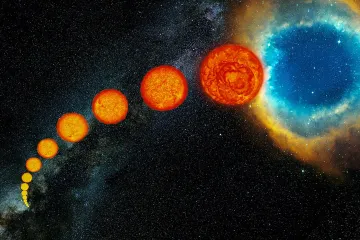
Mass loss intensifies dramatically when stars exhaust the hydrogen fuel in their cores and begin their post-main-sequence evolution. A star swells into a red giant, and later, if massive enough, an Asymptotic Giant Branch (AGB) star. During these phases, the star’s outer layers are held by a much weaker gravitational grip, and the stellar winds—the continuous outflow of material—become vastly stronger.
The AGB phase, in particular, is notorious for being the period where a single star, not destined to explode as a supernova, ejects the vast majority of its mass. The driving mechanism for this intense outflow is still actively investigated, but observational studies point toward stellar pulsations as a critical factor. Stars on the AGB pulsate in different modes, and observations suggest that as a star shifts into certain pulsation modes (corresponding to specific periods, such as a "60-day critical period" noted in some studies), the production of dust and the resulting mass-loss rate increase substantially. This dust, formed from the stellar material expanding outward, then helps to drag even more gas away from the star through radiation pressure.
To put this into perspective, we can compare the typical rates across a star's life. While the Sun's current loss rate is minuscule, an AGB star can lose mass at a rate one million times greater, potentially ejecting enough material to equal the Sun's entire initial mass over the course of this relatively brief evolutionary phase. This difference in scale provides compelling evidence that mass loss is not just present, but rate-dependent on the star's current state and age.
| Stellar Phase | Mass Loss Mechanism | Typical Rate (Relative) |
|---|---|---|
| Main Sequence (e.g., Sun) | Steady Solar Wind | Very Low (Baseline) |
| Red Giant Branch (RGB) | Stronger Stellar Winds | Elevated |
| Asymptotic Giant Branch (AGB) | Intense Pulsation-Driven Winds & Dust Drag | Highest for non-supernovae |
| Massive Stars (Wolf-Rayet) | Catastrophic Ejection/Strong Winds | Extreme |
# Observable Remnants
The material ejected during these late phases does not simply vanish; it forms vast, expanding shells of gas and dust easily observed by telescopes. These structures are the planetary nebulae (PNs), and they serve as direct, visual confirmation of mass loss.
The structure encoded within a PN provides a historical record. If a star shed its mass via a steady, symmetrical stellar wind, the resulting nebula appears as a relatively uniform spherical shell. However, observations frequently show complex, asymmetric structures, clumps, and bipolar shapes. These asymmetries are interpreted as evidence of episodic events—stronger flares, dust ejection events, or interactions with a companion star—that occurred during the star's final, unstable stages. The distribution of these clumps and the presence of specific elemental enrichment within the nebular gas—like carbon, nitrogen, and oxygen ejected from the star's interior layers—act as a tracer, confirming that the star’s outer layers have been blown away and dispersed into the interstellar medium.
# Binary System Interactions
A significant portion of observable stellar mass loss does not result in a pretty nebula but occurs through direct interaction within a system of two or more stars orbiting a common center of mass. When stars orbit closely, gravitational tides can distort the stellar shape, particularly near the system's center of gravity. If one star expands enough to "overflow" its Roche Lobe—the gravitational boundary governing its material—gas is pulled directly onto its companion.
Observational surveys have indicated that this mass exchange is incredibly common, with estimates suggesting that more than 70% of all massive stars participate in such binary interactions, often leading to a merger in about a third of cases. This dynamic transfer fundamentally alters the evolutionary path of both stars. For instance, if the accreting object is a white dwarf, the influx of new material can trigger a thermonuclear runaway, resulting in a Type Ia supernova. The fact that these binary outcomes—such as X-ray binaries or Type Ia events—are routinely observed is compelling evidence that mass is being stripped from one component star, even if it is immediately deposited onto another rather than being lost entirely to space.
# The Final Mass Budget
The ultimate validation of mass loss theory comes from analyzing the remnants left behind after the most violent stellar deaths: supernovae. A star that collapses following a supernova can become either a neutron star or a black hole. The determining factor between these two outcomes is the total mass that remains after the explosion and the preceding mass loss phases.
If a star has managed to retain too much of its initial mass throughout its life, the remnant core will exceed the maximum stable mass for a neutron star, forcing it to collapse further into a black hole. The existence of both neutron stars and stellar-mass black holes across the galaxy requires that stars have lost a massive, yet specific, amount of material before their core collapse phase. If stars did not lose mass efficiently, the resulting population of compact objects would be far more skewed toward neutron stars, or perhaps, all stars massive enough to explode would immediately form black holes, which is contrary to observation. The observed masses of these final objects, inferred through their gravitational influence on orbiting bodies or surrounding light, perfectly align with theoretical models that mandate substantial mass ejection throughout the star's evolution. We observe black holes, and their existence is contingent on the mass not being present, meaning it must have been ejected earlier.
When considering the formation of stellar black holes, one must acknowledge that the explosion itself (the supernova) is the event that reveals the remnant. The visible explosion results from infalling outer layers of the star bouncing off the newly formed, ultra-compact core (whether neutron star or the material just past the nascent event horizon). This rebound shockwave, which blasts material outward, confirms that a massive shell of matter was successfully expelled in a final, dynamic process, leaving behind the compact object whose mass is a function of the mass lost prior to that final moment.
The relationship between the mass lost and the resulting object is a subtle calculation that helps confirm the overall mass budget of stellar evolution. For instance, if a star begins at 25 solar masses, it might lose 10 or more solar masses through winds and ejections before the supernova, leaving a core that collapses to form a black hole. If it had only lost 5 solar masses, the remnant might have been stabilized as a neutron star instead. The census of observed black holes versus neutron stars directly constrains the effectiveness of these various mass-loss mechanisms across the stellar population. By charting the evolution pathways that lead to these endpoints, astronomers use the mass loss not as a footnote, but as a controlling variable in the stellar lifecycle equation. This allows for better modeling of the chemical enrichment of the universe, as the lost matter contains the heavier elements synthesized inside the star. The consistency between the predicted mass loss necessary to form observed stellar remnants and the direct observation of expanding shells of ejected material forms a powerful, multi-faceted body of evidence confirming that stars invariably lose mass.
Related Questions
#Citations
Stellar mass loss - Wikipedia
Mass Loss in Dying Stars - Astrobites
How does the mass inside a supernova manage to create a black ...