Are stars constantly losing mass?
Stars are indeed constantly losing mass throughout their existence, but the rate at which this happens changes drastically depending on the star's age and evolutionary phase. [1][2] It's not a steady, predictable drain like water from a leaky faucet; rather, it involves long periods of slow seepage followed by rapid, voluminous expulsions. [4] The loss occurs through two fundamentally different processes: the steady conversion of mass into energy via nuclear fusion, and the physical expulsion of stellar material through winds and atmospheric ejections. [3][5]
# Fusion's Subtle Toll
Every star, including our Sun, shines because it is performing the ultimate act of mass conversion: nuclear fusion. [3] In the core, lighter elements, primarily hydrogen, are fused into heavier elements like helium. According to Einstein’s famous equation, , a portion of the initial mass is converted directly into the radiant energy that makes the star luminous. [5] While this process sustains the star for billions of years, it is inherently a process of mass consumption and loss from the star's total inventory. [3]
For the Sun, this rate of loss due to energy generation is precise, if not immediately obvious in terms of observable physical shedding. The Sun transforms approximately 4 million metric tons of matter into energy every second. [5] Although this sounds like an enormous amount, when weighed against the Sun's total mass of about kilograms, it represents an incredibly small fraction of its overall bulk over its main-sequence lifetime. [2]
# Winds of Change
Beyond the energy conversion in the core, stars also shed their outer layers physically through stellar winds. [1] For a star like our Sun during its stable, hydrogen-burning phase (the main sequence), this mass loss is driven by the constant outflow of charged particles called the solar wind. [1][2]
This main-sequence mass loss is very modest. The Sun loses mass at a rate estimated to be around times its own mass per year, which translates to about $10^9$ kilograms every second. [1] Over the Sun's entire billion year main-sequence life, the total mass shed via this steady wind amounts to only about $0.01$ percent of its original mass, or roughly solar masses. [2] This is an astonishingly small proportion, meaning that for most of its active life, a star’s mass is effectively constant for practical astrophysical modeling. [2]
Consider the longevity involved: if a star like the Sun maintains this slow, constant bleed for ten billion years, the total mass lost is negligible compared to what happens later in its life. If we look at the Sun's total projected mass loss from both fusion and the solar wind over its entire history, the cumulative effect is still a tiny fraction of its starting mass—perhaps around $0.1$ solar masses total over 12 billion years. [5][2] This steady loss is a minor atmospheric leak when compared to the eventual structural collapse and ejection events that characterize stellar old age. [4]
# Giant Phase Ejection
The most dramatic phase of mass loss occurs when a star exhausts the hydrogen fuel in its core and begins to evolve into a giant star. [9] As the core contracts and heats up, the star's outer layers swell dramatically, becoming vastly larger and cooler—a red giant. [4] This expansion significantly alters the star's surface gravity and atmospheric structure, leading to much stronger stellar winds and episodic mass ejections. [1]
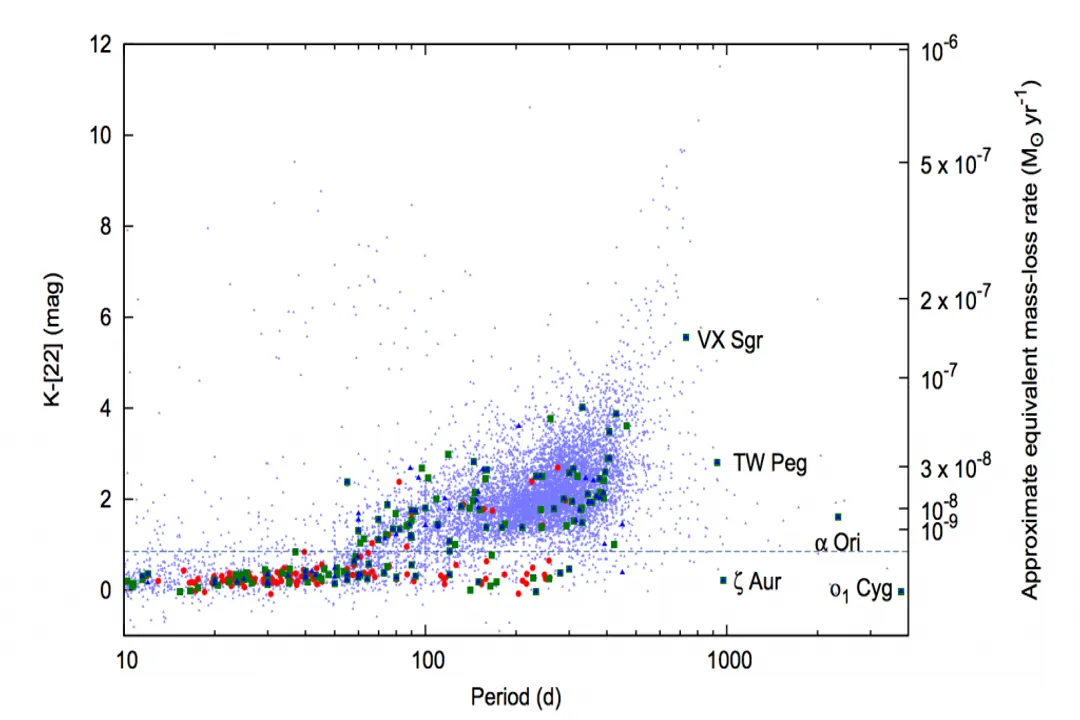
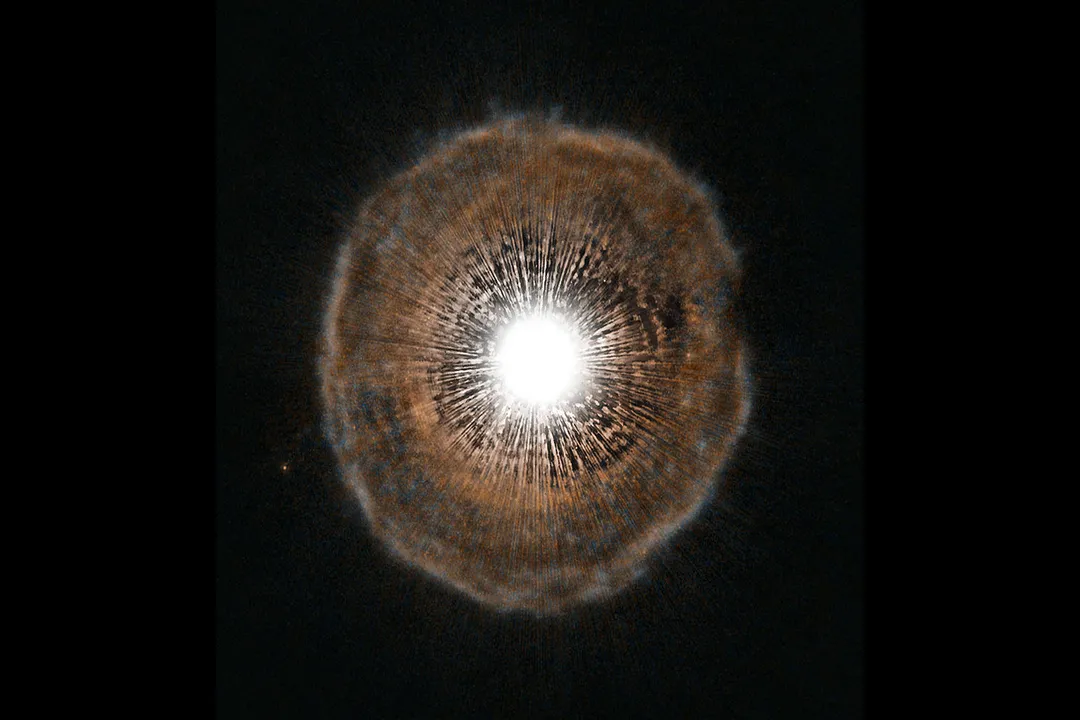
For a star similar to the Sun, the mass loss rate skyrockets during the red giant and subsequent Asymptotic Giant Branch (AGB) phases. [4][9] The mass-loss rate during these episodes can reach up to solar masses per year. [1] This is thousands of times faster than the solar wind loss seen during the main sequence. It is during this late, unstable period that the majority of the star's remaining mass is expelled into space. [4] Estimates suggest that a star like the Sun will shed between $20%$ and $30%$ of its total mass during this late-stage expansion before it settles down as a white dwarf. [7][8] This vast envelope of gas and dust ejected by the dying star eventually forms the beautiful structure we observe as a planetary nebula. [9]
This transition illustrates that mass loss is not a constant property, but rather a phase-dependent phenomenon. A star spends the vast majority of its life (the main sequence) losing mass slowly, and then sheds the bulk of its outer material over a relatively short period (millions of years) as a giant. [1]
# The Cosmic Recycling Connection
The physical mechanisms dictate when and how much mass is lost, connecting the life cycle of a star directly to the composition of the surrounding galaxy. [9] Massive stars lose mass through powerful winds throughout their lives, but their end is often catastrophic, involving supernova explosions that blow off remaining outer layers and eject newly synthesized elements. [1] Lower-mass stars, like our Sun, achieve mass removal more gently through the AGB phase, but the result is similar: enriched material is returned to the interstellar medium. [4][9]
We can observe the tangible outcome of this mass loss in the composition of new stellar generations. The material that forms a new star, like our Sun did $4.6$ billion years ago, is already "contaminated" by the products of previous stars that lived and died. [9] The abundance of heavy elements (anything heavier than hydrogen and helium) observed in modern stars and planets is a direct consequence of this continuous, albeit episodic, mass loss process across cosmic history. If stars were perfectly closed systems, the universe would look vastly different today, composed overwhelmingly of only the primordial hydrogen and helium from the Big Bang. The fact that we, and the Earth, are made of carbon, oxygen, and iron is a testament to the mass loss events of ancient, massive stars. [1]
To put the stages in perspective, here is a simplified comparison of mass loss for a solar-mass star:
| Evolutionary Stage | Primary Mechanism | Approximate Mass Loss Rate () | Total Mass Lost (Estimate) |
|---|---|---|---|
| Main Sequence (Sun-like) | Solar Wind | Very small ($<1%$ of total) | |
| Red Giant/AGB | Strong Stellar Wind/Ejection | to | Significant ($20%$ to $30%$ of initial mass) |
| White Dwarf Cooling | Negligible | Near zero | Minimal |
| [1][4][8] |
When astronomers model stellar evolution, they must account for these changing rates; ignoring the mass loss during the giant phases leads to inaccurate predictions of the star's final state, specifically the mass of the remnant white dwarf. [1] For instance, if a star is initially $1.5$ times the mass of the Sun, its final white dwarf remnant might only be $0.6$ solar masses because the other $0.9$ solar masses were blown away during its later years. [8] This ejected mass forms a shell around the remnant, which expands and cools, becoming the visible nebula.
Ultimately, while the energy production in the core guarantees that some mass is always being converted, the dramatic and observable mass loss that shapes stellar endpoints and enriches the cosmos occurs overwhelmingly when the star begins its final transition out of the main sequence. [3][4]
Related Questions
#Citations
Stellar mass loss - Wikipedia
Is the mass of an individual star almost constant throughout its life?
Since stars are fueled by nuclear fusion, do they constantly lose mass?
Mass Loss in Dying Stars - AAS Nova
Why do stars increase in energy output and decrease in mass over ...
The evolution of massive stars with mass loss. - NASA ADS
The Life Cycles of Stars - Imagine the Universe! - NASA
How much mass is lost in the red giant phase of a star?
12.1: The Death of Low-Mass Stars - Physics LibreTexts