What does the value of the Hubble constant help us to calculate?

The value of the Hubble constant, often denoted as , is far more than just an abstract number derived from distant observations; it serves as the fundamental yardstick against which we measure the scale, age, and expansion history of the entire cosmos. [1][5] When astronomers first observed that galaxies are moving away from us—a phenomenon known as cosmic recession—the relationship they established became the cornerstone of modern cosmology. This relationship, known as Hubble's Law, directly links a galaxy’s speed to its distance. [3]
# Expansion Rate
Hubble's Law is expressed simply as , where is the recession velocity of a galaxy, and is its distance from us. [3][10] The Hubble constant, , is the proportionality constant in this equation. [3] Physically, it tells us how much faster a galaxy moves away for every additional unit of distance separating us. If we use common astronomical units, is typically expressed in kilometers per second per megaparsec (). [5] A megaparsec is a massive distance, equal to about 3.26 million light-years. Therefore, a value of means that for every 3.26 million light-years a galaxy is away from us, it appears to be moving away an additional 70 kilometers per second faster due to the expansion of space itself. [5]
This rate is not uniform across time; it changes as the density of matter and energy in the universe evolves. However, represents the expansion rate now, in our current cosmic epoch. [2] If were much larger, the universe would be expanding much faster today, implying a significantly shorter history. [1]
# Cosmic Distance
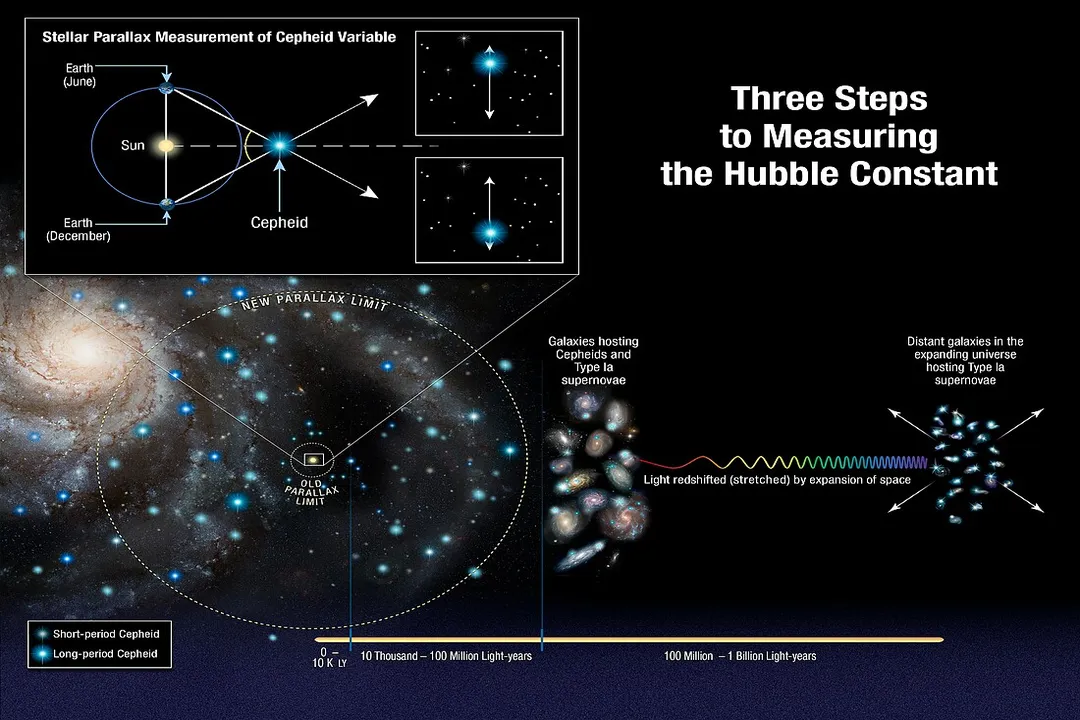
One of the most immediate and practical applications of knowing is calculating the distance to extremely remote objects. [10] For nearby galaxies, distance can sometimes be measured through geometric methods or standard candles whose intrinsic brightness is well-known. However, for objects so far away that their light has been traveling for billions of years, redshift is the primary indicator of speed. [10]
If an astronomer measures the redshift of a distant galaxy, they determine its recessional velocity (). Once is known, rearranging Hubble’s Law provides the distance (): . [10] This calculation allows cosmologists to map the three-dimensional structure of the local universe with accuracy. [1] Without a precise , these distance measurements would contain large, systemic errors, making any resulting cosmic map fundamentally unreliable.
Imagine a scenario: two independent research teams measure the redshift of a newly discovered quasar and agree on a velocity of . Team A uses an older, lower value for (say, ), while Team B uses a newer, higher value (say, ).
| Team | Hubble Constant () | Velocity () | Calculated Distance () |
|---|---|---|---|
| A | Megaparsecs | ||
| B | Megaparsecs |
This difference of over 35 megaparsecs is significant, illustrating that the accuracy of the Hubble constant directly dictates the accuracy of our cosmic address book. [1]

# Universe Age
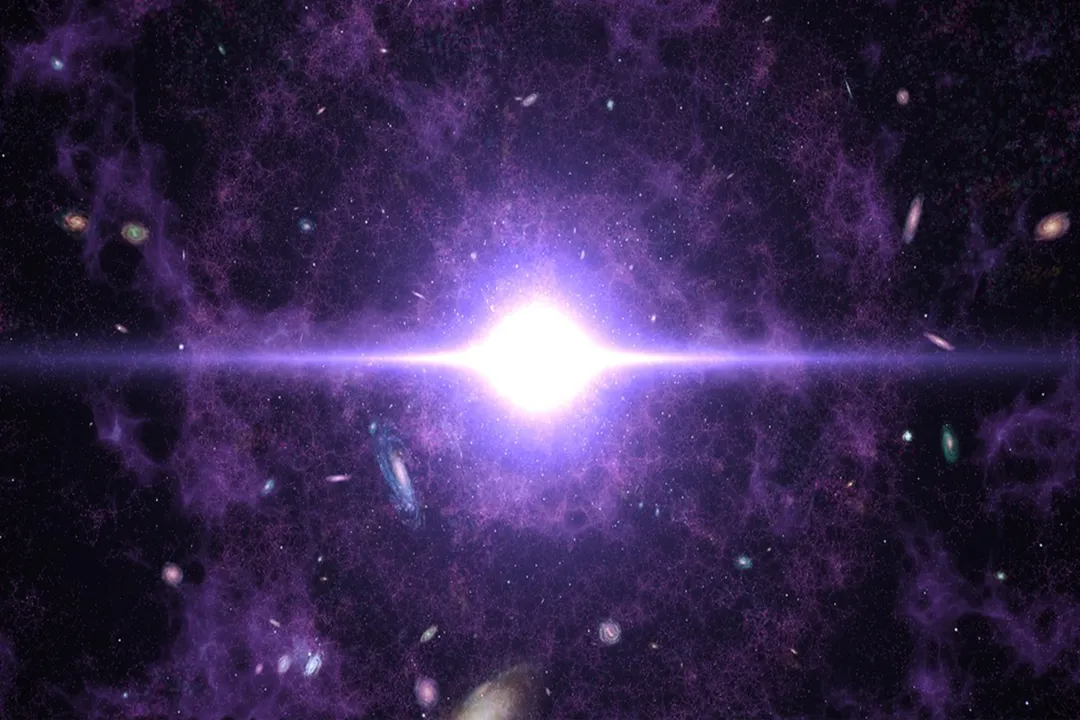
Perhaps the most profound calculation enabled by is an estimation of the age of the universe. [1][9] If the universe had been expanding at a constant rate throughout its entire history—a simplistic but useful starting point—the age would simply be the inverse of the Hubble constant, often called the Hubble Time (). [9]
For instance, if we use a value of , the Hubble Time is approximately $14$ billion years. [1] This inverse relationship makes intuitive sense: a faster expansion rate ( is larger) implies less time has elapsed since the Big Bang, resulting in a younger universe estimate. [9] If were twice as large, the estimated age would be halved.
It is important to recognize that cosmologists do not take as the final answer for the age of the universe. The actual age must account for the changing nature of the expansion, which has been influenced by gravity slowing it down early on, and by dark energy accelerating it more recently. [9] However, because sets the scale for the current expansion rate, it remains the dominant factor in these refined age calculations based on the standard CDM model. [2] The precision of thus translates directly into the precision of the universe’s birthday.
# Observable Scale
By combining the calculated age of the universe with the rate of expansion dictated by , we can estimate the size of the observable universe—the sphere of space from which light has had time to reach us since the Big Bang. [1] This calculation involves sophisticated integrals that account for general relativity and the universe's changing geometry over time, but the value of is a necessary input parameter. [5] A different value means the universe reached a different size in the same amount of time, affecting how far back in time we can see and the overall cosmic horizon. [1]
# Determining the Constant
The value of is determined by two fundamentally different measurement approaches, which unfortunately currently disagree, creating one of the most significant puzzles in contemporary astrophysics—the Hubble Tension. [2]
# Early Universe Inference
One method involves looking back to the universe’s infancy, specifically to the Cosmic Microwave Background (CMB) radiation, the leftover heat from the Big Bang. [2] Instruments like the European Space Agency’s Planck satellite measure minute temperature fluctuations in the CMB. [2] By inputting these precise measurements into the standard model of cosmology (CDM), scientists can predict what the expansion rate () should be today. [2] This method infers the current expansion rate from physics occurring about 380,000 years after the Big Bang. [2]
# Local Universe Measurement
The second method relies on measuring the distances and velocities of relatively local objects—those within about a billion light-years—using what are called "standard candles". [2] These are objects that have a known intrinsic brightness, allowing astronomers to calculate their distance based on how faint they appear to us. [6] The most common standards include Cepheid variable stars and Type Ia supernovae. [2][7] By measuring the redshift (velocity) and the distance for many such objects, astronomers calculate the Hubble constant directly from current observational data. [2][7]
# Tension Puzzles
The conflict arises because these two methods yield statistically different results. [2][6] Measurements based on the early universe (CMB) consistently yield a slower expansion rate, suggesting an older universe. [6] In contrast, measurements based on local standard candles yield a faster current expansion rate. [2] For example, some measurements point to around , while others using local techniques suggest values closer to . [2]
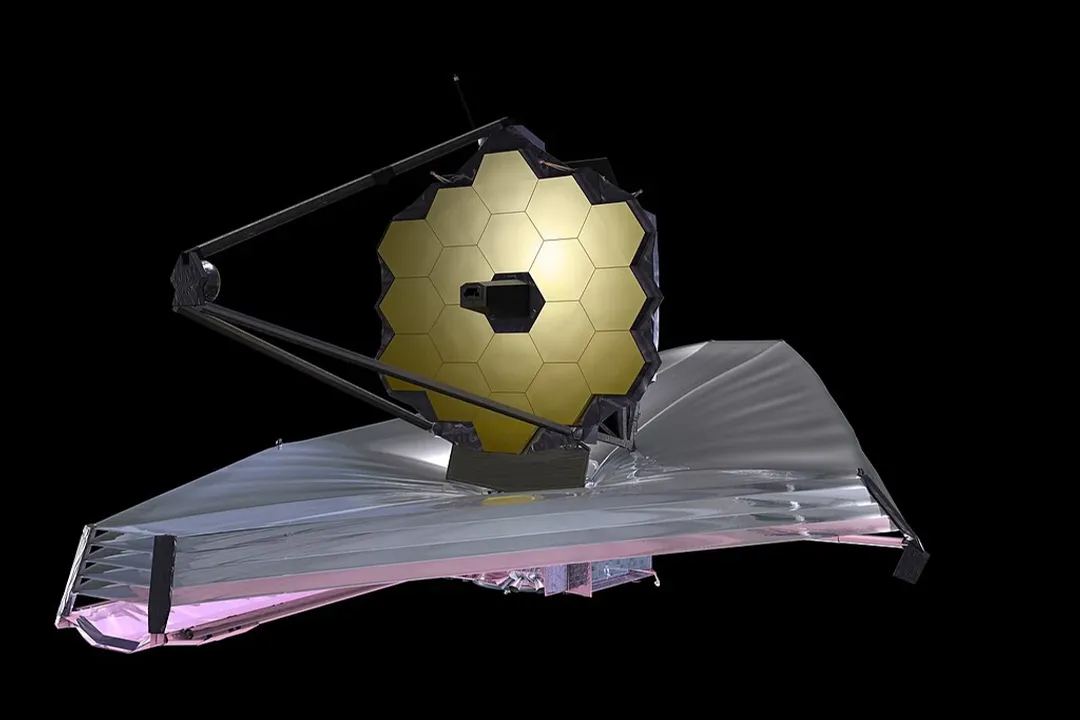
This tension is highly significant. If both sets of measurements are flawless, it implies that the standard cosmological model (CDM) is incomplete. It suggests that some unknown physics—perhaps related to dark energy, dark matter, or new particles—must have influenced the expansion rate between the time of the CMB and today, causing the expansion to speed up or slow down differently than our current equations predict. [2] The fact that newer instruments, like the James Webb Space Telescope, are beginning to confirm the higher local measurements reinforces the reality of this discrepancy. [7]
The constant itself, therefore, helps us not only calculate the dimensions of the universe we see but also diagnose potential flaws in our fundamental understanding of what the universe is made of and how it operates. [2] If the tension persists, the value of will be the critical piece of evidence guiding physicists toward new theories of gravity or cosmic constituents. [6]
#Videos
What is the Hubble Constant? Daniel Holz measures the ... - YouTube
Related Questions
#Citations
The Hubble constant, explained - UChicago News
Hubble Constant and Tension - NASA Science
Hubble's law - Wikipedia
Chandra Independently Determines Hubble Constant
[PDF] Hubble's Constant - UCSB Experimental Cosmology Group
Reconciling Two Different Calculations of the Hubble Constant
James Webb Confirms Hubble's Calculation of Hubble's Constant
Hubble's Law: determining the expansion rate of the Universe
The Age of the Universe | ASTRO 801
What is the Hubble Constant? Daniel Holz measures the ... - YouTube