What are the parts of a comet?
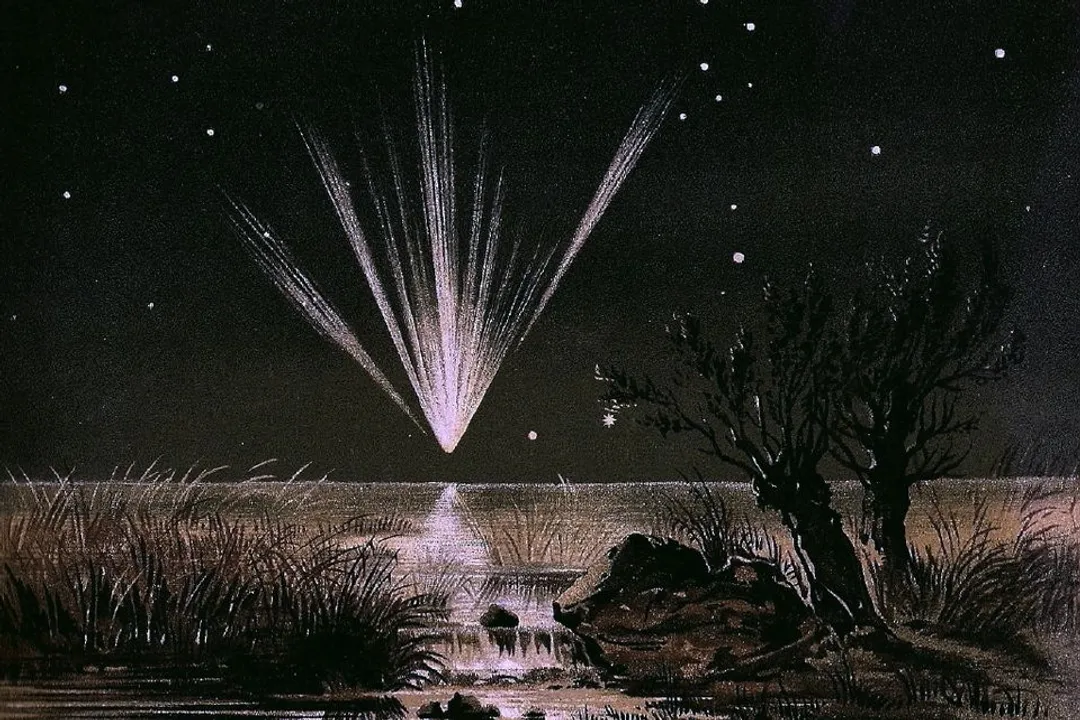
When we look up at the night sky and spot one of those celestial visitors streaking across the darkness, we are seeing an object that is fundamentally different from a planet or a typical asteroid. Comets are often described as cosmic snowballs or "dirty snowballs" because they are mixtures of dust, rocky material, and frozen gases like water ice, carbon dioxide, ammonia, and methane. [1][4][7][8] The true anatomy of a comet becomes apparent only when it nears the Sun, transforming from a relatively inert, dark object into a spectacular display of light and flowing material. [6] This transformation reveals several distinct, dynamic parts: the solid heart, the gaseous cloud, and the magnificent tails. [9]
# Nucleus Size
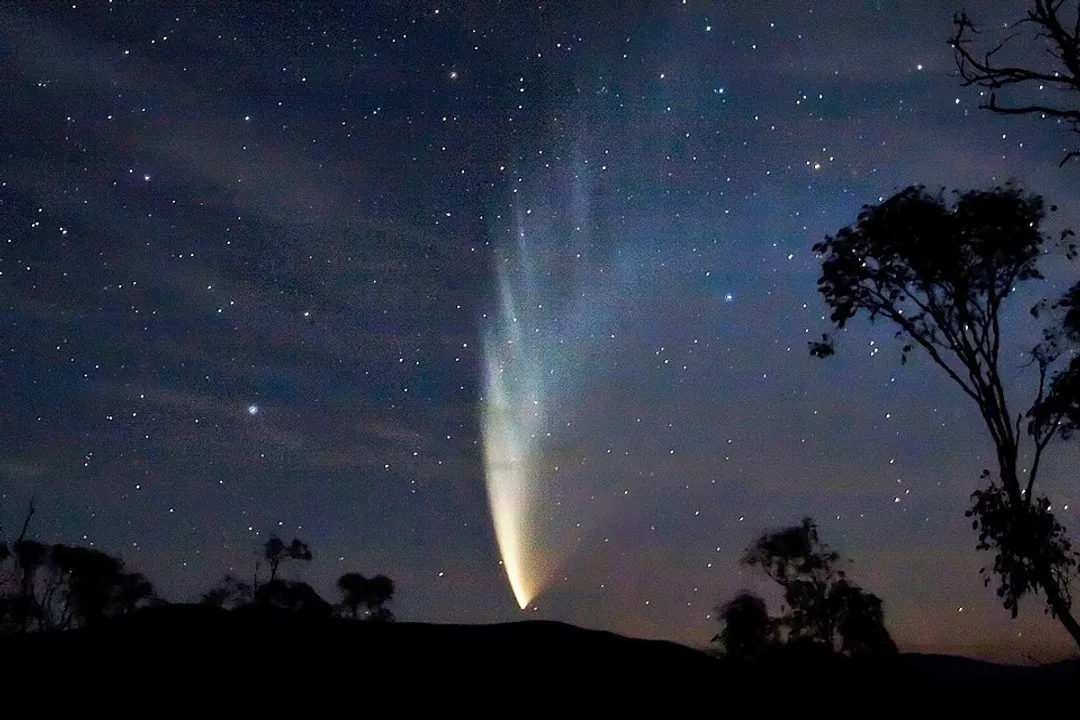
The engine room of any comet is its solid core, known as the nucleus. [8] This is the only part of the comet that exists whether it is near or far from the Sun. [4] Astronomers estimate that most comet nuclei are relatively small, often only a few kilometers across, perhaps ranging from a few hundred meters up to perhaps 30 or 40 kilometers in diameter. [1][6] Considering that the coma and tails can stretch for millions of kilometers, the nucleus itself is an incredibly compact piece of solar system debris, sometimes likened to a miniature mountain or a small asteroid made of ice. [4][7] Its surface is generally very dark, absorbing most of the sunlight that strikes it, making the nucleus itself difficult to observe directly. [1]
# Coma Formation
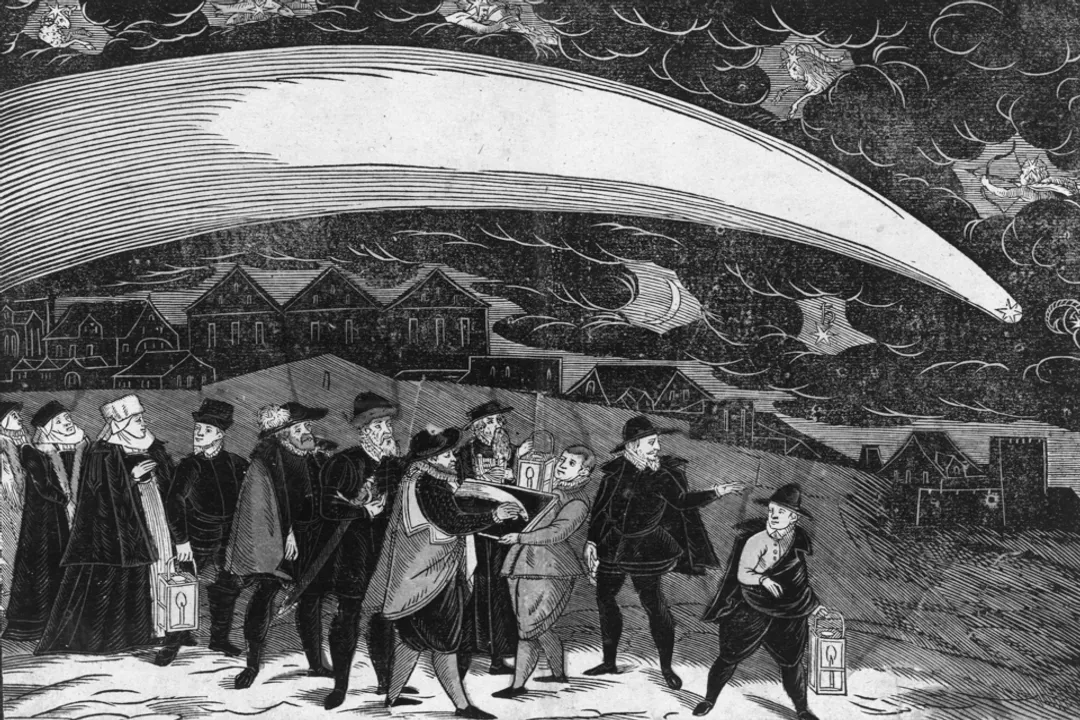
As a comet follows its highly elliptical orbit inward toward the Sun, the solar radiation begins to heat its surface. [4] When the temperature rises sufficiently—even when the comet is still far beyond the orbit of Jupiter—the frozen materials begin to sublimate. [1][6] Sublimation is the process where a solid turns directly into a gas, bypassing the liquid stage entirely. [6] This ejected gas, along with dust particles scraped off the surface, forms a huge, hazy envelope around the nucleus called the coma. [1][4][8]
The coma is essentially a temporary atmosphere created by this outgassing activity. [6] It is the coma, not the nucleus, that we generally see when observing a comet through a telescope. [4] These fuzzy shells can grow to be enormous, sometimes expanding to be larger than the planet Jupiter. [1] The intensity of the coma and its size are directly related to how close the comet is to the Sun and how much volatile material remains locked within the nucleus. [1][4]
# Tail Appearance
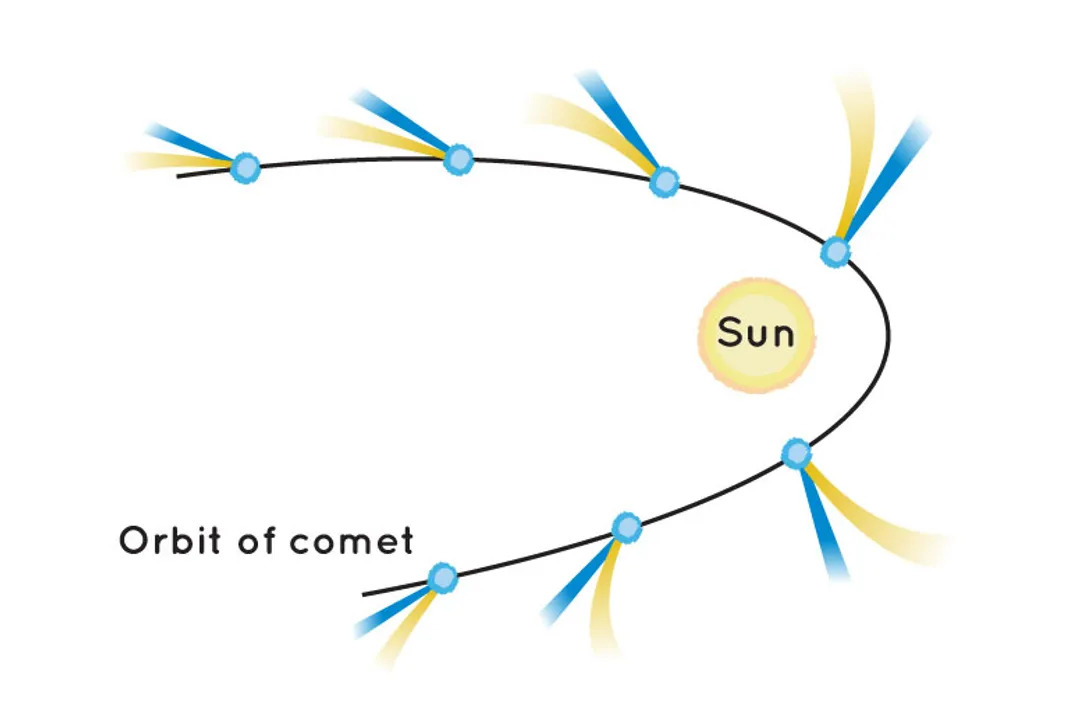
The most recognizable feature of an active comet is its tail, or more accurately, its tails. [8] The intense solar wind and the pressure exerted by sunlight act upon the gas and dust in the coma, pushing this material away from the Sun to form streamers trailing behind the comet. [1][4] It is a common misconception that the tails trail the comet like smoke from a chimney; instead, they always point away from the Sun, regardless of the comet's direction of motion along its orbit. [1][4]
If you manage to observe a bright comet, you will usually notice two distinct tails spreading out, each composed of different materials and behaving differently under the influence of solar forces. [8] Understanding the physics behind these two separate structures offers a wonderful way to grasp the environment of the inner solar system.
# Dust Streamer
One of the visible features is the dust tail. [8] This tail consists of microscopic solid particles that have been vaporized or scraped off the nucleus. [6] Sunlight, which acts as radiation pressure, is the primary force pushing these dust grains away from the Sun. [1][4] Because these particles are relatively heavy compared to individual gas molecules, they are pushed away more slowly than the gas stream, and the pressure is not perfectly aligned with the solar wind direction. [4]
This results in the dust tail appearing broad, yellowish-white, and noticeably curved. [1][4][8] The curvature occurs because the dust particles, having some orbital momentum, lag behind the comet's nucleus in its orbital path, creating an arc rather than a perfectly straight line pointing directly away from the Sun. [4] Viewing a comet with a pronounced dust tail is like watching a slow-motion spray of glittering grains following the main body. [6]
# Ion Streamer
The second tail, often appearing straighter and slightly blueish in color, is the ion tail or gas tail. [4][8] This feature is composed of gases that have been energized or ionized by solar ultraviolet radiation. [6] These charged particles are then swept away forcefully by the continuous flow of charged particles streaming from the Sun, known as the solar wind. [1][4][8]
Since the solar wind moves at high velocity, the ion tail is generally thinner, narrower, and points almost directly away from the Sun. [4][8] If the comet is moving very fast toward or away from the Sun, the ion tail can appear nearly straight, tracing the Sun-comet line in space. [4] Its blue tint comes from the emission spectrum of ionized carbon monoxide molecules, , which radiate strongly in the blue-violet region when energized. [7]
| Feature | Primary Composition | Driving Force | Appearance |
|---|---|---|---|
| Nucleus | Ice, Dust, Rock | N/A (Solid Core) | Small, dark, inert |
| Dust Tail | Larger dust particles | Solar Radiation Pressure | Broad, curved, yellowish-white |
| Ion Tail | Ionized gases (, etc.) | Solar Wind | Narrow, straight, blue |
| [1][4][8] |
# Observing the Structure
For those interested in amateur astronomy, observing the difference between these two tails can be a rewarding exercise. When a comet is moving rapidly, particularly near its closest approach to the Sun (perihelion), the forces separating the two tails are most evident. [4] A key characteristic to note is that even though the dust tail curves, the ion tail remains very straight, as the solar wind is a highly directional force. [4] If you track a comet over several nights as it moves through a star field, you might notice the entire structure—nucleus, coma, and tails—swinging around the Sun like the hand of a clock whose center is the Sun itself. [1] This apparent motion is a direct result of the tails being constantly redirected by the solar environment, offering a real-time visualization of solar activity affecting objects millions of miles away.
# Origin and Lifecycle
The materials that make up a comet’s structure—the ice, dust, and rock—are remnants from the formation of the solar system, meaning they have remained largely unchanged for billions of years. [4][7] Most long-period comets are thought to originate in the distant, spherical Oort Cloud, a vast reservoir far beyond Pluto. [7] Short-period comets, on the other hand, usually hail from the flatter Kuiper Belt, located beyond Neptune’s orbit. [7]
As a comet repeatedly passes the Sun, it loses significant amounts of its volatile material through sublimation. [1] The ice turns to gas, which escapes, carrying dust with it into the coma and tails. [6] Over many orbits, a comet will eventually exhaust its readily available volatile ices. When this happens, the comet may cease to form a bright coma and tails, effectively becoming inert, resembling a dark, irregularly shaped asteroid. [1] This process leads to the lifecycle of a comet: from a pristine icy body in the outer reaches to a dramatically active spectacle, and finally to a dormant rocky remnant wandering the inner solar system. [4] The sheer volume of matter ejected during a single perihelion passage is astounding; while the nucleus may only be a few kilometers wide, the total mass lost can still represent a significant fraction of its original volume. [6] This persistent mass loss is why comets are transient features, unlike planets or asteroids, which maintain a stable form.
# Minor Features
While the nucleus, coma, and two main tails are the primary components, astronomers sometimes observe other temporary features on active comets. [4] One is the antitail, which is not a true tail. [8] Sometimes, due to the specific geometry of our viewing angle relative to the Sun and the comet’s orbital plane, we can see dust particles that are actually being pushed toward the Sun but appear to point back along the orbital path. [4] This feature is only visible when the comet is near the point in its orbit where Earth is looking almost directly along the orbital plane toward the Sun. [4] Furthermore, as the comet approaches perihelion, jets of gas and dust can erupt violently from localized spots on the nucleus surface, creating temporary, fan-like structures before they are swept into the main coma structure. [3] Observing these jets requires high-resolution imaging, often provided by space-based telescopes, as they reveal the patchy nature of the nucleus's icy composition. [3]
Related Questions
#Citations
What Is a Comet? | NASA Space Place – NASA Science for Kids
Parts of a Comet - How Comets Work - Science | HowStuffWorks
ESA - Structure of a comet - European Space Agency
Comet | Definition, Composition, & Facts | Britannica
Anatomy of A Comet | National Air and Space Museum
[PDF] The Anatomy of a Comet
Comet - Wikipedia
Parts of a Comet: Name, Composition, & Labelled Diagram
Comet Anatomy | Research Starters - EBSCO