Is there any solid land on the Sun?
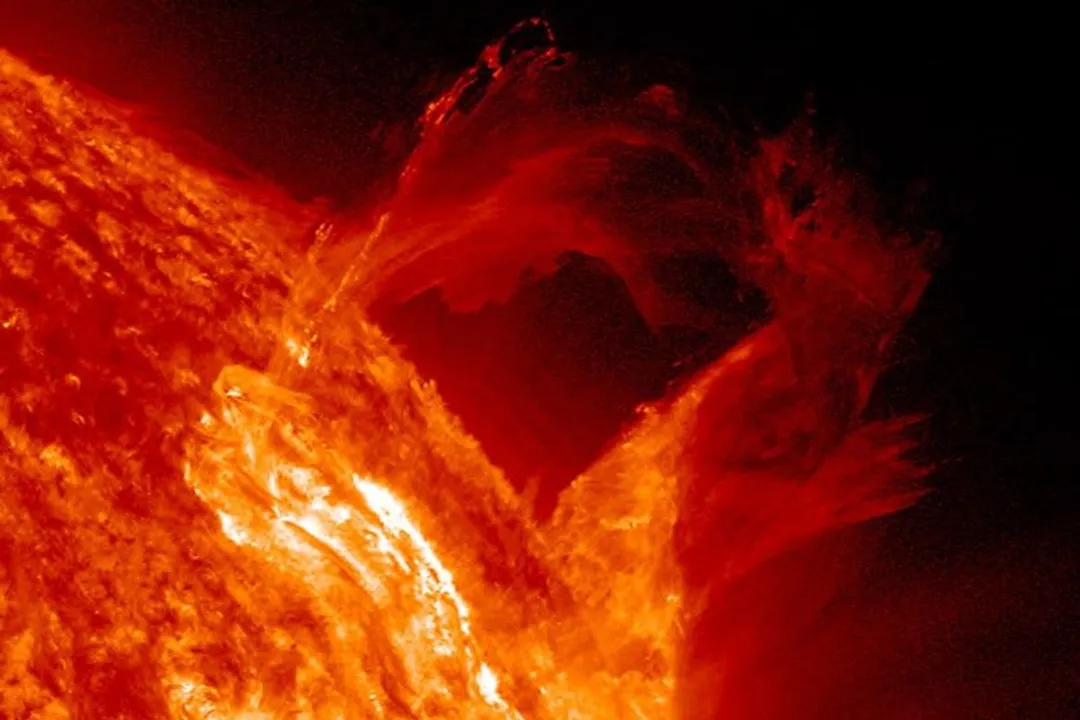
The star at the heart of our solar system might look, through our protective atmosphere, like a perfectly smooth, glowing ball—a cosmic marble or an incandescent boulder—but the reality is far different: there is no solid land, no rocky crust, and certainly no terrain to set foot upon anywhere on the Sun. [1][3] To seek solid ground on the Sun is to look for a condition that is fundamentally impossible given the star's composition and staggering heat. The Sun is not made of rock, metal, or liquid in the way we understand those states on Earth; rather, it is a colossal sphere composed almost entirely of plasma, which is essentially superheated, electrically charged gas. [1][4]
# Stellar Heat
The primary reason for the absence of solids is the intense thermal environment. The Sun is a massive fusion reactor, and its core temperatures reach an astonishing $27$ million degrees Fahrenheit ($15$ million degrees Celsius). [4] These temperatures are far beyond the melting or boiling points of any known substance. [1] Even the relatively "cool" outer layer that we observe, the photosphere, maintains a surface temperature around (). [4] At these temperatures, materials that form Earth’s mountains and bedrock—like silicates or iron—would instantly vaporize. [1] The condition for a solid, which requires atoms to lock into a stable, fixed crystalline structure, is completely shattered by this intense kinetic energy. [3] Any material that might theoretically form at lower temperatures would be stripped of its electrons, becoming part of the surrounding plasma. [3]
# The Visible Skin
If there is no land, what is the visible boundary we see when we look at the Sun (with proper protection, of course)? Scientists refer to this visible edge as the photosphere. [4] The name literally means "light sphere," which is appropriate because this layer is where the vast majority of the Sun's visible light escapes into space. [4]
The photosphere is not a sharp, defined surface like the shore of an ocean. Instead, it is a layer where the plasma density drops to a point that allows photons—the particles of light—to travel a significant average distance (a few hundred kilometers) before scattering again. [3] This scattering effect gives the Sun its apparent boundary, similar to how we see the "fluffy surface" of a cloud even though we know the cloud is composed of individual water molecules. [1]
This visible "surface" is exceptionally thin compared to the Sun's overall bulk. While the Sun’s diameter is about $865,000$ miles, [4] the photosphere itself is only about $250$ miles thick, [4] or a few hundred kilometers. [3] To put this thinness in perspective, if the Sun were scaled down to the size of a typical beach ball, the visible layer we call the surface would be thinner than the paint coating on that ball—an almost negligible fraction of the whole object. [4]
Above this light-emitting skin, the Sun continues outward with layers like the chromosphere and the expansive, tenuous corona, which can stretch for several million kilometers. [1] Ironically, the corona, the farthest out, is far hotter than the photosphere beneath it, reaching up to $3.5$ million ($2$ million ), a phenomenon that remains one of the star's great scientific mysteries. [4]
# The Falling Sensation
The fluid nature of the Sun raises interesting hypothetical questions about what would happen if one could survive the heat and step onto the photosphere. Since there is no solid foundation, any object not supported would simply begin to fall inward, accelerating due to the Sun’s immense gravity. [3] The gravitational acceleration at the visible surface is about $28$ times that on Earth. [5]
However, you would never hit a hard bottom. As you descend deeper, the plasma becomes exponentially more compressed and dense. [3] This density gradient means that eventually, you would reach a depth where the surrounding plasma has the exact same density as you do. At this specific point, the force of buoyancy would exactly counterbalance the downward pull of gravity, causing your fall to cease. [3] For an object with a density similar to water (about ), this equilibrium point is theorized to be roughly halfway through the Sun’s radius. [3] You wouldn't land; you would achieve a state of suspended animation, essentially floating within the superheated stellar material. [3] Further in, the material becomes denser than you are, and you would actually begin to float upward toward the equilibrium layer. [3]
This concept of gradual deceleration, where you are neither supported nor crushed into a solid mass, is a key distinction from falling into a planetary core, which might possess a defined, solid center. [3] Inside the Sun, the transition from a wispy, thin plasma near the photosphere to an extremely dense state near the core—where densities reach , [4] much denser than gold [4]—is continuous, not marked by a sudden change in phase to rock or liquid. [3]
# Probing the Atmosphere
While landing is off the table, scientists have successfully sent robotic explorers into the Sun’s outer envelope. In a historic achievement, NASA’s Parker Solar Probe flew through the Sun's upper atmosphere, the corona, sampling magnetic fields and particles directly. This milestone, achieved by passing through the solar wind, allowed scientists to sample the star’s material for the first time, offering critical data about the Sun’s influence on the solar system. The probe did not land; it traveled through the tenuous outermost layers where the plasma is less dense, allowing it to survive conditions that would instantly vaporize conventional spacecraft. This mission underscores that our interaction with the Sun is one of atmospheric traversal, not surface contact. [4]
The Sun, therefore, lacks any solid geography. It is a dynamic, fluid sphere of incandescent gas, defined by layers of continuously changing pressure and density, from the visible photosphere to the ultra-dense core powering its existence. [1][4]
#Videos
NASA's Parker Solar Probe Touches The Sun For The First Time
Related Questions
#Citations
Does the sun have a solid(like) surface? : r/askscience - Reddit
Our Sun: Facts - NASA Science
Is it possible to land on sun? - Physics Stack Exchange
Does the Sun have a surface? | High Altitude Observatory
NASA's Parker Solar Probe Touches The Sun For The First Time